
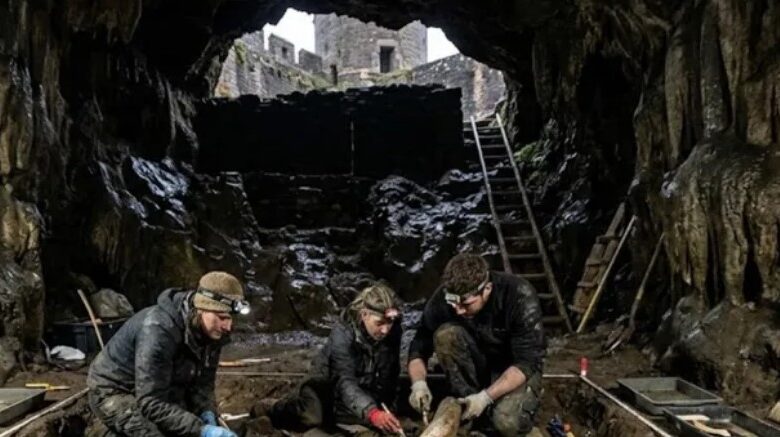

Archaeologists investigating ‘Wogan’s Cavern’ beneath Pembroke Castle in Wales say the site could become one of Britain’s most significant prehistoric discoveries.
Evidence of human and animal activities more than 1 lakh years old has been found in the cave hidden beneath this 11th century fort. Researchers have found stone tools there as well as bones of mammoth, woolly rhinoceros and hippopotamus.
These animals once roamed ancient Britain. Experts at the University of Aberdeen believe the cave may also contain traces of Neanderthals and early Homo sapiens, providing rare information about Britain’s ancient past. This cave is located just below Pembroke Castle, which is also the birthplace of King Henry VII.
The cave can be accessed through a winding staircase within the fort. It is approximately 23 meters long and 10 meters high. For many years archaeologists believed that the site had no scientific importance because everything would have been destroyed during excavations in the Victorian era.
But modern excavations have revealed that ancient remains are still preserved beneath the surface. The remains of hippopotamus found here are very important as they may be around 120,000 years old. The climate of Britain at that time was much warmer than today, allowing such large animals to live even in areas such as Wales.
Comments are closed.