
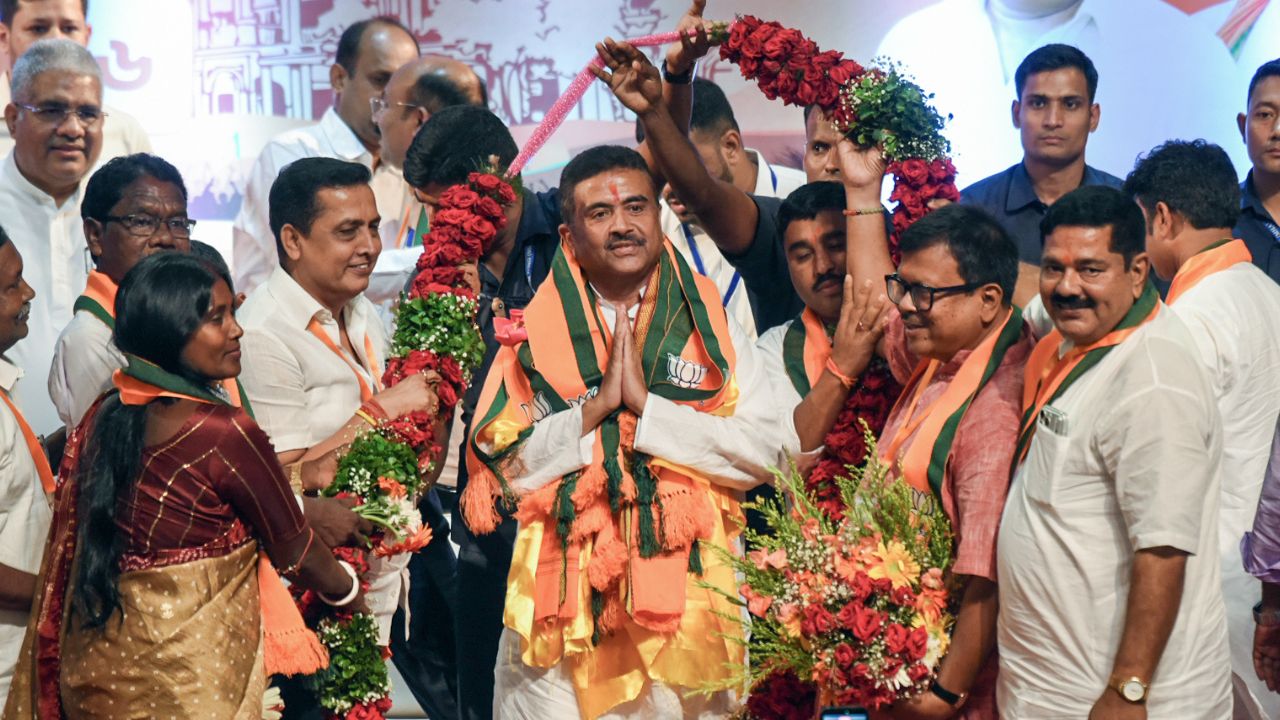

A big change has been seen in the politics of West Bengal. After the formation of BJP government for the first time in the state, 56-year-old Subhendu Adhikari has taken oath as the Chief Minister. But after assuming power, discussions regarding his personal life have also intensified. Especially one question that is being asked the most among the people is why Shubhendu Adhikari has not married till date?
Actually, Shubhendu Adhikari, who has been active in Bengal politics for a long time, has himself given the answer to this many years ago. He had told that during the days of student politics, he was inspired by some freedom fighters who had dedicated their entire lives to serving the country. The same inspiration forced him to take the decision to remain unmarried throughout his life.
Why did Shubhendu Adhikari decide not to marry?
Shubhendu Adhikari had told in one of his interviews that he entered student politics in the year 1987. During this time, his life was influenced by three big freedom fighters, including Satish Samant, Sushil Dhara and Ajay Mukherjee. He said that these three leaders devoted their entire lives to serving the country and society without marrying. This touched his heart and he also decided that he would not marry and would dedicate his life to public service. Let us know about these three freedom fighters…
Who was Satish Chandra Samant?
Satish Chandra Samanta, born on 15 December 1900, was influenced by nationalist ideas since childhood. Mahatma Gandhi’s non-cooperation movement lit such a fire of independence within him that he completely dedicated himself to the freedom struggle. In 1942, when the flames of Quit India Movement rose across the country, Satish Chandra Samant played the biggest bet against the British in Tamluk. On 17 December 1942, he established ‘Tamralipt Jatiya Sarkar’. This was a parallel government which directly challenged the British rule.
This government not only protested, but also handled health services, relief work and administrative arrangements for the public. At that time, people were suffering from diseases like malaria and cholera, then Samant organized health camps in every village. Even after independence, his journey did not stop. He was elected MP from Tamluk Lok Sabha seat for five consecutive times from 1952 to 1977. In Parliament, he was known as a simple and public serving leader.
Who was Sushil Dhara?
If anyone can be called a ‘field commander’ of the Tamralipt Jatiya Sarkar, then that name was Sushil Kumar Dhara. Sushil Dhara, born on March 2, 1911, was not just a leader but also a revolutionary warrior. During the Quit India Movement, he prepared an armed strategy against the British. He created a special unit named ‘Vidyut Vahini’, which handled the security and operations of the copper-clad national government.
The British government considered him so dangerous that he was arrested several times. He spent almost 12 years of his life in jail. But even the jail bars could not break his courage. Even after independence, he played an active role in politics. He became a member of the West Bengal Legislative Assembly and was also the Minister of Industry and Commerce in the state government. In 1977, he was elected Lok Sabha MP from Tamluk. His biggest characteristic was his sacrifice. He never married and dedicated his entire life to social service and the nation. Bengal BJP leader Suvendu Adhikari still considers him as his idol.
How did Ajay Kumar Mukherjee become the first non-Congress Chief Minister of Bengal?
The name of Ajay Kumar Mukherjee is considered an example of simplicity and morality in Bengal politics. Ajay Mukherjee, born on 15 April 1901, was deeply influenced by Gandhian ideology. He also took an active part in the Quit India Movement and was among the founders of the Tamralipta Jatiya Sarkar. But after independence, his identity was not limited to just being a freedom fighter.
In 1966, he separated from the Congress and formed a party named ‘Bangla Congress’. After this there was a big upheaval in the politics of Bengal. In 1967, he became the first non-Congress Chief Minister of West Bengal. He held the post of Chief Minister a total of three times. His politics was known more for simplicity and principles than display of power. This was the reason why the Government of India honored him with the Padma Vibhushan in 1977. It is said that Ajay Mukherjee also played a big role in promoting former President Pranab Mukherjee in politics.

Comments are closed.