
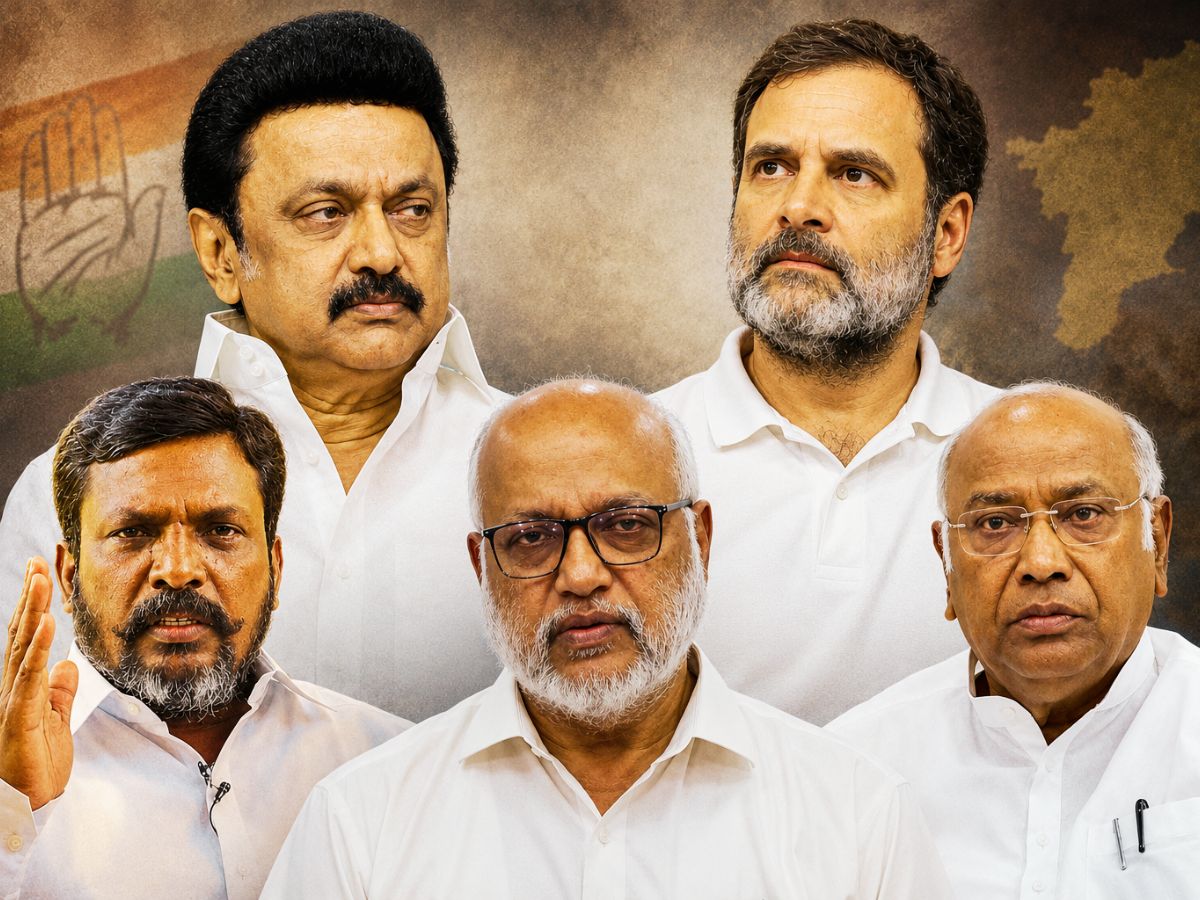
INDIA Bloc Collapsing? What Do DMK-Congress-CPM Rifts After Elections Say About Alliance’s Fate?

A variety of dramas are happening in Indian politics these days, especially in Tamil Dravidian politics. Election results are finally out for West Bengal, Tamil Nadu, Kerala, Assam and Puducherry and the post-poll politics is already taking a turn. What started as a regular election cycle has now turned into a period of deep reflectance for India’s opposition camp. In some states, people’s mandate has surprised ruling and opposition parties alike and reshaped the alliance structure. The cracks that were earlier thought to be within the INDIA’s coalition are now on focus, especially between the key regional players such as DMK, Congress and Left parties. Tamil Nadu has become the latest hotbed for post-poll realignments where the post-poll stage has exposed allegations of betrayal and mistrust.
INDIA Bloc and What is MK Stalin’s role?
The Indian National Developmental Inclusive Alliance or INDIA is a big opposition alliance that was formed by about 28 political parties before 2024 Lok Sabha elections. The primary goal in forming INDIA bloc was for the opposition parties to oppose the Governing National Democratic Alliance (NDA) and Bharatiya Janata Party at the national level. Comprising of ideological opposites such as the Congress, regional parties such as Trinamool Congress, DMK, RJD, Shiv sena (UBT), Left parties, and other smaller parties.
Although the alliance is not a single political party, it is a coordination platform where the parties agreed on seat-sharing and an overall opposition message and stand in Parliament. However, there have always been challenges due to regional interests and internal contradictions.
Within this framework, MK Stalin and DMK in particular has had a major role to play in South India. Stalin is not just a player but one of the architects of opposition coordination in Tamil Nadu politics and his DMK has been one of the most crucial players in the parliament strength of INDIA bloc from South. Stalin has himself portrayed as the interface between national parties and regional partners, calling for a united front against BJP while at the same time safeguarding regional political autonomy of Tamil Nadu. This has made him a stabilizing figure as well as a key decision maker in the alliance.
What went wrong with MK Stalin and Congress?
The tension between MK Stalin’s DMK and Congress has escalated to another stage after elections due to shifting post-poll alliances. An immediate cause has been the Congress’ distancing itself from DMK led Alliance after the results and backing actor-politician C Joseph Vijay’s Tamilaga Vettri Kazhagam TVK to form government.
For DMK, it was not simply a disagreement, but a violation of trust. Stalin specifically highlighted that the Congress MLAs who won in the alliance leadership was not met or officially acknowledged by him after results. That was considered as lack of political niceties and courtesy within the DMK.
One big issue is the perception that Congress went out on a limb without consulting DMK leadership even though they were in a long-term alliance. DMK leadership also claims that Congress benefited from DMK’s strong grass roots campaign and changed its tune when post electoral equations changed. This has resulted in breakdown of trust and DMK has also openly questioned whether the alliance is still relevant in Tamil Nadu politics.
ALSO READ: Who is S Keerthana? Sivakasi’s First Female MLA Joins Vijay Cabinet As Lone Woman Minister, Fluent In Multiple Languages
Congress lacks basic political courtesy
Dr Narmatha, former DMK student wing leader and ex-chairperson of Pondicherry University, told NewsX that DMK should never reopen political ties with Congress, calling the party historically unreliable and opportunistic. She said Congress’s behaviour cannot be seen as simple politics but as repeated betrayal of Tamil interests.
She also criticised Congress for disrespecting MK Stalin after earlier being supported by him, especially when others did not take Rahul Gandhi seriously. According to her, Congress MLAs should have shown basic political courtesy by informing Stalin directly about their decisions. She further claimed that the INDIA bloc no longer exists in practice and was mainly held together due to Stalin’s leadership. She added that Congress’s decision was politically “stupid” as no party would risk long-term gains for a short-term state-level position.
Kanimozhi’s LS Seat Arrangement demand
Later, a major symbolic issue has emerged from DMK MP Kanimozhi who formally wrote to Speaker of the Lok Sabha for a change in the arrangement of MPs of DMK. In her letter, she stated that, as a result of “changed political circumstances” and the end of the DMK-Congress alliance, it is no longer appropriate for DMK members to sit alongside Congress MPs in Parliament.
This is not just an administrative issue but a very political issue. In parliamentary practice, seating arrangements are often a sign of alliance ties and working relationships. By asking for a separation, Kanimozhi has effectively said that the DMK no longer considers Congress a political partner, which is a formal institutional distancing at the national level.
It also shows growing mistrust between the two parties and is one of the clearest signals that the decades-old DMK-Congress partnership has come to an end.
Congress Betrayal. How will DMK Face this?
DMK leader R Deepansaranraj told NewsX that Congress’s stand even before the elections appeared “suspicious” and alleged that it maintained a silent alignment with TVK while not fully supporting the DMK alliance on the ground. He claimed Congress cadres did not sincerely work for the alliance in several constituencies. According to him, what was earlier seen as internal differences later proved to be a deliberate political move by Congress.
He called it a “betrayal,” saying Congress benefited from DMK’s campaign efforts and later “backstabbed” the alliance after the results. He also said such actions have deeply hurt DMK cadres, who are staying silent only due to MK Stalin’s leadership. Deepan warned that Congress may not have a strong future in Tamil Nadu after this political move.
Stalin and Rahul relationship
Stalin and Rahul had a very close relationship in politics, built on the platform of coordination between opposition parties. During earlier years and especially among meetings of the joint INDIA bloc, both leaders displayed an image of cohesion and mutual respect. Rahul has often spoken of Stalin as a senior and seasoned regional player, while Stalin has been on Rahul’s side at interstate level when Rahul was coordinating campaigns against the BJP at large.
But in recent times this relationship has taken on a different tenor, due to political differences at state level. There is formal coordination at the national level through the INDIA bloc structure, but TN developments have led to a cooling-off. The decision of Congress to support TVK and the strong reaction of the DMK have added to the distance between Stalin and Rahul. Rahul Gandhi campaigned very late for DMK in this election.
So the previously buoyant symbol of opposition unity now displays a more careful political distance with both leaders being attached more to their party and its interests than to coordination between the alliance parties.
Unclear stand of VCK, CPM and CPI(M)
The smaller partners in the alliance such as VCK and the Left parties have plotted their course in a very careful manner. VCK led by Thol Thirumavalavan has said that the party is, in principle and in ideology, aligned and close to the DMK-led alliance. But in the specific situation of the political crisis in the government formation process, VCK has expressed “unconditional support” to TVK. But Thirumavalavan made it clear that this support has no bearing on stability of government alone and does not mean a shift away from DMK permanently.
Likewise, the Communist Party of India (CPI) and Communist Party of India (Marxist) [CPI(M)] have maintained a policy of caution. They have extended external support for TVK to form the government but have not joined the cabinet. In other words, they are not in the ruling coalition but are supporting it to prevent political chaos or new elections.
However, their position is not fixed. CPI and CPI(M) have stressed that their support is conditional and depends on the circumstances. So, it all depends on how the Tamil Nadu government formation process progresses.
Congress and CPM fight in Kerala
Adding more injury to the wound, Kerala has become another hotbed of tension in INDIA bloc. In the state, a direct political showdown has been observed between the Congress-led United Democratic Front (UDF) and the CPI(M)-led Left Democratic Front (LDF). In the last election, the UDF returned to power with a huge majority, and the Left became the opposition.
This competition has created ideological and political differences between Congress and CPI(M) at the national level. CPI(M) leaders have accused Congress of targeting Chief Minister Pinarayi Vijayan with political hostility and of trying to undermine the Left government with coordinated political onslaughts.
However, the Congress leaders say that their opposition to the Left in Kerala is based on issues of governance and politics. Nevertheless, CPI(M) has also expressed its concern that such a heated state-level rivalry is damaging unity in the INDIA bloc at the national level.
The result is a contradictory situation where Congress and CPI(M) are allies nationally but fierce rivals in Kerala, creating structural instability within the opposition alliance.
Recalling history of DMK-Congress alliance
If we go back to history, the picture will be more clear. DMK-Congress relationship is one of the longest and most complex political alliances in Tamil Nadu politics. It dates back to the early post-Independence period and has gone through repeated cycles of alliance, breakup, and reunion.
Initially, DMK emerged as an anti-Congress force in the 1960s, winning major elections by opposing Congress dominance. However, from the 1970s onwards, both parties began forming strategic alliances based on electoral necessity. The DMK first aligned with Congress in the early 1970s, marking the beginning of a long but unstable partnership.
Over the decades, the alliance has broken and reunited multiple times. In 2004, DMK was part of the UPA government led by Congress at the national level, with strong cooperation between the two. However, differences over seat-sharing, policy decisions, and major scandals like the 2G issue strained ties significantly.
In 2014, DMK briefly parted ways with Congress, but they reunited again for the 2016 Tamil Nadu elections and later for national coordination under the INDIA bloc framework.
Despite being electoral allies for decades, the relationship has always been transactional rather than ideological. It has survived due to political convenience rather than deep trust. The current breakdown of INDIA Bloc after the elections is being seen as one of the most serious ruptures in this long and unstable partnership. What will happen next is a major question.
ALSO READ: Vande Mataram First, Tamil Thai Vazhthu Third: Is Vijay Changing Decades-Old Dravidian Model Or Sending Message To BJP?
Sofia Babu Chacko is a journalist with over five years of experience reporting on Indian politics, crime, human rights, gender issues, and stories about marginalized communities. She believes journalism plays a crucial role in amplifying unheard voices and bringing attention to issues that truly matter. Sofia has contributed articles to The New Indian Express, Youth Ki Awaaz, and Maktoob Media. She is also a recipient of the 2025 Laadli Media Awards for gender sensitivity. Beyond the newsroom, she is a music enthusiast who enjoys singing. Connect with Sofia on X:
The post INDIA Bloc Collapsing? What Do DMK-Congress-CPM Rifts After Elections Say About Alliance’s Fate? appeared first on NewsX.

Comments are closed.