
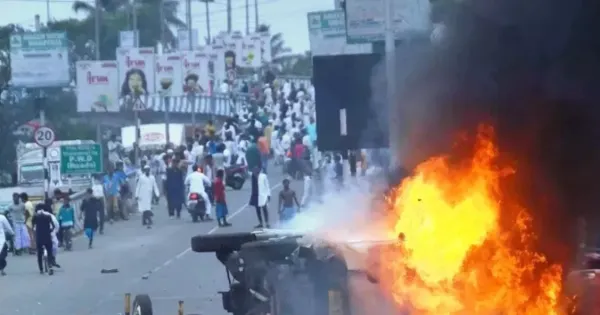

The Bengal violence has created a crisis for the democratic system. For peace, it is necessary that all political parties exercise restraint and motivate their workers to stay within the ambit of law.

Vivek Saxena, Ayodhya
India, the country whose Father of the Nation taught the lesson of non-violence to the whole world, today communal tension and violent clashes have now become a common thing in the state of West Bengal, which is a serious challenge for democracy. After the results of West Bengal Assembly elections, violence and tension have increased significantly in the state. Reports of arson, clashes and vandalism started coming from many areas including Asansol, Cooch Behar and New Town.
So far, more than 200 FIRs have been registered, 433 people have been arrested and more than 1100 have been taken into preventive custody. The Chief Election Commissioner has directed the Chief Secretary, DGP and CAPF to adopt a policy of ‘zero tolerance’. Not only this, joint police-CAPF control rooms have been created to stop the violence. At the same time, both TMC and BJP are accusing each other of violence.
The situation is that West Bengal was saved from violence before and during the elections, but could not escape from violence after the elections. The kind of violence that has taken place reveals a horrifying picture of what happened after the last assembly elections. In a way, Mamata has provoked her supporters by saying that she has not lost but has been defeated, hence she will not resign. This makes it clear that she cannot escape the allegations of inciting violence after the elections. The terrorizing violence that the supporters are displaying is the result of that violent political culture, which Mamata has preserved in the same way for 15 years.
The horrific proof of how audacious are the violent elements creating terror in Bengal is the murder of Chandranath Rath, personal assistant of Suvendu Adhikari, who has become the Chief Minister. Mamata never cared about the violent incidents in Bengal. Recent incidents, especially the violence in Murshidabad and tensions over the Waqf amendment issue, show that the communal divide is deepening in the state. Critics believe that the appeasement policy of the Mamata Banerjee government has worsened the situation, thereby emboldening radical elements.
Mamata Banerjee has often blamed ‘outsiders’ for the violence, but contradictions between police reports and statements of local people raise questions over her claims. Not only this, the Calcutta High Court has had to intervene several times, including ordering the deployment of Central Armed Police Forces in sensitive areas like Murshidabad. This raises serious questions on the impartiality of the state police and its ability to maintain law and order.
Communally charged processions and alleged police inaction have further stoked tensions in the state. The history of political and community violence in Bengal goes back decades. From time to time, there have been reports of electoral and social tensions during the rule of different political parties. There should be no place for violence in a democracy, no matter which side it is committed by. The growing conflict between opposition parties and the ruling party often results in violent clashes between workers on the ground, which ultimately affects ordinary citizens and the peace of the state.
Mamata and her state assembly, who were adamant on not resigning, were dismissed with immediate effect by Governor RN Ravi on Thursday using his powers. Now the government will have to see how the current violence can be controlled. Although a decision was taken to retain the central forces for 60 days after the elections, their deployment may have to be increased further. Whatever may be the case, BJP has to understand that it faces a serious challenge of strengthening and completely straightening out the law and order front along with many other challenges. He will have to face this challenge, because only through this the state can be brought back on track.
To establish peace in West Bengal, it is necessary that all political parties exercise restraint and motivate their workers to stay within the ambit of law. Maintaining law and order is the primary responsibility of the state administration, but better coordination between the Center and the state is also essential. The agenda of development and good governance has to be placed above communal or political polarization. As long as violence is seen as a weapon in politics, democratic institutions will continue to weaken. A lasting solution requires a fair investigation, speedy justice and inclusive dialogue, so that the state’s rich cultural heritage and democratic values are preserved.

Comments are closed.