

67
The walls of Nabanna, West Bengal’s state secretariat on the banks of the Hooghly, have witnessed much political theatre over the years. But the seven days following Suvendu Adhikari’s swearing-in carried a different texture—the purposeful, at times combative, energy of a Chief Minister signalling from day one that the rules of engagement in Bengal had irrevocably changed.
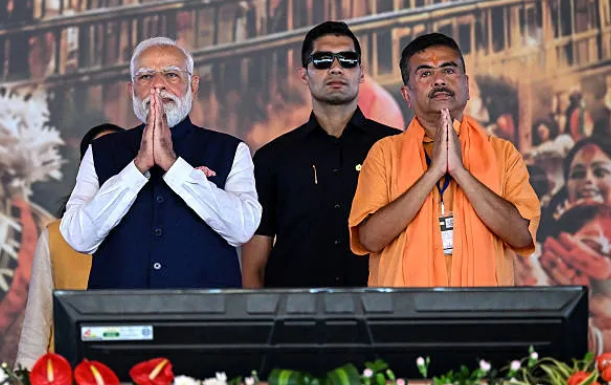
Adhikari was sworn in on May 9 at the Brigade Parade Ground before Narendra Modi, Union Home Minister Amit Shah, and Chief Ministers of BJP/NDA-ruled states, becoming the first Chief Minister of West Bengal from the BJP.
By the time the week ended, he had convened his first Cabinet meeting, unlocked four stalled CBI investigations, suspended three senior IPS officers over the R.G. Kar case, installed a new generation of technocrat administrators at Nabanna’s apex, and despatched a cascade of orders covering everything from cattle slaughter to school morning prayers.
Even before the Cabinet held its first formal session, Adhikari signalled the kind of administration he intended to run through his choice of the two men who would sit closest to him.
On the day of the swearing-in itself, retired IAS officer Subrata Gupta was appointed adviser to the Chief Minister. A 1990-batch IAS officer and IIT Kharagpur alumnus, Gupta had served as the Election Commission’s Special Roll Observer ahead of the Assembly elections, credited with deploying technology and AI to identify illegal voters, weed out fake entries, and ensure a transparent polling process.
Two days later came the more consequential appointment. Manoj Kumar Agarwal, the state’s Chief Electoral Officer who had overseen the controversial Special Intensive Revision of voter rolls, was named Chief Secretary—the senior-most serving IAS officer in the state. Despite the political firestorm surrounding the SIR exercise, Agarwal was praised by the Election Commission for overseeing a notably peaceful poll, marked by an absence of the traditional electoral violence, and a high voter turnout.
The BJP defended both appointments robustly, noting that unlike the previous dispensation—which had superseded dozens of officers in violation of IAS service rules—the new government had simply appointed the most senior eligible officer as Chief Secretary.
Addressing the media after his maiden Cabinet meeting at Nabanna, Adhikari said the new government would move forward on “good governance, security and double-engine government.”
Several decisions carried immediate symbolic weight.
The Bharatiya Nyaya Sanhita, the new criminal law framework that replaced the colonial-era IPC and which the previous TMC government had declined to implement, was adopted with immediate effect.
On national security, the Cabinet moved swiftly. Nearly 600 acres of land in border areas would be transferred to the BSF for border fencing, with the Chief Minister setting a 45-day deadline for completion.
Officers of the IAS, IPS, and WBPS—allegedly barred by the previous Chief Minister from deputation to other states or the Centre for training—would henceforth be sent regularly. And for the lakhs of young people who had lost years waiting for jobs mired in recruitment scams, a five-year age relaxation was ordered for all candidates who had missed government job opportunities due to those scams.
The week’s most dramatic single act came on Friday.
The Chief Minister announced the suspension of three of the most senior IPS officers in the state—former Kolkata Police Commissioner Vineet Goyal, and ex-deputy commissioners Indira Mukherjee and Abhishek Gupta—for alleged mishandling and dereliction of duty during the initial investigation into the R.G. Kar hospital rape-murder case of August 2024, when a trainee doctor was raped and murdered inside the hospital where she worked.
“The protectors themselves had become predators. There was a nexus, and a crackdown is underway against it,” Adhikari declared, adding that the government would investigate whether the officers had acted under instructions from Ministers or the former Chief Minister.
On the same afternoon, a sudden raid on Presidency Correctional Home—which houses, among others, Sandeshkhali’s notorious Sheikh Shahjahan—recovered 23 mobile phones and over 30 SIM cards, leading to the suspension of the prison superintendent and chief controller.
The R.G. Kar shadow also loomed over a high-level Health Ministry meeting with principals and medical superintendents of state-run medical colleges. The message was unambiguous: the culture of administrative cover-up must end, and hospital security would be subject to independent audit and strict accountability.
At a press conference on May 13, Adhikari announced that the government had granted CBI sanction to proceed against officials in four cases that the previous TMC dispensation had blocked for nearly four years—cases involving alleged irregularities in teacher recruitment, Municipal Affairs recruitment scams, and Cooperative Department irregularities being monitored by courts. “The previous government had deliberately withheld those permissions to shield corrupt bureaucrats,” he charged, reaffirming a zero-tolerance policy on graft. Two orders issued on May 14 carried as much cultural as administrative weight.
Vande Mataram was made mandatory in all government and government-aided schools, replacing the Banglar Mati Banglar Jol tradition introduced during the TMC era—a move aligned with the Ministry of Home Affairs’ national push to mark 150 years of the song.
In another symbolically significant directive, the new government invoked a decades-old Bengal law to ban public cattle slaughter, restricting it to designated municipal slaughterhouses or facilities approved by local authorities. Offenders now face imprisonment of up to six months, a fine of up to Rs 1,000, or both, with authorities directed to adopt zero-tolerance towards illegal cattle markets and smuggling networks.
The velocity of decisions has not gone unchallenged. Veteran TMC politician Sovandeb Chattopadhyay, who became Leader of the Opposition after the party’s historic defeat, has emerged as the principal voice of dissent.
The octogenarian former Power Minister, a Mamata Banerjee loyalist since the mid-1980s, warned that he would examine each decision with the rigour the Assembly demands. “I was a boxer before I was a politician,” he said. “The fight in the Assembly will be no different.”
The bureaucratic appointments drew the sharpest protests. TMC MP Sagarika Ghose said on X that officials who oversaw the deletion of voters’ names as supposed neutral umpires were now rewarded with top administrative posts—a quid pro quo, she suggested, that cast serious doubt on the fairness of the 2026 elections.
Other TMC leaders echoed the charge. On post-poll violence, the party alleged arson and damage to its offices across multiple locations, from Tollygunge and Baranagar to Howrah and Kasba. Adhikari was brisk: “There has not been much violence. But don’t compare with TMC—in 2021, the BJP had to build 355 safehouses and 110,000 people were forced to leave their homes.”
In a pointed riposte to Sovandeb Chattopadhyay on the floor of the House, Suvendu Adhikari said: “If the Opposition can prove that innocent Trinamool leaders were facing atrocities and had to run away, the BJP legislators and the local SP will personally escort them back to their homes. But if these people are those who were identified as having engaged in post-poll violence in 2021, then these people will be sent to jail.”
The Vande Mataram and cattle slaughter orders were separately criticised as attempts to enforce cultural conformity on a diverse state, with senior TMC voices warning they risk inflaming communal sentiment.
Whether Bengal’s bureaucracy—long conditioned to a very different style of political management—will match the Chief Minister’s pace, and whether Opposition challenges in the courts and the Assembly will slow the march of decisions, remain open questions. For now, the message from Nabanna is unmistakable: in Suvendu Adhikari’s Bengal, accountability has a new address, and impunity has an expiry date.

Comments are closed.