
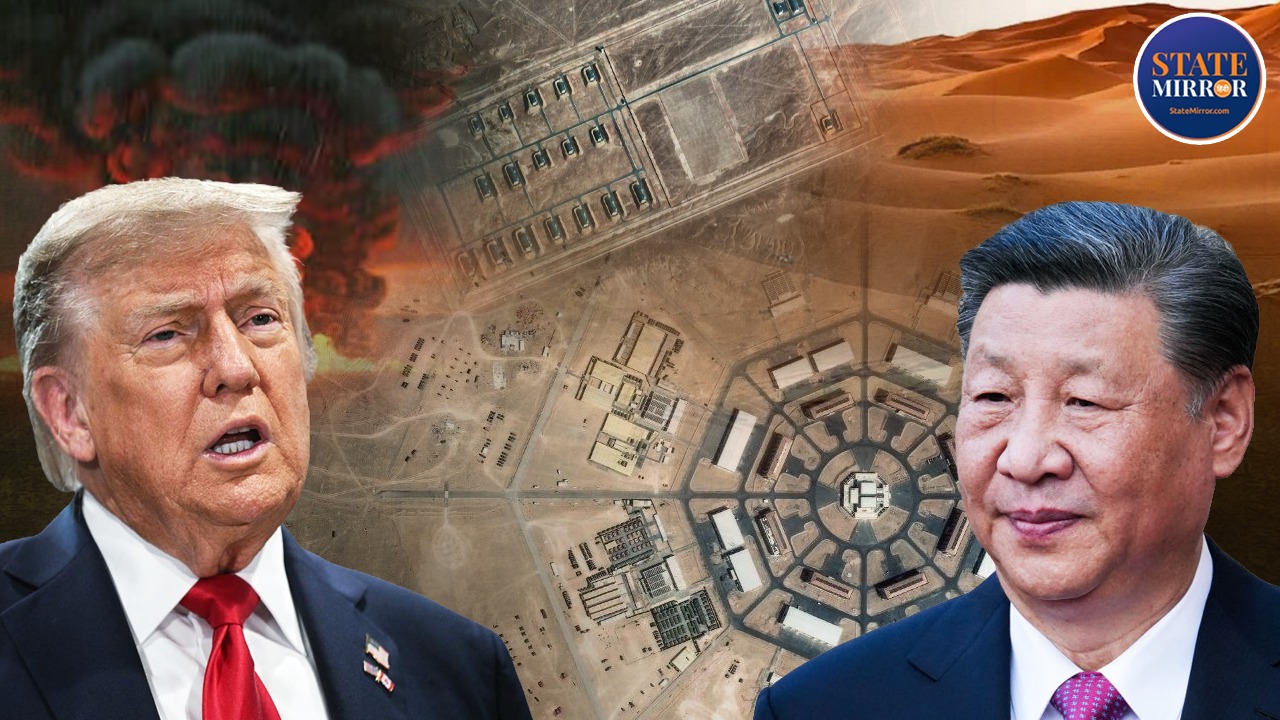
China’s ‘Doomsday Plan’? Nuclear site, 80 launch pads and secret bases in the desert increase Trump’s uneasiness

China A huge military construction project going on in the North West desert region of India has attracted the attention of the world’s defense experts and put them in tension. This is because Dragon is working on a plan to respond to the first nuclear attack by America, which has put Trump in tension. Recently surfaced satellite images indicate that Beijing is making efforts to make its nuclear infrastructure stronger and more durable than before. Defense experts say that the main objective of the entire project is to ensure that in the event of any conflict, even if America makes the first attack on China’s nuclear facilities, China can still take retaliatory nuclear action.
China already has intercontinental ballistic missiles (ICBMs) that can reach any part of America. But now Beijing seems to be investing heavily not only in the number of missiles, but also in the network to keep them safe and operate in every situation.
What is the secret of 80 launch pads and the mysterious octagonal building?
TOI quoted Reuters as saying that as per satellite images, China has developed more than 80 launch pads around the Hami nuclear missile silo area. Apart from this, three large octagonal structures have also been built, the purpose of which is not yet officially clear.
According to defense experts, these launch pads can be used for mobile missile launchers, air defense systems and strategic military operations. At the same time, octagonal structures may have been built for important tasks related to military communications, electronic warfare, command and control and missile operations.
The biggest feature of these constructions is that they can make China’s nuclear infrastructure spread and safe at many levels instead of relying on a single location.
Ability to respond even after the first nuclear attack
According to defense experts, this project is not just an exercise in creating new bases, but an effort to strengthen China’s “second strike capability”. That is, even if the enemy attacks first and destroys some of China’s nuclear bases, China will still have enough nuclear infrastructure and weapons to launch an effective counter-attack.
According to Alexander Neel, Adjunct Fellow of the Pacific Forum based in Hawaii, this construction work appears to be spread over an area of thousands of square kilometers. According to him, China is trying to take its strategic nuclear deterrence to new heights, so that its nuclear power can become more diverse and durable.
Why is American Superman restless?
US Defense Secretary Pete Hegseth recently expressed concern over China’s increasing military activities during the Shangri-La Dialogue held in Singapore. He said that many countries in the Indo-Pacific region are concerned about China’s military preparations and are constantly keeping an eye on its activities.
Hegseth said that the rapid expansion of China’s military capabilities is becoming a matter of concern not only for Asia but also for the global strategic balance. However, he also made it clear that America does not want any unnecessary conflict with China and is in favor of maintaining regional stability.
Despite this, there is a growing concern in the American strategic community that the speed with which China is developing its military and nuclear capabilities could change the balance of power in the future.
Why is China’s model different?
America and Russia are still the two largest nuclear powers in the world. They have far more nuclear warheads and deployed weapons than China. But generally they do not build such large-scale defense infrastructure around their nuclear bases.
Both countries mainly depend on a large number of missile silos, strong bunkers and remote bases. In comparison, China is seen developing missile silos, mobile launchers, electronic warfare capabilities and multi-layered defense networks simultaneously. This is the reason why many experts are considering this project as different and more ambitious than the models of other nuclear powers.
Even experts were surprised and said – never seen anything like this before
Analyst Hans Christensen, who has been monitoring nuclear programs for a long time, has called this expansionist policy of China extraordinary. According to him, the speed at which launch sites, support facilities and defense infrastructure are expanding is unprecedented.
Christensen said he had never seen such a comprehensive and ambitious project in his career. According to him, this is not just infrastructure but an indication of China’s long-term strategic thinking.
Is China really working on ‘Doomsday Plan’?
Although the project is being associated with terms like “Doomsday Plan” in many places in the Western media, China officially calls itself a defensive nuclear power. Beijing has been continuously saying that its nuclear policy is not aggressive but deterrence based.
China’s declared policy is “no first use” i.e. not to use nuclear weapons first. This means that China claims that it will only respond with a nuclear response if it is attacked first.
This is why many experts see this entire construction campaign as a strategy to strengthen the ability to respond even after a nuclear attack, rather than as a preparation for starting a nuclear war.
Taiwan becomes the biggest tension center
The issue of Taiwan is at the center of the increasing tension between China and America. Beijing considers Taiwan part of its territory, while Taiwan’s democratic government rejects this claim.
Western countries fear that if there is a major military conflict over Taiwan in the future, China may use its growing nuclear capability to create strategic pressure. For this reason, China’s nuclear expansion is being seen not only in the context of military modernization but also in the context of the Taiwan crisis.
Recently, President Xi Jinping had warned US President Donald Trump that if the Taiwan issue is mishandled, both the countries could move towards a dangerous situation.
What is changing globally? nuclear balance?
New missile silos, more than 80 launch pads, octagonal military bases and a vast defense network spread across Xinjiang and Gansu provinces are a sign that China is not just modernizing its military, but also developing long-term strategic deterrence.
At a time when tensions between the US and China are rising over issues such as trade, technology, the South China Sea and Taiwan, China’s new nuclear preparations could deeply impact the global balance of power and security architecture in the years to come. This is the reason why this network being built in the desert of Beijing has now become not just a military project of China, but one of the biggest strategic debates in the world.

Comments are closed.