

79
Bengaluru:
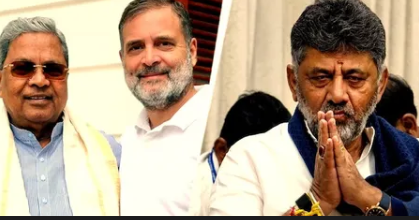
The smooth, peaceful handling of leadership transition and power-sharing arrangements within the ruling Indian National Congress government in Karnataka has significantly strengthened the party’s confidence as it prepares for the 2028 Assembly elections.
Party leaders and insiders believe the successful management of internal differences has projected an image of stability and maturity, contrasting with the factional disputes that have affected several regional and national parties in recent years.
Political observers note that Karnataka remains the Congress party’s most significant state government in southern India, making political stability there crucial for its broader electoral strategy. The leadership’s ability to maintain unity, despite periodic speculation over power-sharing formulas, has reassured party workers and strengthened organizational morale across the state.
Senior Congress leaders have increasingly highlighted Karnataka as a model of governance and political management. The administration’s focus on welfare schemes—including the five guarantees, infrastructure development, and social programmes—is expected to form the backbone of the party’s campaign narrative heading into the 2028 Assembly elections.
Developments in Karnataka are also influencing the Congress party’s calculations across southern India. In Tamil Nadu, sections within the party are reportedly exploring the possibility of deeper electoral cooperation with the Tamilaga Vettri Kazhagam (TVK), led by actor-turned-politician Vijay.
While no formal alliance discussions have been publicly confirmed, political analysts believe Congress sees potential opportunities in broader opposition unity to challenge rival political formations in the state.
In Kerala, where power traditionally alternates between the Congress-led United Democratic Front (UDF) and the Left Democratic Front (LDF), Congress strategists are optimistic about improving the party’s electoral prospects. Leaders argue that organizational strengthening, coupled with anti-incumbency factors and renewed coordination among UDF constituents, could enhance the coalition’s chances of securing a comfortable majority in future Assembly elections.
The Congress leadership views the southern region as increasingly important to its national revival efforts. Strong performances in Karnataka, Telangana, and Kerala, along with potential electoral gains through strategic alliances in Tamil Nadu, could provide the party with a robust political base ahead of future national contests.
Political analysts, however, caution that electoral outcomes remain dependent on multiple factors, including governance performance, alliance dynamics, economic conditions, and the strategies adopted by rival parties.
Nevertheless, the successful management of Karnataka’s political transition has undoubtedly provided Congress with a confidence boost and a platform from which to expand its ambitions across southern India. As preparations gradually begin for the 2028 electoral cycle, Karnataka’s experience is likely to remain central to the party’s message on stability, governance, and internal cohesion.

Comments are closed.