
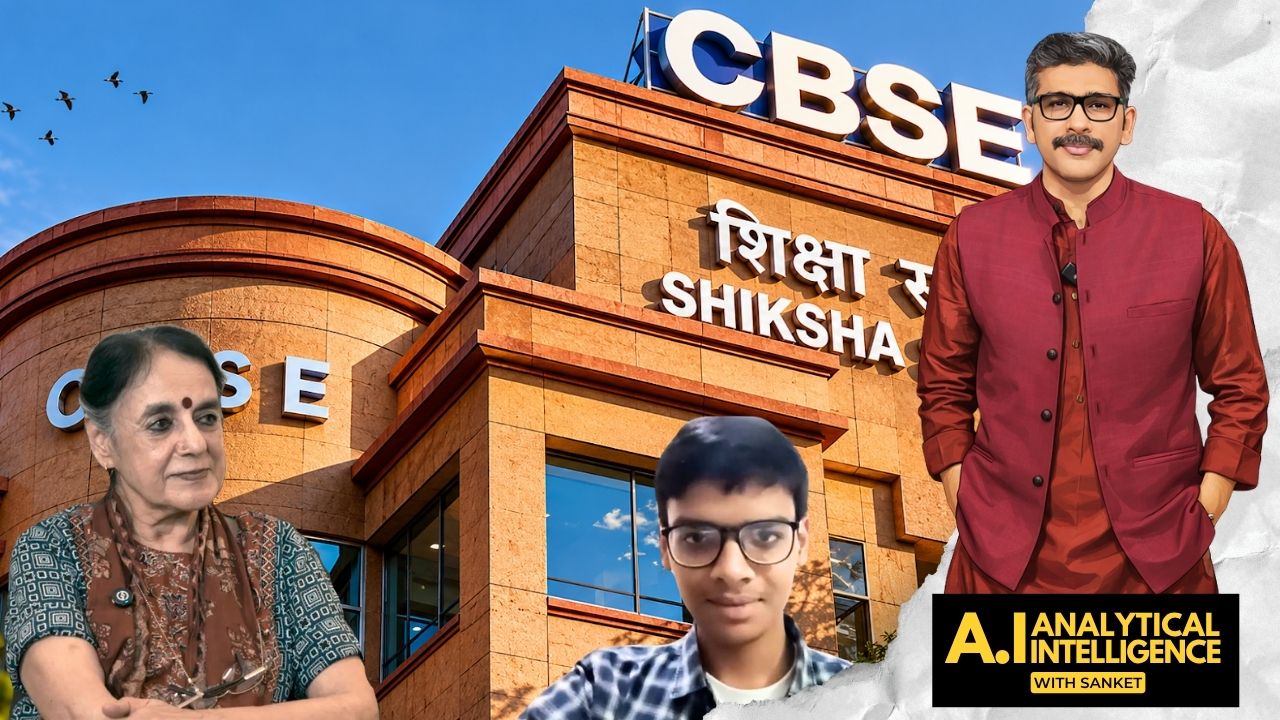

Questions over the CBSE’s controversial On-Screen Marking (OSM) system have intensified after an 18-year-old CBSE Class 12 whistleblower, Sarthak Sidhant, alleged that changes were made in tender conditions that appeared to favour the vendor selected for the project. He stopped short of making direct allegations, but repeatedly sought answers from the Board on why multiple tender revisions were required and why key provisions were altered.
The controversy comes amid widespread complaints regarding the evaluation and re-evaluation process for Class 12 Board examinations. Students and parents have raised concerns over scanned answer sheets, marking discrepancies and technical glitches.
Also read: CBSE OSM row: Student alleges rule changes in tender to favour Coempt over TCS
On AI With Sanket, The Federal spoke to Sidhant, and educationist Prof Anita Rampal about the allegations surrounding the OSM system, the tendering process, and what should happen next.
Tender questions
Explaining how his investigation began, Sidhant said he was discussing the issue with journalist Sanjay Maurya and student activist Nisarg Adhikari when he became interested in the vendor selection process.
According to him, he examined hundreds of CBSE tender documents and identified multiple tenders related to the same project. He said the board appeared to have made several attempts before finalising a vendor.
Sidhant said he could access documents related to tenders issued in May and August 2025 and noticed changes in eligibility conditions. One of the most significant changes, he claimed, was the removal of a clause related to poor performance records.
Also read: Education Ministry clarifies blaze occurred at SPA building, not its office
He pointed out that an earlier tender stated that a service provider could be disqualified for a record of poor performance. According to him, that provision was removed in a later version of the tender.
Seeking answers
Asked whether he was certain about his conclusions despite his young age, Sidhant maintained a cautious position.
“I am never absolutely sure of anything,” he said, adding that his findings were based on differences he observed while reading the documents.
Referring to the vendor’s past record, Sidhant argued that the removal of certain clauses raised legitimate questions. However, he repeatedly emphasised that his objective was not to make allegations but to seek explanations.
“My questions are directed to CBSE. I want the Board to answer them and provide a reasonable response,” he said.
When asked whether the tender modifications amounted to wrongdoing, he avoided making legal judgments. Instead, he described the developments as “weird” and “concerning”, particularly in relation to transparency.
He said the cumulative effect of the findings raised questions about the fairness of the process and whether adequate safeguards had been maintained.
Hope from students
Rampal said the episode offered an important lesson about civic responsibility and collective action among young people.
While cautioning against broad generalisations, she said the actions of students such as Sidhant, Nisarg Adhikari, Vedant Srivastava and others provided reassurance that young people remain willing to engage with public issues.
Rampal said one of education’s key responsibilities is to nurture hope and encourage students to think beyond themselves.
She cited examples of students who highlighted difficulties in accessing re-evaluation mechanisms and argued that many affected students may not have had the resources or awareness to challenge discrepancies.
According to her, what impressed her most was that several students were speaking not only for themselves but also for others who might have been adversely affected.
CBSE response
Rampal criticised what she described as the Board’s handling of concerns raised by students.
She argued that instead of acknowledging legitimate issues, authorities initially denied problems and challenged those raising questions.
Referring to ethical hacker Nisarg Adhikari’s findings regarding access vulnerabilities, Rampal said the Board should have appreciated students who identified problems rather than treating them adversarially.
She said a respected academic institution should respond with transparency and accountability when concerns emerge.
Rampal also suggested that the board should consider broader corrective measures rather than limiting relief only to students who formally applied for re-evaluation.
Re-evaluation debate
A major point of discussion was whether the current evaluation system should continue.
Rampal strongly opposed the use of scanned answer sheets for assessment, arguing that screen-based evaluation undermines deeper academic judgement.
She said teachers are often required to assess answers on screens under monitoring systems that prioritise speed over careful evaluation.
According to her, education systems in several countries continue to rely on human assessment rather than fully digitised evaluation models.
Rampal argued that meaningful assessment requires teachers to interpret answers, evaluate understanding and exercise professional judgement — tasks she believes are difficult to replicate through screen-based workflows.
She also expressed concern that examination systems increasingly encourage questions designed for mechanical assessment rather than testing the depth of understanding.
Technology versus implementation
Sidhant acknowledged that technology can play an important role in modernising education systems.
However, he argued that technological reforms must be implemented carefully and after adequate testing.
According to him, the OSM platform was developed and rolled out within a relatively short timeframe, leaving limited scope for comprehensive testing and security audits.
He said the issue was not technology itself but the manner in which it was introduced.
“Technology should be the future forward. We should move forward with technology, but it should not be done in a hasty way,” he said.
Rampal disagreed with the assumption that assessment necessarily benefits from digitisation. While supporting the use of technology for tasks such as providing digital copies of answer sheets to students, she maintained that evaluation itself should remain a human-centred process.
Ignoring trolls
Towards the end of the discussion, Sidhant was asked whether he had faced online abuse similar to that directed at other students involved in exposing problems with the system.
He said he had encountered trolling on social media but preferred not to engage with it.
“I believe ignoring them is the best option,” he said.
The discussion ultimately highlighted two parallel concerns — questions surrounding transparency in the OSM tendering process and broader concerns about the future of examination assessment. While Sidhant focused on obtaining answers from CBSE regarding procurement decisions, Rampal argued that the debate should also prompt a deeper examination of how student learning is evaluated in the first place.
(The content above has been transcribed from video using a fine-tuned AI model. To ensure accuracy, quality, and editorial integrity, we employ a Human-In-The-Loop (HITL) process. While AI assists in creating the initial draft, our experienced editorial team carefully reviews, edits, and refines the content before publication. At The Federal, we combine the efficiency of AI with the expertise of human editors to deliver reliable and insightful journalism.)

Comments are closed.