

New Delhi: Militant violence in Pakistan surged by 27 per cent in May, according to the Pakistan Institute for Conflict and Security Studies (PICSS).
The country is caught in a vicious cycle of armed attacks, and there is no let-up in them.
The consistency and increasing intensity of the attacks and the failure of the Pakistani security agencies to contain them raise serious questions about the capability of the Pakistan Army.
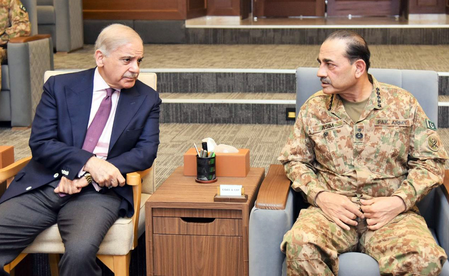
The security situation has worsened at a time when the security establishment, under Field Marshal Asim Munir, has openly dominated the country’s domestic and foreign policy.
The role of the civilian leadership has been limited to either approving or promoting the decisions taken by the security establishment.
In the past, at least efforts were made not to acknowledge it (while the world knew well who pulled the strings when a decision on security, foreign policy, and even the economy was to be made).
Since Shehbaz Sharif’s assumption as the Prime Minister, the government has been more focused on validating the Pakistan Army’s role than on highlighting its role in governing the country.
Defence Minister Khawaja Asif accepted publicly that Pakistan had an “existing hybrid model of governance”.
Emphasising the dependency of the civilian leadership on the establishment, Asif said that a “hybrid regime” was necessary for the country to emerge from economic and governance crises.
Khawaja Asif’s statements and his role in endorsing the Army need to be taken seriously, including his understanding of the country’s security issues and his options for addressing them.
While consistently praising the Army, Asif has been actively trying to shift attention from the failures of the Pakistan Army to externalise the crisis.
He is insistently trying to link the armed attacks with Afghanistan, accusing the Taliban regime of being complicit in the activities of the Tehreek-e-Taliban Pakistan (TTP) and acting as a “proxy” of anti-Pakistan powers.
The narrative rolled out by Asif is a tactic to defend the Army for its failure to fight the armed Baloch nationalists in Balochistan and religious extremists in Khyber Pakhtunkhwa (KP).
It was Asif who had declared that Pakistan was in “open war” with its neighbouring country.
Asif is acting more like a spokesperson of the Army than the Defence Minister of the government.
Undermining the credibility of the civilian government and heaping praise for the Army, Asif said in an interview last year that the hybrid model was “not an ideal democratic government”, but it was “doing wonders”.
No proof has been provided to illustrate what “wonders” the hybrid model has done.
Pakistan is still seeking bailouts and financial aid.
Despite forming the Special Investment Facilitation Council (SIFC) with the Army at its centre to attract foreign direct investment (FDI), instead of increasing, the interest of foreign investors in Pakistan is decreasing.
As far as security is concerned — the main job of the Army — if anything, has deteriorated, as vindicated by the attacks carried out by various armed groups.
For the last two decades, the Pakistan Army has conducted operation after operation to fight off various armed groups. None of these operations has achieved its goal. On the one hand, the Army has been carrying out these operations, mainly in KP; on the other hand, armed attacks are on the rise. In fact, these operations have led to human rights violations and the displacement of hundreds of thousands of people.
Additionally, these operations have created fear and anger among the common population. For example, in January, some reports claimed that the Pakistan Army was planning yet another operation in the KP’s Tirah Valley against armed militants in the area.
The proposed operation was strongly opposed by the local political and tribal leaders and population. It also created panic in the local population, forcing many to migrate to safer areas, leading to the displacement of the local population
More than 70,000, mostly women and children, had vacated the area. Earlier, in August 2025, a military campaign in the northwestern Bajaur district had displaced thousands as well.
After getting bad press, although Asif denied that any military operation was being planned, distrust between the local population and the ruling elite is so deep that the people refused to pay any heed to the government’s assurances and kept vacating the area to avoid being collateral damage in the possible military operation.
The distrust is caused by the destruction and violations of human rights in the previous military operations in the area.
In the last more than two decades, 14 operations were conducted in KP alone to fight armed militants, apart from two military operations across Pakistan (Operation Radd-ul Fassad in 2014 and Operation Azm-e-Istehkam in 2024).
The demand to launch yet another military operation undermines rather hollow claims of the Pakistan Army that the previous operations were successful.
Finally, the Pakistan Army decided to carry out military action against Afghanistan to defuse the pressure that was building against it in the wake of the rise in terror attacks. It makes no military or strategic sense to carry out strikes against a country that is weakly governed by a regime that has yet to consolidate its control, but to divert attention from internal criticism.
The Afghan Taliban continue to engage with Islamabad in an effort to avoid military escalation. In his statement, the Deputy Spokesperson of the Islamic Emirate, Hamdullah Fitrat, said that the issue of TTP is an internal matter of Pakistan.
He said that while the Emirate is ready to take steps to ensure that Afghan soil is not used against any country, “some of Pakistan’s demands are unrealistic and cannot be implemented by Afghanistan.”
On the other hand, Pakistan seems to be bent on being offensive, mainly because the country’s security establishment is unable to ensure internal security. It is indifferent to Kabul’s pleas.
In his statement in Quetta recently, Prime Minister Shehbaz Sharif warned that Pakistan’s military action is to be “continuing with full resolve to defend lives and property of innocent citizens against Afghan Taliban-based terrorist proxies”.
Pakistan is building pressure on the Afghan Taliban to behave in a certain way, which is unreasonable and unrealistic.
Since the Afghan Taliban cannot allow Islamabad to dictate its internal and foreign policy, the situation has reached an impasse.
It is up to Pakistan to be realistic and address its internal political security matters.
The Afghan Taliban seem to be ready to cooperate in the areas in which they can deliver. But Pakistan is bent on showing its military strength and coercing Kabul into submission.

Comments are closed.