
How Nikki Haley, Vivek Ramaswamy And Hirsh Vardhan Singh Challenged Trump In The Republican Race – Obnews

When the Republican Party began selecting its candidate for the 2024 United States presidential election, Donald Trump appeared to be the dominant figure from the beginning. However, the crowded field also included three Indian American candidates with very different political backgrounds, campaign styles and levels of national support: Nikki Haley, Vivek Ramaswamy and Hirsh Vardhan Singh.
Their presence was notable because it reflected the growing visibility of Indian Americans in United States politics. The three candidates did not represent a single political viewpoint or a coordinated community effort. Instead, they entered the race with distinct messages and attempted to reach different sections of the Republican electorate.
Nikki Haley entered the contest with the strongest political resume. Born in South Carolina to Indian immigrant parents, Haley served as governor of South Carolina from 2011 to 2017 and later became the United States ambassador to the United Nations during Donald Trump’s first administration. She launched her presidential campaign in February 2023, calling for a new generation of leadership and presenting herself as a conservative alternative to Trump.
Haley gradually emerged as Trump’s final major Republican challenger. Her campaign emphasized foreign policy experience, fiscal discipline and a more traditional style of Republican leadership. She also argued that the party needed to appeal to voters beyond its existing base. Although Haley was unable to defeat Trump nationally, she made history by becoming the first woman to win a Republican presidential primary contest when she secured a victory in Washington, D.C. She later won the Vermont Republican primary.

Haley suspended her campaign on March 6, 2024, after Trump defeated her in 14 of the 15 Republican contests held on Super Tuesday. In her departure speech, she did not immediately endorse Trump. Instead, she said it was up to him to earn the support of Republicans and other voters who had not backed his campaign.
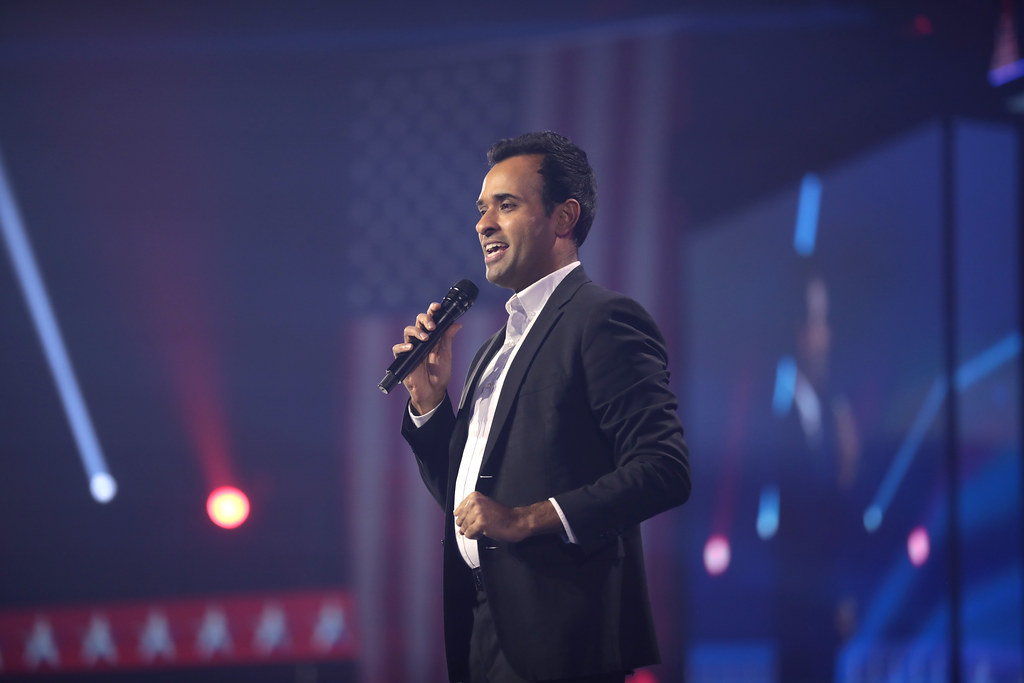
Vivek Ramaswamy followed a different path. The Ohio born entrepreneur and former biotechnology executive had never held elected office before entering the presidential race in February 2023. The son of immigrants from southern India, Ramaswamy built his campaign around an assertive America First message, criticism of corporate activism and opposition to what he described as excessive influence from unelected institutions.
Ramaswamy gained attention during Republican debates because of his energetic style and willingness to challenge more established candidates. He often defended Trump’s record while arguing that a younger leader could carry the movement forward. However, his campaign did not gain enough support to create a realistic path to the nomination. After finishing behind Trump, Ron DeSantis and Haley in the Iowa caucuses, Ramaswamy suspended his campaign on January 15, 2024, and endorsed Trump.
Hirsh Vardhan Singh entered the race in July 2023. An engineer with experience in New Jersey Republican politics, Singh described himself as a lifelong Republican and an America First conservative. He had previously sought public office in New Jersey, including campaigns for governor and the United States Senate. His presidential campaign received attention in Indian media because he became the third Indian American to seek the Republican nomination during the same election cycle.
However, Singh’s campaign remained a minor candidacy and did not achieve the national profile reached by Haley or Ramaswamy. He did not become a major factor in the Republican debates or the primary results. His presence was still significant as an illustration of how Indian American political participation has expanded beyond a small number of established figures.
The three campaigns also demonstrated that Indian American candidates cannot be treated as a single political bloc. Haley attempted to build a broad coalition of Republicans seeking an alternative to Trump. Ramaswamy positioned himself close to Trump’s political movement while presenting a younger and more confrontational style. Singh appealed to a smaller conservative constituency and did not achieve comparable national momentum.
Ultimately, none of the three candidates prevented Trump from winning the Republican nomination. Trump dominated the primary contests, formally became the party’s nominee and returned to the White House after the 2024 election. As of June 2026, he is serving as the 47th president of the United States.
The campaigns of Haley, Ramaswamy and Singh were still important. They showed that Indian Americans are increasingly visible across the political spectrum and are willing to compete for the highest office in the country. Their candidacies did not produce a presidential nominee, but they marked another stage in the growing influence of a community that continues to play a larger role in American public life.

The longer term impact is still developing. Ramaswamy has remained active in Republican politics and secured the party’s nomination for governor of Ohio in 2026. Haley retains a national profile after becoming Trump’s most persistent major rival during the Republican primary. Together, their campaigns demonstrated that Indian American political representation is no longer limited to symbolic participation. It is becoming an established part of the American political landscape.

Comments are closed.