
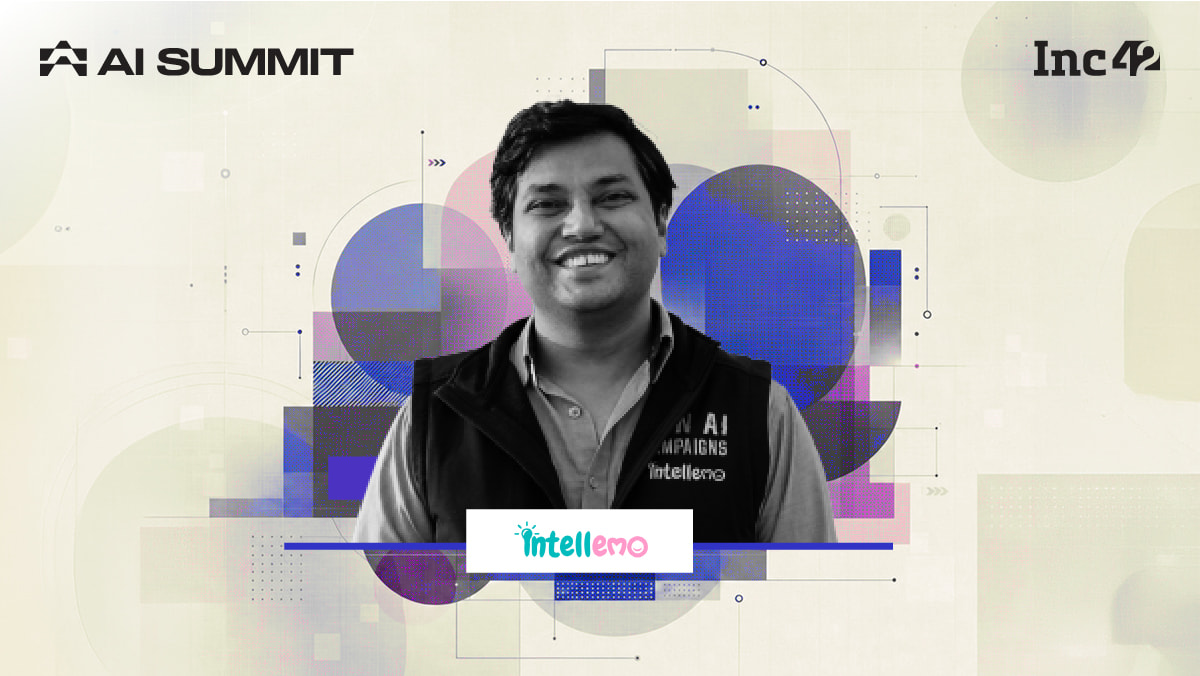

Intellemo founder and CEO Saurabh Gupta said that consumer AI products will increasingly compete on trust and outcome delivery rather than product features alone
SpeakX.ai founder Arpit Mittal highlighted how memory systems have become a core differentiator in AI products, helping platforms personalise experiences and improve outcomes
Flash AI’s Ranjith Boyanapalli said that AI-assisted shopping traffic is proving more valuable than traditional acquisition channels, with users arriving better informed and converting at higher rates
Consumer AI is entering a new phase of growth. As adoption surges, the market is expected to become a $55 Bn opportunity by 2030. But founders are realising that building powerful AI features is only half the battle won.
For Saurabh Gupta, founder and CEO of Intellemo, the real challenge is winning user trust.
Speaking at Inc42’s AI Summit 2026during a discussion on ‘How Consumer AI Products Are Winning Distribution And Retention In India’, Gupta said that the success of AI startups depends on whether users trust the system to understand their preferences and deliver outcomes consistently.
Reflecting on Intellemo’s journey, Gupta said the startup initially focused on building marketing automation tools before realising that customer trust mattered more than product sophistication.
“Over the course of time, we realised that it’s not about building the product; it’s about winning the trust of the client. The product gets built. We do fancy things, and we drive a lot of productivity and a lot of ROAS enhancement. None of that matters. What matters is whether the person on the other side of the table trusts you or not,” he said.
The insight has shaped Intellemo’s latest pivot into cinematic AI video creation. The startup now enables users to generate videos with storylines, voiceovers and character consistency through a largely automated workflow.
According to Gupta, the next generation of consumer AI products must reduce decision fatigue rather than increase it. As AI applications become more capable, users should not be required to repeatedly set preferences or make multiple decisions during every interaction. Instead, products should remember user context, offer opinionated workflows and act more like copilots than instruction-driven tools, he added.
“It is always much better that you allow the user to become a co-passenger,” he said.
The discussion also explored how memory and context are becoming critical competitive advantages in consumer AI.
SpeakX.ai founder and CEO Arpit Mittal said advances in memory management have significantly improved AI products’ ability to personalise user experiences. According to him, companies are building systems that intelligently decide what information to retain, retrieve and surface based on user context.
For SpeakX, which helps users improve linguistic skills, these memory systems have become central to delivering personalised learning journeys and improving long-term engagement.
Meanwhile, Flash AI founder Ranjith Boyanapalli highlighted how AI is reshaping online commerce and product discovery. He said there is growing evidence that users who conduct AI-assisted research before making purchases tend to be more informed and convert at higher rates than those arriving through traditional paid marketing channels.
According to Boyanapalli, brands need to understand how they appear across AI search and recommendation engines, as discovery gradually shifts from traditional search optimisation to AI-driven interactions.
Paras Madan, founder of Varnan, also highlighted the growing importance of context and discoverability, arguing that visibility in the AI era is increasingly becoming an engineered process. He explained that startups are beginning to optimise their content and distribution strategies for AI answer engines rather than traditional search engines.
The panel, moderated by Digio entrepreneur-in-residence Kshitij Shah, also explored one of consumer AI’s biggest challenges: retention. While AI applications often attract strong initial engagement, sustaining user activity beyond the novelty phase remains a key hurdle.
As AI capabilities become increasingly commoditised, products that remember context, reduce complexity and build user trust are likely to enjoy a lasting advantage over those competing primarily on features.

Comments are closed.