
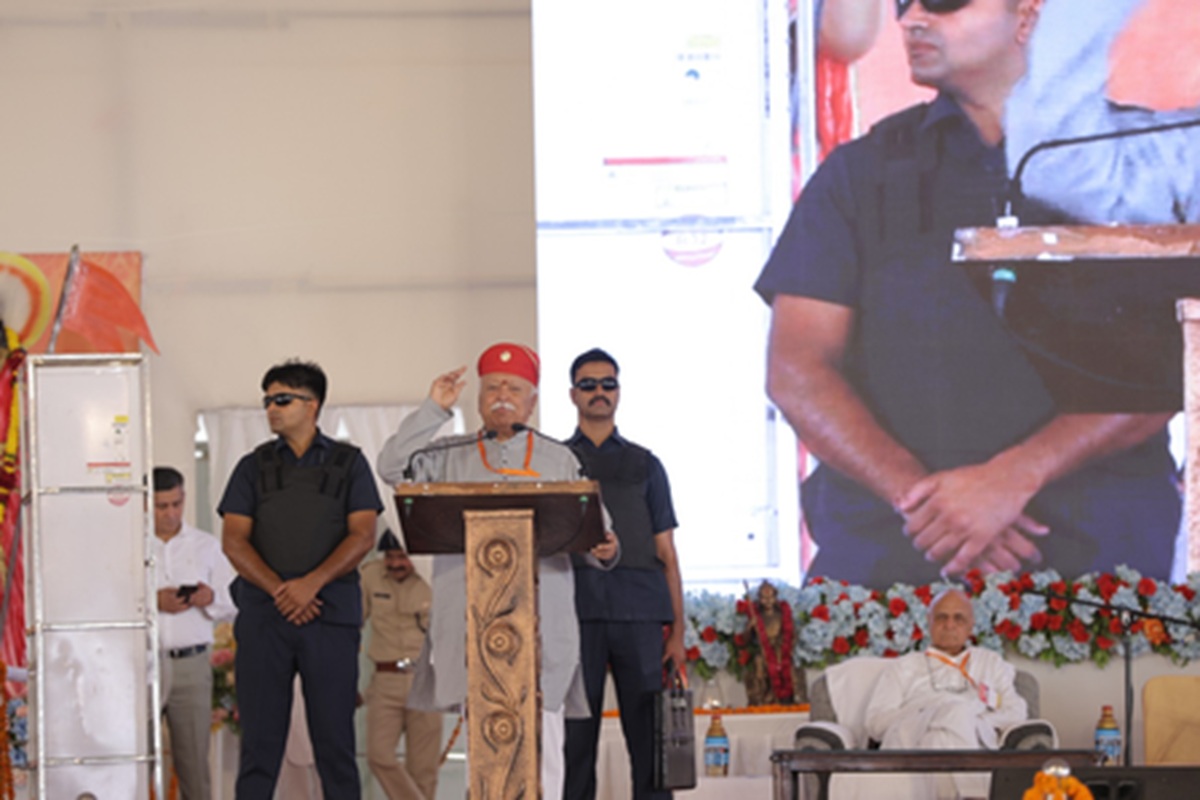

Bhagwat was addressing the ‘Rashtra Chetna Sankalp Sabha’ organized on the occasion of 486th birth anniversary of Maharana Pratap and 450th anniversary of Haldighati victory at Gandhi Maidan in Udaipur on Wednesday.
He said that Maharana Pratap’s birth anniversary is celebrated with reverence and pride throughout the country. This is proof that the nation remembers those great personalities who fought to protect self-respect, freedom and culture.
He said that in the battle of Haldighati, the Mughal Empire was superior in terms of army size, resources and weapons. Maharana Pratap had limited resources, lack of money and his army was relatively small, yet he did not give up the path of struggle.
The RSS chief said that Indian society has never accepted subordination easily. Whenever any invader tried to capture this land, the process of resistance started immediately. Various historical events have been presented through a specific narrative from time to time. A similar situation is seen in the context of the battle of Haldighati.
He said that it is mentioned in the accounts of Mughal historians themselves that the Mughal army was forced to retreat during the war. If the Mughal army faced continuous difficulties at various stages of the conflict and remained in a state of fear and insecurity even after the war, it is necessary to consider who actually emerged victorious.
Referring to various incidents of the war, Bhagwat said that during the initial attack the Mughal army was forced to retreat. In the second phase, the bravery of Maharana Pratap’s army had such an impact that the major warriors of the enemy side suffered heavy losses.
The RSS chief said that India’s history is not of those who accepted defeat and surrendered, but of those who fought continuously. The wave of invasion that started from the West wanted to enter India also, but because of heroes like Bappa Rawal, Lalitditya and others, it could not achieve its desired success here.
Bhagwat said that Indian society has faced many difficulties and struggles, yet it has successfully preserved its culture and religion. There may be differences in society, but whenever the nation and its culture are in crisis, Indian society stands united. However, society needs to remain organized and united not only in times of crisis but also in normal circumstances. The life of Maharana Pratap is a symbol of this message.
Citing historical examples, the RSS chief said history has often been written from the perspective of the winners or those close to power. Referring to Babu Kunwar Singh, Bhagwat said that although he reclaimed his kingdom during the struggle against the British and ruled independently for a long time, the events are presented differently in some historical accounts. Similarly, there is a need to re-examine the facts related to the battle of Haldighati.
The RSS chief said that Maharana Pratap is known as ‘Hindu Sun’. He never compromised with his religion, self-respect or values. His struggle was not motivated by personal interest or lust for power, but was dedicated to the protection of society, culture and nation. Through his life he showed how an ideal administration and welfare state could be established.
He said that comprehensive study of the life and achievements of Maharana Pratap is still necessary and the young generation should take inspiration from his life.
Addressing the gathering, Nimbarka Peeth chief Shriji Shyamcharan Maharaj said that today there is a need for unity, organization and preservation of cultural values in the society. He urged the society to abandon divisive tendencies and move forward on the path of positive, constructive and national interest.
He emphasized that the basic message of Indian culture is harmony, unity and public welfare and by maintaining this spirit the nation can progress.
Second ODI: Gill-Ishan’s centuries, Afghanistan set 403 targets!

Comments are closed.