
Modi Takes Cautious Approach In Trump Meeting As India Reassesses United States Relationship – Obnews

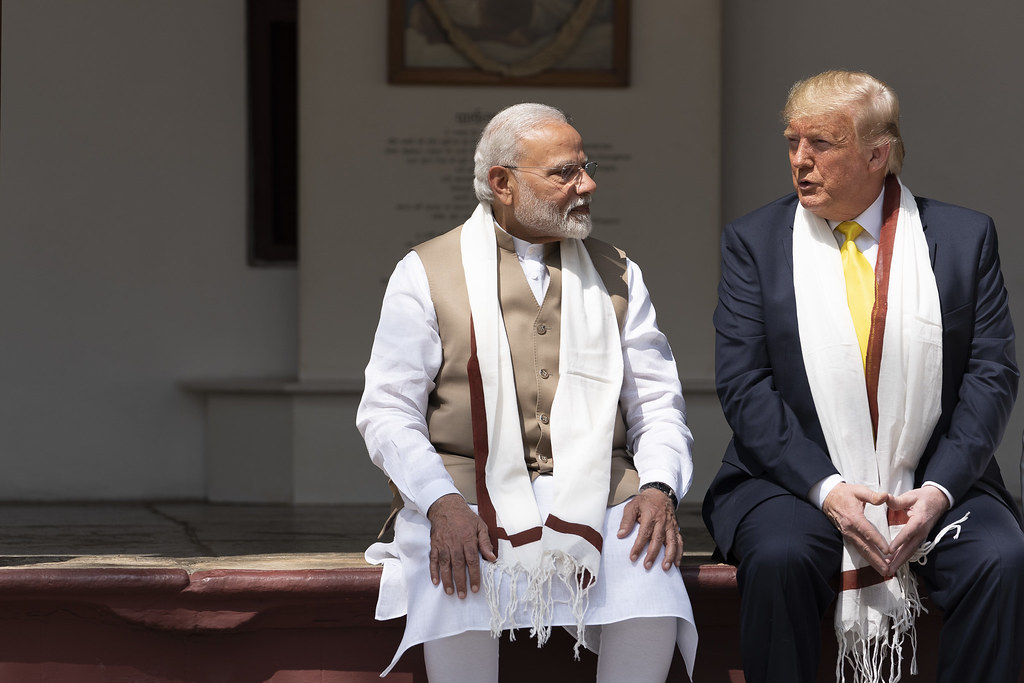
Indian Prime Minister Narendra Modi adopted a notably measured tone during his meeting with United States President Donald Trump at the Group of Seven summit in France, highlighting the caution now shaping relations between New Delhi and Washington.
According to Bloomberg News, Trump praised Modi warmly during their first face to face meeting in more than a year. The American president described Modi as a longtime friend and a tough trade negotiator, saying the Indian leader may appear gentle but is extremely firm during negotiations.
Modi was more restrained in his public comments. Speaking beside Trump after their bilateral discussions, the Indian prime minister largely relied on prepared remarks, described the talks as productive and thanked Trump for his role in restoring peace in the Middle East.
However, Modi did not publicly refer to Trump as a friend, a term he has frequently used during previous meetings. Analysts said the change in tone reflected India’s growing caution following more than a year of disagreements involving tariffs, Russian oil purchases, Pakistan and the conflict involving Iran.

Milan Vaishnav, director of the South Asia Program at the Carnegie Endowment for International Peace, told Bloomberg that the past 18 months had demonstrated the risks of India relying too heavily on its relationship with the United States. He said India would remain engaged with Washington while also seeking to strengthen partnerships with other countries.
Modi used the G7 summit to hold discussions with several major international partners, including Canada and the United Kingdom. The United Kingdom announced that its £4.8 billion trade agreement with India would take effect on July 15, while India is also expected to pursue new agreements with Canada and the European Union.
India was among the first countries to begin negotiating a new trade agreement with the United States after Trump returned to office. Trump said the two countries were very close to reaching a deal, but analysts noted that similar statements have been made for months without a final agreement.
Michael Kugelman, a senior fellow for South Asia at the Atlantic Council, told Bloomberg that the continued absence of an agreement suggests unresolved problems remain. United States Trade Representative Jamieson Greer is expected to visit India next week in an effort to advance the negotiations.
Indian officials have indicated that a deal may not be completed until Washington finishes two trade investigations that could provide the basis for additional tariffs. Trump imposed a 50 per cent tariff on Indian exports to the United States last year, partly in response to India’s continued purchases of Russian oil.
Relations have also been affected by the United States’ renewed engagement with Pakistan. Trump has repeatedly claimed that he helped end the four day conflict between India and Pakistan last year, a claim the Indian government has rejected.
Pakistan welcomed Trump’s account of the conflict, and the American president has since developed closer relations with Pakistani leaders, including army chief Asim Munir. Washington also reportedly sought Pakistan’s assistance during negotiations connected to the Iran conflict.
Kugelman said these actions have not been well received in India and have made a complete reset in relations more difficult. New Delhi continues to closely watch Washington’s policies toward Pakistan and their possible implications for India’s regional security.

Another source of tension emerged after a United States strike against three Indian crewed vessels in the Gulf of Oman reportedly killed at least three sailors. The vessels were targeted during an American blockade involving ships travelling to and from Iranian ports.
Modi faced criticism from opposition parties for not publicly condemning the American action. During his meeting with Trump, Modi emphasized that the safety of Indian seafarers and other civilians must be protected during the conflict.
In a statement posted after the meeting, Modi said keeping the Strait of Hormuz open was essential for the global economy. He also repeated the importance of protecting civilians and seafarers operating in the region.
The Pentagon’s decision to rename the Indo Pacific Command as the United States Pacific Command has created another concern for New Delhi. Analysts said removing the word “Indo” may signal a shift in Washington’s approach to India and its role in countering China’s influence in the region.
India is also seeking clarity about whether it can continue purchasing Russian oil without facing additional American penalties. Washington temporarily allowed Indian refiners to resume buying Russian oil during the Iran conflict, but those waivers have not been renewed following the peace agreement.
Despite the tensions, the United States remains one of India’s most important economic and strategic partners. India relies heavily on American technology, investment and access to the United States market, while defence cooperation between the two countries has expanded considerably.
Vivek Mishra, deputy director of the strategic studies program at the Observer Research Foundation, told Bloomberg that both countries have invested more than two decades in building their partnership. He said the personal relationship between Modi and Trump remains useful, but the wider strategic and economic interests shared by the two countries are even more important.
The meeting in France showed that India is not seeking a break with the United States. Instead, New Delhi appears determined to protect the relationship while reducing its dependence on Washington and developing stronger ties with Canada, Europe, the United Kingdom and other international partners.

Comments are closed.