

Virendra Pandit
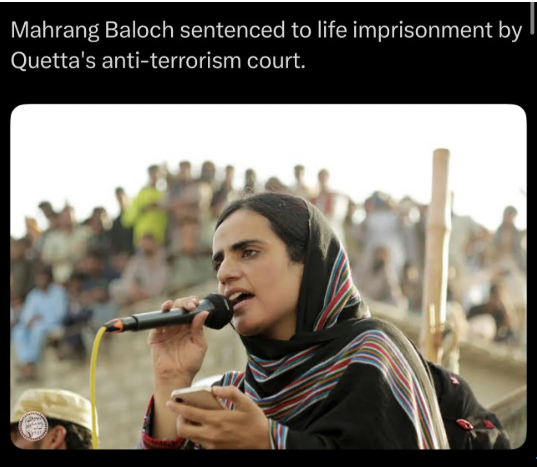
New Delhi: Mahrang Baloch, the public face of Baloch freedom fighters, has been sentenced for life in a prison, the media reported on Tuesday.
A military-controlled “anti-terrorism” kangaroo court in Quetta handed down the sentence to Mahrang Baloch, and activist Sibghatullah Shah. Both were tried through a video link from Quetta district jail. Mahrang Baloch has been in prison for more than a year.
The Baloch Movement has been demanding accountability for alleged forced disappearances, extrajudicial killings and other human rights violations in Baluchistan.
The life sentence given to human rights activist Mahrang Baloch, 32, in Pakistan on Monday has led civil society members, politicians and journalists to lament ‘the death of judiciary’ in the country. They say, “The hard state” is weakening the foundations of Pakistan.
“This is the funeral of the constitution, law, justice, and democracy—may it depart with great fanfare,” Akhtar Mengal, President of Baluchistan National Party, wrote on X.
“In the past two weeks, Gilgit-Baltistan elections were rigged, JAAC in Kashmir was declared a banned organization, PTI’s leaders in Kot Lakhpat were sentenced to 10 years imprisonment. Now, Mahrang Baloch has been handed a life sentence. “Hard state” is weakening the foundations of Pakistan,” Pakistani activist and politician Ammar Ali Jan wrote on X.
Trial in secrecy
Mahrang’s activism made her among TIME Magazine’s 100 most influential people in the world. She was also nominated for the 2025 Nobel Peace Prize. Her father, Abdul Gaffar Langove, a Baloch activist, was allegedly killed by Pakistani armed forces in 2024.
Her organization, the Baloch Yakjehti Committee (BYC), is carrying out long marches, sit-ins and demonstrations, drawing thousands of participants, particularly relatives of missing persons in Balochistan. Authorities, however, have repeatedly accused the organization of maintaining links with separatist militants. The group has consistently denied such allegations.
State investigators traced the case against Mahrang to March 2025, when militants attacked the Jaffar Express train, killing at least 26 people, Hum News reported.
She was arrested in March 2025, under the Maintenance of Public Order Ordinance. It was days after protests erupted across Baluchistan following a police crackdown on demonstrators in Quetta. The protests were organized around allegations of human rights violations committed against ethnic groups of Baluchistan.
According to local reports, prosecutors also claimed that a police officer, Shabbir, died after being struck by a stone during a BYC-led protest in Gwadar. The state held Mahrang Baloch and her co-accused legally responsible for the death and charged them under Pakistan’s anti-terrorism laws.
‘Lopsided and prejudiced’
The Human Rights Commission of Pakistan (HRCP) and Aurat March also condemned the sentencing.
“Regrettably, the state has continued its policy of dealing with advocacy for fundamental rights in the same way as it deals with militancy, leading to executive and judicial decisions that are lopsided and prejudiced,” HRCP wrote on X.
Activists and civil society members rallied behind Mahrang.
Jamil Baloch, a political activist, described the proceedings as a “faceless trial” conducted behind prison walls and lacking transparency.
“The accused were denied the fundamental right to a fair, open defence,” he wrote in a post on Instagram, calling the verdict a form of “political vengeance”.
“This sentencing exposes a terrifying pattern of the Pakistani state: the criminalization of dissent. When bullets, threats, and enforced disappearances fail to break the resolve of human rights defenders, the state resorts to “judicial terrorism.” They use draconian antiterrorism laws to lock away peaceful activists, branding them as enemies of the state.”
“Mahrang Baloch and Sibgatullah getting life imprisonment is not only harsh but unfortunate. It sends out a clear message to other activists across Pakistan that peaceful activism is not tolerated,” former Dawn journalist Sahar Baloch wrote on

Comments are closed.