
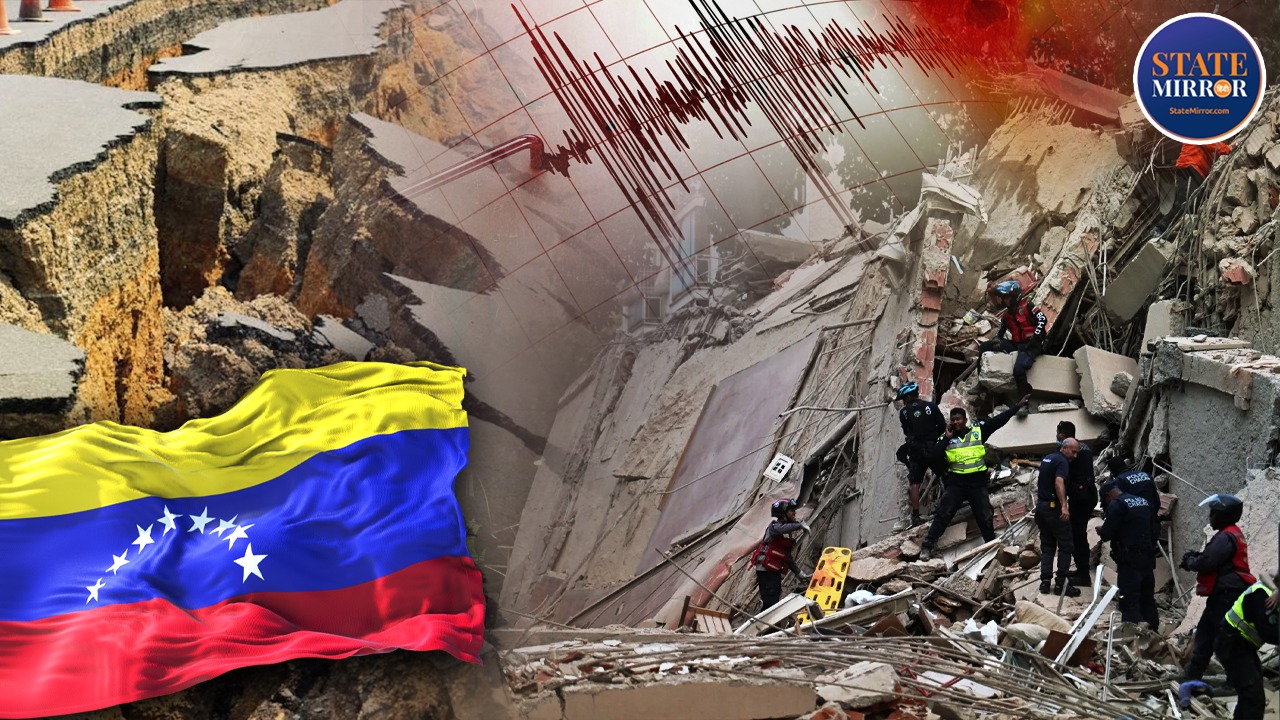
Why and how such a severe earthquake occurred in Venezuela, understand the geographical situation there, Explainer

The powerful earthquake in Venezuela has once again drawn the world’s attention towards the geographical sensitivity of this South American country. The strong tremors felt in many areas including the capital Caracas caused huge destruction and spread panic among the people. According to experts, this is not a sudden natural phenomenon, but is the result of the activities of tectonic plates active for millions of years. Constantly increasing pressure between the Caribbean and South American plates, active fault lines and shallow seismic centers made this disaster more dangerous.
After all, why is Venezuela so sensitive to earthquakes and how did this earthquake prove to be so devastating? Let us understand in detail.
country of south america Venezuela Once again it has been hit by a severe earthquake. On June 24, 2026, two powerful earthquakes of magnitude 7.2 and 7.5 occurred in the northern coastal region of the country at an interval of just 39 seconds, causing buildings to collapse and massive damage in many cities including the capital Caracas. According to the US Geological Survey (USGS), the epicenter of the earthquake was located near the Caribbean coast west of Caracas and its depth was relatively shallow, due to which the impact of the tremors was more devastating.
Why is Venezuela a dangerous zone?
Venezuela’s geographical location makes it vulnerable to earthquakes. This country is located on the border of two major tectonic plates, the Caribbean Plate and the South American Plate. There is constant pressure and collision between these two plates. When this pressure increases too much and the rocks cannot bear it, then energy is suddenly released, which we feel as an earthquake.
According to experts, the Caribbean Plate is moving towards the east, while the South American Plate is moving in a different direction relative to it. This complex collision creates many active fault lines, which periodically produce large earthquakes.
How did this earthquake become devastating?
Scientists are calling this earthquake a “seismic doublet”. This means that two major earthquakes occurred in almost the same area within a very short period of time. The first quake of 7.2 magnitude was followed only 39 seconds later by a more powerful earthquake of 7.5 magnitude.
Moreover, the depth of the earthquake was only about 10 to 13 kilometers. Shallow earthquakes generally cause more damage because their energy is dissipated much less before reaching the ground surface. This is why buildings in Caracas and surrounding areas were heavily damaged.
What does earthquake history say?
The history of Venezuela is full of major earthquakes. In 1812, a 7.7 magnitude earthquake struck Caracas, killing 15,000 to 20,000 people. Hundreds of people were also killed in the 1967 Caracas earthquake. In 2018, an earthquake of 7.3 magnitude occurred in the eastern part of the country, whose tremors were felt in many neighboring countries. There is a possibility of thousands of people dying in this earthquake. This history shows that Venezuela is not just a country that experiences occasional earthquakes, but it is also one of the most seismically active areas in the world.
Seismologists say that it is normal for aftershocks (follow-up earthquakes) to occur after such big tremors. Sometimes these aftershocks are also very powerful and can collapse already damaged buildings. Officials have advised people to stay away from weak structures and remain alert.
Experts say that this terrible earthquake in Venezuela was not the result of any one sudden event, but is the result of tectonic processes active for millions of years. The continuous movement between the Caribbean and South American plates, the presence of active fault lines, the shallow center and the occurrence of double earthquakes combined to make this disaster extremely destructive. This is the reason why Venezuela is not considered completely free from the danger of major earthquakes in the future.

Comments are closed.