
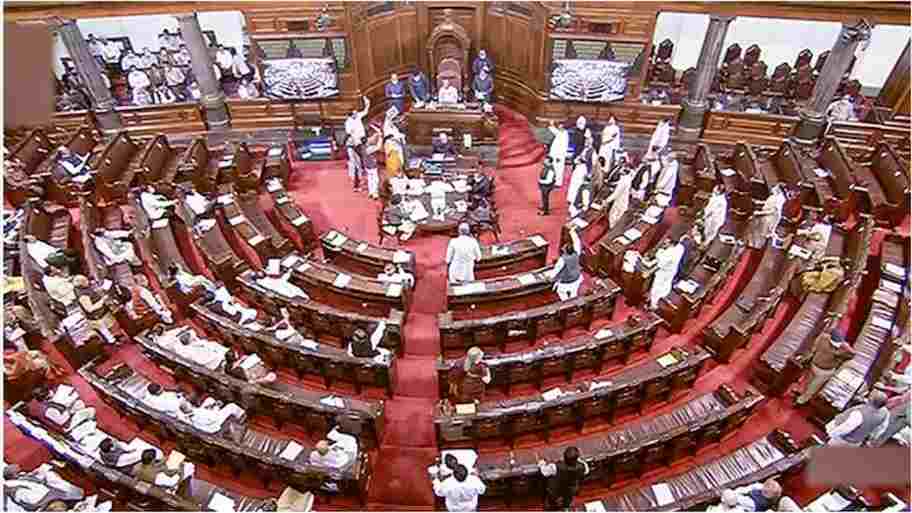
Rajya Sabha Number Game: Mathematics changed with the oath of newly elected MPs; Is NDA going to create history in the Upper House?

A big news is coming out from the country’s politics and the Upper House of the Parliament (Rajya Sabha). With the swearing in of the newly elected Rajya Sabha MPs, the political equation of the House has completely changed. The Bharatiya Janata Party (BJP) led National Democratic Alliance (NDA) has now become heavier and stronger in the Rajya Sabha than ever before. After this major reshuffle, the Modi government seems to have a big chance to achieve the historic figure of ‘two-thirds majority’ in the Upper House. If the government tries to implement major constitutional amendment bills related to increasing (delimitation) of Lok Sabha seats in the upcoming sessions and implementing 33% reservation for women in the upcoming general elections, then this new mathematics of Rajya Sabha is going to prove to be a game changer. On the strength of independents and nominated MPs, NDA’s own number of MPs in the Rajya Sabha, which currently has 242 effective members, has increased to 141, beyond the simple majority. Apart from this, it is certain that the government will also get the support of 10 nominated and independent MPs during the legislative work. Including these two, the confirmed tally of NDA reaches 151, which is much ahead of the simple majority required to pass any normal bill in the House. However, the NDA is still 11 seats short of the magic figure to touch the threshold of two-thirds majority required for major decisions like constitutional amendment. BJD and YSR Congress will play the role of kingmakers. In this new equation of Parliament, two regional forces – Odisha’s Biju Janata Dal (BJD – 5 MPs) and Andhra Pradesh’s YSR Congress Party (YSRCP – 4 MPs) are currently seen in the role of kingmakers. These two parties are neither part of NDA nor associated with the opposition ‘INDIA’ block. But parliamentary history is witness to the fact that in the past both these parties have openly supported the big and main legislative agenda of the Central Government on many complex issues. If the government gets the indirect or direct support of these 9 MPs, then the graph of NDA in Rajya Sabha will directly reach 160. Will ‘magical 164’ bring by-elections and opposition rebellion? Mathematics of Constitution Amendment: Two-third majority in the Rajya Sabha requires 164 votes in the case of the entire House, and the NDA is now very close to it. By-elections are going to be held on three vacant Rajya Sabha seats of West Bengal in the coming time. Considering the number of present BJP MLAs in the state assembly, NDA’s victory on these seats is considered almost certain, due to which this figure can reach 163. Along with this, rebel groups of Trinamool Congress (TMC) claim that some more MPs of the party may change sides in the coming days. If this happens, it will be very easy for NDA to achieve the magic figure of 164. Will the path to Lok Sabha be easy due to disunity in the opposition? While the path seems completely clear for the government in the Rajya Sabha, the real test is to be held in the Lok Sabha. However, the internal discord in the opposition camp has dashed the hopes of the ruling party. There are rumblings of rebellion within Trinamool Congress (TMC), which is the fourth largest party in Parliament, while in Tamil Nadu, reports of rift between DMK and Congress have weakened the position of the opposition ‘INDIA’ alliance. If the merger of rebel factions of TMC and Shiv Sena (UBT) is given formal green signal by the Lok Sabha Speaker, then the numerical strength of NDA in the Lok Sabha will also increase unexpectedly. However, despite this, it will still be a challenging task for the NDA to reach the huge figure of 360 required for constitutional amendment in the 540-member lower house.

Comments are closed.