

Trump Praises Tariffs in Michigan as Supporters Voice Cost Concerns/ TezzBuzz/ WASHINGTON/ J. Mansour/ President Donald Trump promoted his tariffs during a Michigan visit, claiming they had strengthened automakers and the state’s economy. Economic data shows continued manufacturing losses and higher business costs, while many voters blame tariffs and the Iran war for rising prices. Even several committed Trump supporters acknowledged financial hardship but said they believe the policies will produce long-term benefits.
Quick Look
- Trump promoted his tariff policies at a General Motors event.
- He claimed automakers were performing better than ever.
- Trump also said “Michigan is thriving.”
- Tariffs have increased costs for businesses and contributed to inflation.
- Michigan’s economy relies heavily on trade with Canada.
- Trump plans 50% tariffs on many Canadian imports.
- Automakers have warned that tariffs raise production costs.
- GM, Ford, Stellantis and Toyota have announced future U.S. investments.
- Michigan lost 8,300 manufacturing jobs after the “Liberation Day” tariffs.
- Auto-parts employment fell by approximately 4,000 jobs through June.
- Some Trump supporters acknowledged that prices remain too high.
- Trump endorsed John James in Michigan’s Republican gubernatorial primary.
- Mike Rogers is again running for the U.S. Senate.
- Michigan’s primary is scheduled for Tuesday.
- The November races could help determine control of Congress.

Deep Look
Trump promotes tariffs at GM event
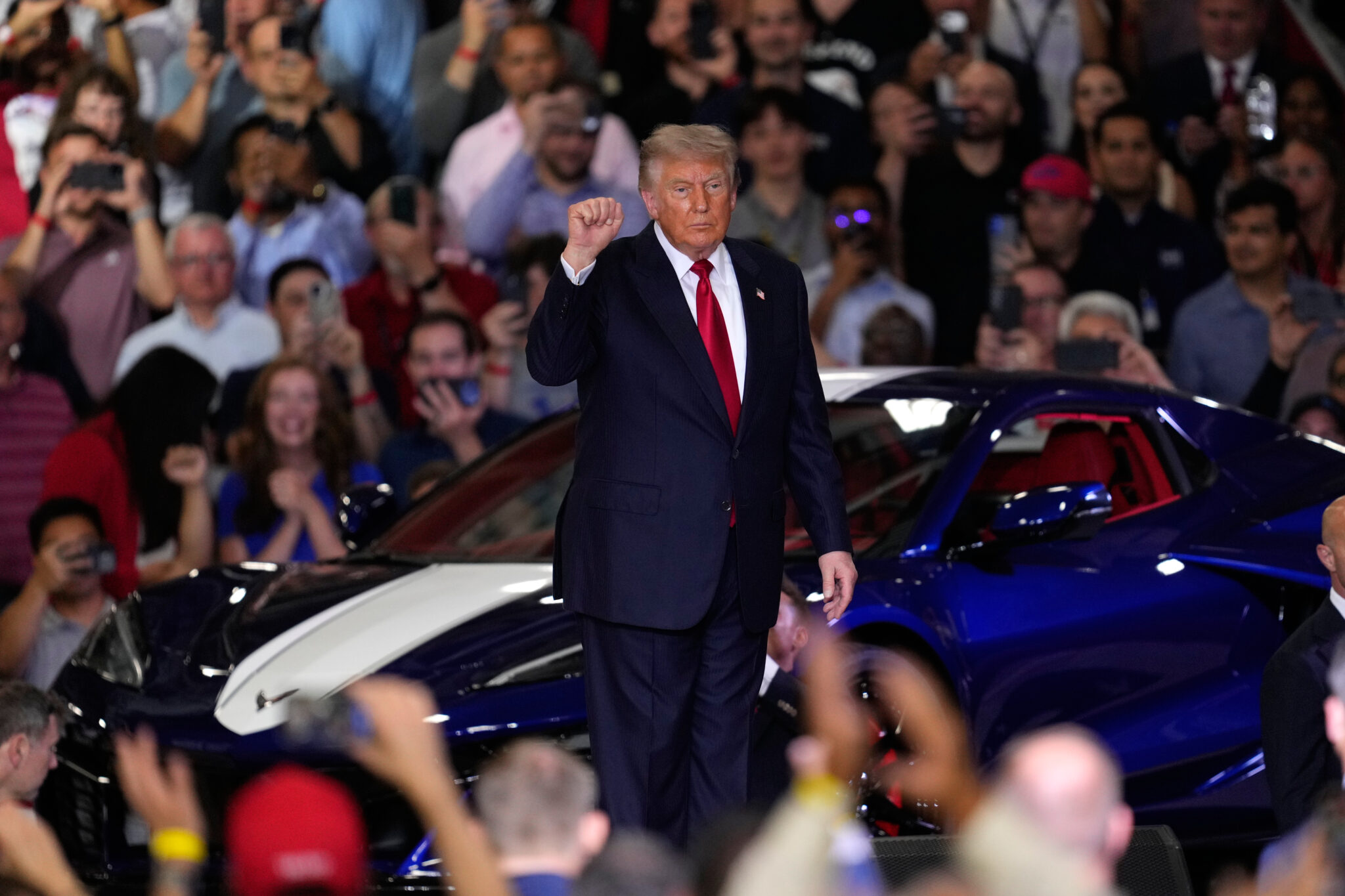
MILFORD, Mich. — President Donald Trump praised his tariff policies during a visit to a General Motors facility in Michigan, arguing that import taxes had strengthened American automakers and revitalized the state’s economy.
While traveling to the event, Trump declared that “car companies are doing better than they’ve ever done” because of his policies.
“All because of Trump,” he said.
The Republican president repeated that message while examining new GM vehicles.
He predicted that “it’s amazing what tariffs will do for General Motors” before signing a white Chevrolet Corvette created to commemorate the United States’ 250th anniversary.
Trump later told cheering supporters that “Michigan is thriving.”
Available economic indicators present a more complicated picture.
Tariffs add to inflation concerns
Businesses in Michigan and across the United States have paid billions of dollars in tariff costs.
Import taxes can protect domestic producers from foreign competition, but they also increase the price of materials, components and finished goods entering the country.
Companies may absorb the additional costs, reduce investment or pass them to consumers through higher prices.
Trump has repeatedly promoted his business experience as evidence that he could eliminate inflation.
Instead, inflation has remained elevated, with tariffs joining higher energy costs and other factors placing pressure on household budgets.
Iran war pushes energy prices higher
The conflict with Iran has disrupted global energy markets and increased gasoline prices.
Iranian attacks and restrictions on shipping through the Strait of Hormuz have raised the cost of oil and created uncertainty about future supplies.
Higher fuel prices affect consumers directly at gas stations and indirectly through increased transportation and production expenses.
The combination of tariffs and war-related energy costs has weakened confidence in the economy and contributed to Trump’s low approval ratings.
Those concerns are especially important before the November midterms, when Republicans will attempt to retain control of Congress.
Michigan puts Trump’s claims to test
Michigan is one of the clearest places for the president’s optimistic economic message to collide with public concerns about affordability.
The state’s economy depends heavily on manufacturing, automobile production and international supply chains.
Trump carried Michigan in 2016 and again in 2024.
The state supported Democrat Joe Biden in 2020, demonstrating its continuing position as a highly competitive battleground.
Michigan holds its primary Tuesday, with major gubernatorial and Senate contests on both parties’ ballots.
Supporters acknowledge financial strain
The crowd at Trump’s Milford rally greeted him enthusiastically.
Some loyal supporters nevertheless acknowledged that high prices and tariffs had created short-term economic pain.
Lisa Scherer, 64, previously owned a landscaping business and worked as a bus driver and union steward.
She said expensive gasoline is “hurting a lot” and that it is “very rough” to afford daily necessities.
“But I’m just hoping, if we hang in there,” she said, emphasizing she still thinks the president is doing a good job.
Her comments reflected a broader sentiment among some rally attendees: continued personal support for Trump despite concerns about the immediate consequences of his economic policies.
Michigan and Canada share supply chains
Michigan’s automobile industry is closely integrated with Canada.
Vehicles and components can cross the border several times during production, meaning tariffs may repeatedly increase costs along the supply chain.
Decades of trade policies reduced barriers between the two countries and encouraged manufacturers to organize production on both sides of the border.
Those policies included the United States-Mexico-Canada Agreement negotiated during Trump’s first term.
Trump declined to renew the trade pact, initiating what could become years of negotiations over a replacement.
Trump targets Canadian imports
The Supreme Court struck down many tariffs Trump imposed after returning to the White House.
His administration responded by establishing new import taxes through other legal authorities.
It recently invoked the Tariff Act of 1930 while accusing Canada of discriminatory trade practices.
The administration plans to impose tariffs of 50% on many Canadian imports.
Such duties could have an especially strong effect in Michigan because of its proximity to Canada and its reliance on cross-border automotive trade.
GM welcomes presidential visit
General Motors said it was “honored to spend time showcasing our vehicles and facilities” for Trump.
Automakers have nevertheless warned for years that tariffs increase production expenses.
The industry’s concerns prompted Trump to offer relief from tariffs on imported auto parts.
An initially temporary rebate was extended in October through 2030.
The extension suggests that the administration recognizes the difficulty manufacturers face in immediately replacing foreign components with domestically produced alternatives.
Pollster questions Trump’s economic message
Veteran Michigan pollster Bernie Porn said Trump’s optimistic claims could not conceal voter anxiety over inflation and affordability.
“When I was listening to him, I said, ‘What planet are you on?’” Porn said.
He also noted that some Republicans nationally worry their voters will lack motivation to participate in the November elections.
“I doubt if Michigan is going to be very different,” he said.
Porn argued that Trump could become a political burden for Republican candidates.
“He is like an anchor around Republicans,” Porn said.
Supporter urges voters to see larger strategy
Other rally attendees strongly defended Trump’s tariff policies.
Joe Miskovich, 57, owns an aerospace business and lives in Fenton, approximately 20 miles north of Milford.
He said “the American public needs to look at the bigger picture.”
People must recognize, he said, that “yes, granted, there might be a little higher increase in price. But the long-term effect is going to be absolutely positive to the nation.”
Supporters such as Miskovich view the immediate price increases as an investment in rebuilding American manufacturing and reducing dependence on foreign suppliers.
Trump shapes Michigan Republican primary
Trump has used endorsements in Michigan and other states to support Republican candidates he considers loyal and helpful to his agenda.
In Michigan’s gubernatorial primary, he endorsed Rep. John James over businessman Perry Johnson.
Trump’s support could influence Republican primary voters and strengthen James’ position before Tuesday’s vote.
The endorsement also reinforces the extent to which Republican candidates remain tied to the president’s political organization and policy priorities.
Mike Rogers campaigns for Senate
Former Rep. Mike Rogers also spoke at the Milford rally.
Rogers is again running for the U.S. Senate after narrowly losing to Democratic Sen. Elissa Slotkin two years earlier.
He argued that Michigan needs a senator who will advance Trump’s agenda instead of obstructing it.
“This is the time that we will stand up and get Michigan up off of her knees,” he said at Trump’s rally.
The Senate race could become one of the most closely watched contests of the midterms.
Democrats face competitive Senate primary
Much of the national attention has focused on Michigan’s Democratic Senate primary.
Rep. Haley Stevens is competing against Abdul El-Sayed, a progressive favorite.
The winner is expected to face Rogers in the general election.
The race will test whether Michigan voters respond more strongly to Trump’s promises of future industrial growth or Democratic arguments about present-day inflation and affordability.
Economic conditions could prove decisive in a state where margins are often narrow.
Fixed-income supporter feels overlooked
Scherer traveled nearly five hours from her home near Columbus, Ohio, to attend Trump’s rally.
Although she remains committed to the president, she said his administration had neglected some lower-income supporters.
“I’m brutally honest, like Trump is, aren’t I? He’s forgot about the people on a fixed income,” said Scherer, who lives on Social Security benefits of $1,100 per month. “But I look at it like, I guess, no pain, no gain.”
Her comments highlight the pressure inflation places on retirees and others whose incomes do not rise quickly with consumer prices.
Higher gasoline, food and household costs consume a larger share of limited monthly benefits.
Michigan Republican leader praises tariffs
Michigan House Speaker Matt Hall defended Trump’s trade policies during the rally.
He also credited the president with announcing a new fighter jet mission that protected the future of Selfridge Air National Guard Base.
“This is what putting Michigan first looks like,” he said.
Republicans are presenting tariffs and military investments as part of a broader strategy to create jobs, protect American industry and strengthen Michigan’s economy.
The timeline for many promised manufacturing benefits, however, extends beyond the upcoming election.
GM plans future U.S. production
General Motors announced in June 2025 that it would invest $4 billion to transfer some vehicle production from Mexico to the United States.
The shift is expected to begin next year.
Ford and Stellantis, the parent company of Chrysler, have announced similar plans for expanding domestic operations on roughly the same schedule.
The investments could eventually increase American factory employment and reduce exposure to tariffs.
Those benefits have not yet appeared fully in Michigan’s labor market.
Toyota announces Texas investment
Toyota said it would invest $3.6 billion and move production of its Tacoma pickup truck from Mexico to Texas.
The relocation is expected to take place over approximately four years.
Such announcements support Trump’s argument that tariffs encourage companies to manufacture more products inside the United States.
They also demonstrate that changing international production systems is expensive and time-consuming.
Consumers and manufacturers may face higher costs for years before new domestic facilities reach full production.
Michigan manufacturing jobs decline
Michigan experienced only modest growth in automobile-sector employment during Trump’s second term.
Jobs connected to auto-parts manufacturing fell by approximately 4,000 through June compared with the same month one year earlier.
The state has lost 8,300 manufacturing positions since Trump announced his “Liberation Day” tariffs in April 2025, according to the Bureau of Labor Statistics.
Those figures conflict with the president’s broad claim that Michigan is already thriving because of the trade policy.
Future factory investments could alter the trend, but they have not yet offset the documented job losses.
Rally remains firmly supportive
Despite economic concerns, the event remained overwhelmingly favorable toward Trump.
When the president recalled meeting a “beautiful” waitress in Las Vegas during the 2024 campaign, a supporter shouted, “You’re beautiful!”
The audience later chanted “10 more years!” as Trump discussed leaving office after January 2029.
The enthusiasm showed that economic dissatisfaction has not necessarily broken the personal loyalty many Republican voters feel toward him.
Supporters continue offering trust
Rose Stroud, 75, traveled from Commerce, Michigan, to attend the rally.
“Trump is, like, No. 1. You know, he’s the best,” Stroud said. “He thinks about the people, about what they need.”
Other supporters argued that voters should remain patient even when the president’s policies produce consequences they dislike.
They believe Trump’s strategy may require time before its intended results become clear.
That trust could help Republicans maintain support despite high prices and current manufacturing losses.
Handyman describes short-term pain
Roy Parks, 49, is a self-employed handyman, photographer and videographer from Milford.
He defended Trump’s willingness to pursue policies that may initially appear confusing or harmful.
“There’s always a method to the madness, and people sometimes don’t understand or get it,” Parks said. “But there’s always a reason he’s doing things a certain way, and it may not make sense at first, but after six, 12 months, it all comes together.”
He applied that argument directly to tariffs.
“You may not like it at first, but it’s a short-term pinch, short-term pain, but long-term good. It works out in the end. It’s for the best.”
“When you rip off the Band-Aid right away, it stings,” Parks added. “But, after a few minutes, there’s no pain. You have to go through a little bit of pain at first to get to long-term good.”
The midterm elections will help determine whether enough Michigan voters share that confidence or decide that the immediate costs have become too high.
More on US News
Comments are closed.