
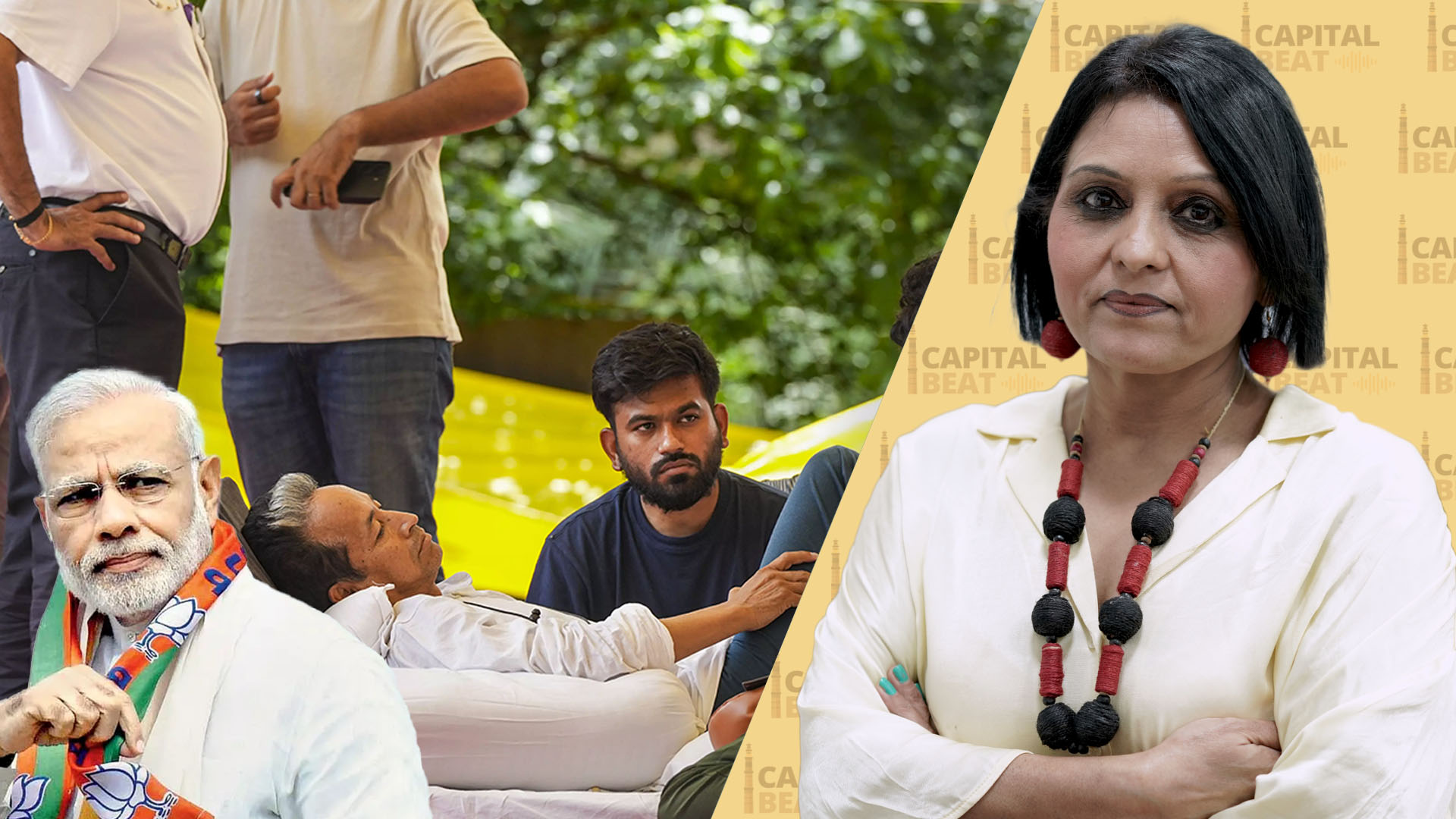

The worsening health of climate activist Sonam Wangchuk, who has entered the 17th day of his indefinite hunger strike, has sparked renewed debate over the Centre’s response to public protests. The Federal spoke to senior journalist T K Rajalakshmi, author and policy expert Pushparaj Deshpande, and researcher and YouTuber Anchal Gupta on Capital Beat to examine the political, social and democratic questions surrounding the protest.
Rajalakshmi said Sonam Wangchuk’s deteriorating health warranted concern, but argued that the movement would need to expand beyond Delhi to build sustained political momentum. Other panellists echoed this view, agreeing that broader public mobilisation across the country would be essential for the campaign to achieve lasting impact.
The discussion came against the backdrop of reports that Wangchuk had lost significant weight, was experiencing muscle loss and recurring low blood sugar, while doctors continued to monitor his condition. The panel also examined the role of political parties, civil society and the media in shaping the movement.
Government’s response
Opening the discussion, Anchal Gupta drew parallels with the late environmental activist Prof. G.D. Agrawal (Swami Gyan Swaroop Sanand), who died after a prolonged hunger strike demanding protection of the Ganga.
Also read: Eminent voices urge end to hunger strike as Wangchuk’s health worsens
According to Gupta, the current government’s response reflects a larger political approach in which public movements are assessed primarily through their electoral impact.
He argued that unlike previous governments, which attempted negotiations during major protests, the present dispensation has shown little inclination towards dialogue. Gupta said this reflected what he described as a leadership style focused on projecting strength rather than consensus-building.
He also contended that democratic institutions had gradually weakened over the past decade and suggested that this political environment explained why the government appeared confident in ignoring protests that did not immediately threaten its political position.
Opposition’s role
The discussion also turned towards the Opposition, particularly Congress leader Rahul Gandhi, with the moderator raising questions about criticism on social media over his perceived absence from Wangchuk’s protest.
Responding to the criticism, Pushparaj Deshpande argued that expecting every national protest to converge in Delhi was neither practical nor effective. He maintained that India, with more than 800 districts, required decentralised mass movements rather than protests concentrated at Jantar Mantar.
Using the NEET controversy as an example, Deshpande said student mobilisation should occur across districts and states instead of remaining confined to the national capital.
He further observed that while Rahul Gandhi, as Leader of the Opposition, faced greater public expectations, numerous protests concerning examinations and education were already taking place across the country. According to him, Congress and affiliated organisations had organised demonstrations in multiple cities against examination irregularities, though these received comparatively less media attention.
Delhi-centric protests
Deshpande questioned whether protests held exclusively in Delhi had succeeded in forcing policy reversals over the past decade, citing the farmers’ agitation as one of the few notable exceptions.
While reiterating his belief in the importance of satyagraha and civil disobedience, he argued that movements would need to expand geographically before they could compel governments to reconsider policy decisions.
Also read: CJP announces Parliament march after 23 days of protest; Wangchuk still on fast
He also cautioned against reducing the movement to demands for the resignation of a single minister, saying deeper structural reforms were necessary to address problems within India’s education system.
Throughout the discussion, panelists repeatedly stressed that concerns over examination systems, higher education funding and institutional reforms extended far beyond one protest or one individual, making broader public participation essential.
Senior journalist T.K. Rajalakshmi agreed that Wangchuk’s health deserved attention but argued that the movement needed to grow beyond Delhi if it hoped to achieve lasting political impact.
She noted that several student organisations, including the NSUI and Left-affiliated groups, had been raising issues relating to examination reforms and education in different parts of the country. However, these protests often received little attention from mainstream media.
According to Rajalakshmi, while Wangchuk’s protest had drawn support from prominent public figures, including actors and political leaders, broader issues affecting India’s education system required sustained nationwide mobilisation rather than symbolic gestures.
She also observed that the government may avoid making immediate concessions because doing so could be perceived as political weakness. In her assessment, unless the movement expanded significantly in scale, the Centre was unlikely to alter its position.
Structural reforms
The panel agreed that the issues raised during the protest extended well beyond demands for ministerial accountability.
Deshpande argued that structural concerns such as declining higher education funding, rising university fees and institutional appointments deserved equal attention.
Also read: Can Wangchuk’s hunger strike evolve into education reforms movement? | Capital Beat
He maintained that replacing an individual minister would not resolve systemic problems and called for broader reforms addressing the governance of higher education.
Drawing comparisons with previous mass movements, he argued that successful campaigns required sustained organisation across districts rather than remaining confined to a handful of protest sites.
Anchal Gupta echoed this view, saying the movement would need greater participation from opposition parties, civil society groups, youth organisations and student bodies if it hoped to generate the kind of national pressure that could influence government policy.
What’s next?
The discussion also focused on the planned “Chalo Sansad” march scheduled for July 20 and whether it could mark a turning point in the campaign.
Rajalakshmi said the protest had succeeded in highlighting concerns over the education system but questioned whether the organisers possessed the organisational capacity to sustain a nationwide movement.
She argued that future mobilisation would depend largely on established student organisations and political groups capable of expanding the campaign beyond Delhi.
Gupta, who has frequently visited the protest site, expressed concern that Wangchuk’s health could deteriorate further before the scheduled march. He suggested that medical intervention might become unavoidable if his condition continued to worsen.
While acknowledging uncertainty over how events would unfold, Gupta reiterated that meaningful dialogue between the government and the protesters remained essential.
The panel concluded that the coming days would determine whether Wangchuk’s hunger strike remained an isolated protest or evolved into a broader national movement demanding reforms in India’s education system. They agreed that the government’s response, the Opposition’s participation and the scale of public mobilisation would all shape the next phase of the campaign.

Comments are closed.