
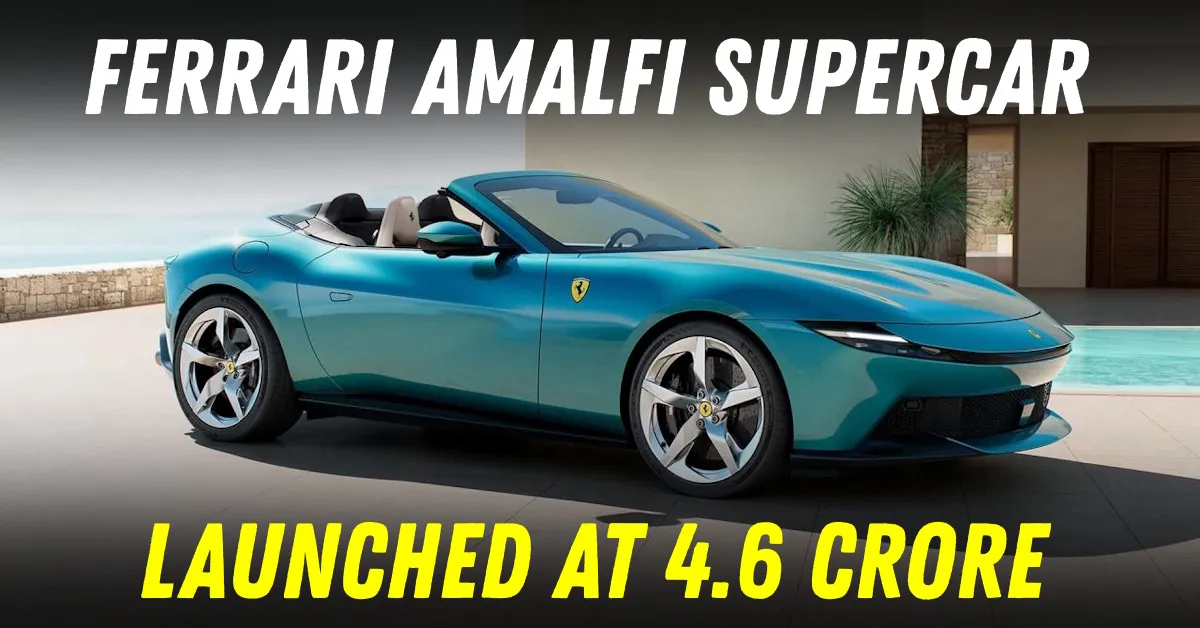

Ferrari has launched the Amalfi Spider at Rs 4.6 crore, before options. The convertible joins the fixed-roof Amalfi in the company’s range only four months after making its global debut in March 2026.
The Spider currently costs Rs 52 lakh more than the Amalfi coupé, which is listed at Rs 4.08 crore before options. That premium does not buy more power or better acceleration. It pays for the folding fabric roof, the additional engineering required by the open body and the experience of driving Ferrari’s front-engined grand tourer with the roof lowered.
Earlier reports had placed the Amalfi coupé at Rs 5.59 crore. However, the current price used for a direct comparison with the Spider is Rs 4.08 crore. Both figures exclude the extensive personalisation that can push the final invoice substantially higher.
The Amalfi Spider uses the same 3.9-litre twin-turbocharged V8 as the coupé. It produces 640 CV, equivalent to approximately 631 bhp, and 760 Nm. An eight-speed dual-clutch gearbox sends power exclusively to the rear wheels.
Ferrari claims the Spider can accelerate from 0-100 km/h in 3.3 seconds and reach 320 km/h. It achieves the same 0-100 km/h time as the coupé despite weighing approximately 86 kg more.
This is not a detuned lifestyle version of the Amalfi. The powertrain, electronic differential and principal vehicle-control systems remain focused on performance. The front-mid-engine layout and 2+2 cabin, however, place it closer to the grand-touring end of Ferrari’s range than to a stripped-out circuit model.
It also uses Ferrari’s brake-by-wire setup and ABS Evo controller. The system estimates the grip available at each wheel and adjusts braking intervention to improve consistency and stability, particularly when braking hard from high speeds.
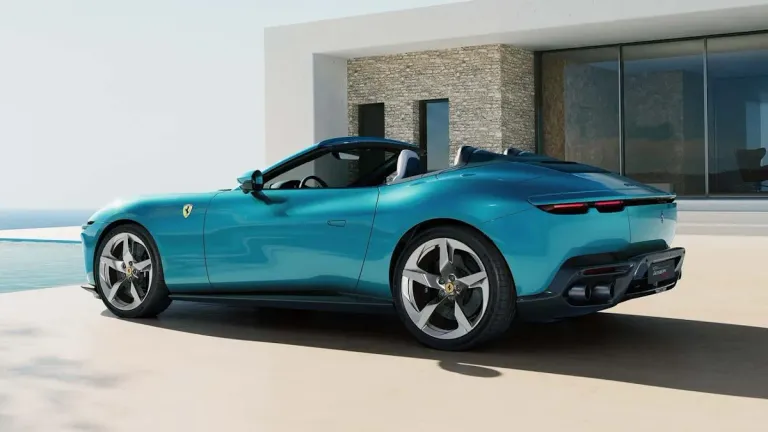
The five-layer fabric roof opens or closes in 13.5 seconds and can be operated at speeds of up to 60 km/h. Ferrari says the multi-layer construction provides thermal and acoustic insulation comparable with one of its fixed roofs.
When folded, the roof mechanism occupies only 220 mm of vertical space. The luggage compartment offers 255 litres with the roof closed and 172 litres when it is lowered. That is enough to preserve some weekend usability, although the Spider loses 83 litres of luggage space in open-top mode.
Wind deflectors incorporated into the rear-seat backrests reduce turbulence in the cabin. The roof is available in several colours and materials, while Rosso Tramonto is offered as a Spider-specific exterior shade.
The rear seats remain better suited to small passengers, bags or additional storage than regular adult use.
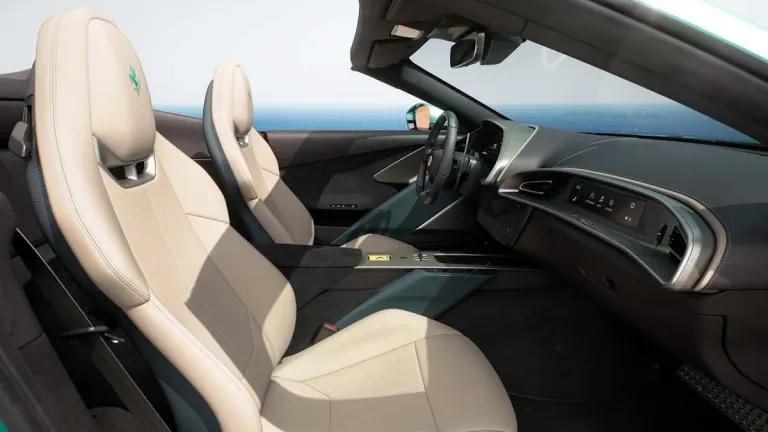
The cabin follows the Amalfi coupé’s dual-cockpit layout. The driver gets a 15.6-inch digital instrument display, while a 10.25-inch central touchscreen handles infotainment functions. The passenger has a separate 8.8-inch display showing vehicle and journey information.
Ferrari has also moved away from the heavily criticised touch-sensitive steering-wheel interface used in some earlier models. The Amalfi uses physical controls and brings back a conventional red engine-start button.
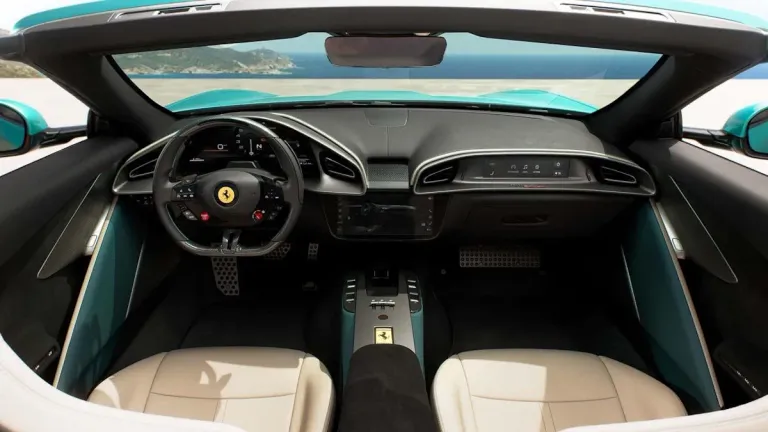
Equipment includes wireless Apple CarPlay and Android Auto, wireless phone charging, connected functions and automatic climate control. Driver-assistance equipment includes adaptive cruise control, autonomous emergency braking, lane-departure warning, lane-keeping assistance, blind-spot monitoring and rear cross-traffic alert.
The Rs 52 lakh premium over the coupé is not a performance upgrade. The coupé is lighter, quieter and has more consistent luggage space. The Spider offers almost identical straight-line performance while adding the open-air experience.
Bookings are open, but Ferrari has not announced a fixed delivery schedule for the market. Production slots, options and individual specifications will determine when each car arrives.
At Rs 4.6 crore before personalisation, the Amalfi Spider is expensive even by grand-tourer standards. But the price is Rs 4.6 crore, not Rs 46 crore, and it buys one of the few modern convertibles capable of combining a front-mounted V8, four-seat packaging and a claimed 320 km/h top speed.
Comments are closed.