
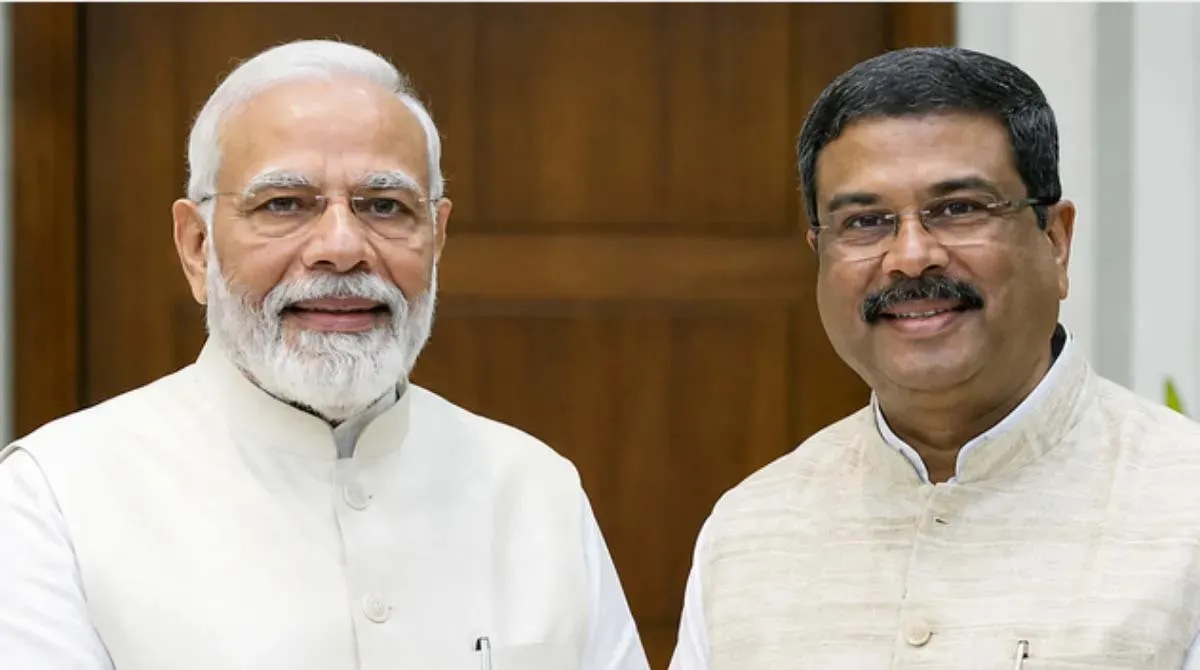

Amidst the ongoing protests at Delhi’s Jantar Mantar, only one demand is resonating the most – Union Education Minister Dharmendra Pradhan should resign in the NEET exam paper leak case. Despite the huge uproar by the opposition and student organizations, at present there is no rumor that Dharmendra Pradhan will be removed from his post.
The history of the governments led by Prime Minister Narendra Modi is witness to the fact that they do not easily accept the resignation of their ministers under the pressure of agitation or opposition. In such a situation, the biggest question arising is that why does the government seem so careless even after this huge protest and what is the real power behind Dharmendra Pradhan’s chair? Let us know the complete inside story behind this.
Dharmendra Pradhan is included among the top seven ministers
Ever since Narendra Modi became the Prime Minister of the country for the first time in 2014, Dharmendra has been among the select seven ministers who have remained a part of the government continuously. The names of Rajnath Singh, Nitin Gadkari, Nirmala Sitharaman, Piyush Goyal, Rao Inderjit Singh and Dr. Jitendra Singh are also included in this special list. Home Minister Amit Shah and Foreign Minister S. Strong leaders like Jaishankar also joined the Modi cabinet only after Dharmendra Pradhan. In his political journey so far, he has handled many very important ministries.
Long tenure as Education Minister and records to come
If we look at his ministries, he was the Minister of Petroleum and Natural Gas from 2014 to 2021, held the Ministry of Skill Development and Entrepreneurship from 2017 to 2024, Minister of Steel from 2019 to 2021 and has been holding the responsibility of the Education Minister of the country since 2021.
Talking about his previous education ministers in Modi government, Smriti Irani held this post for 2 years 36 days, Prakash Javadekar for 2 years 329 days and Ramesh Pokhriyal for 2 years 38 days, whereas Dharmendra Pradhan has held this post for more than 5 years and 13 days. If he continues on this post for some more time, he will soon break the record of Dr. Murli Manohar Joshi (about 6 years and 2 months), who was the Education Minister in the Atal Bihari Vajpayee government.
These 5 big reasons are hidden behind non-resignation
Political experts believe that there are many concrete reasons behind Dharmendra Pradhan not resigning:
- Strong political hold: Dharmendra Pradhan is not an imported leader, rather he has emerged from ABVP and reached the post of President of BJP and Bharatiya Janata Party Yuva Morcha.
- RSS and ideological background: Due to the changes made in the curriculum—such as replacing the history of Mughal rulers with chapters on Indian history and the Emergency—he is considered ideologically very close to the Sangh and the party.
- PMO’s direct view: In the working style of Prime Minister Narendra Modi and Home Minister Amit Shah, the work of every minister is kept under close watch. Had his performance been poor, he would not have remained a minister continuously for 12 years.
- Strategic shortcomings of the movement: The government’s internal assessment is that the ongoing protests have been politicized and the protesting groups have no concrete option or alternative plan.
- Not giving psychological advantage: If Dharmendra Pradhan resigns under pressure from the opposition, it will be the first time in the tenure of the Modi government that a minister has been removed under pressure, which can give the opposition a psychological advantage.

Comments are closed.