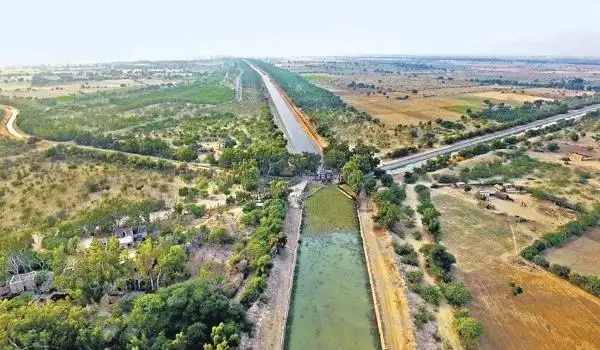
In the desert areas of Rajasthan, where every drop of water was once a struggle, fields now bloom with greenery. This transformation is due largely to the Indira Gandhi Canal Project, one of India’s largest irrigation projects. It was once known as the Rajasthan Canal and before that, the Ganga Canal. This canal not only served as a water supply, but also completely transformed the economy, agriculture, and lives of western Rajasthan.
A Story That Began with the Ganga Canal
The foundation of this massive canal project is linked to the Ganga Canal. The Ganga Canal was built through the efforts of Maharaja Ganga Singh of the Bikaner State. At that time, a large part of Bikaner State was desert and faced severe water shortages. Farmers and herders faced difficult conditions to make a living.
Maharaja Ganga Singh dreamed of bringing water from the Sutlej River to the arid regions of Rajasthan. After extensive efforts, the Ganga Canal Project was completed in 1927. This canal sparked a new era of agriculture in Sri Ganganagar and the surrounding areas. For the first time, large-scale farming became possible in the desert, and the region gradually began to prosper.
The Birth of the Rajasthan Canal Project
After independence, the government launched another major plan to provide water to the vast desert region of western Rajasthan. The Rajasthan Canal Project was launched in 1958. Its objective was to bring water from the rivers of Punjab to the arid areas of Rajasthan.
Under this project, water from the Sutlej and Beas rivers was diverted from the Harike Barrage to Rajasthan’s Jaisalmer, Bikaner, Sriganganagar, Hanumangarh, Churu, and Barmer areas.
How did the Indira Gandhi Canal get its name?
In 1984, the Rajasthan Canal Project was renamed the Indira Gandhi Canal Project. This massive project was named in memory of the then Prime Minister Indira Gandhi.
Today, this canal system is one of India’s longest and largest irrigation canal systems. Its main canal is approximately 650 kilometers long, while the entire network, including its distributaries, stretches for thousands of kilometers.
The Green Revolution in the Desert
The Indira Gandhi Canal brought about a major social and economic transformation in western Rajasthan. Previously, only water-intensive crops like millet and cluster beans were cultivated, but now wheat, cotton, mustard, and other crops were cultivated.
Districts like Sri Ganganagar and Hanumangarh became major agricultural regions of Rajasthan. Many new villages were established, providing new employment opportunities.
Challenges Were Not Abundant
With such a massive project, numerous challenges arose. Waterlogging and soil salinity increased in some areas. Disputes also frequently arose regarding the proper management and distribution of water.
The government promoted drainage systems, water conservation, and modern irrigation techniques to address these problems.
The canal became the lifeline of Rajasthan
The Indira Gandhi Canal is not just a water project, but a story of Rajasthan’s development. It brought a new wave of hope to the Thar Desert. Where once sand dunes were visible as far as the eye could see, today fields are lush.
This journey, which began with the Ganga Canal and reached the Indira Gandhi Canal, has become one of the most transformative projects in Rajasthan’s history. This canal continues to be the lifeline of millions of people and the state’s economy.