Yaghi, who shared the 2025 Nobel Prize in Chemistry with Richard Robson and Susumu Kitagawa for pioneering work on metal-organic frameworks and reticular chemistry, made the comments as he prepares to leave the University of California, Berkeley, for Tsinghua University in Beijing.
His decision to relocate comes as the U.S. research environment faces growing uncertainty. The Trump administration has proposed major changes to federal research funding and tighter restrictions on collaborations with Chinese universities. American institutions are contending with funding cuts and geopolitical tensions, prompting many top scientists to pursue opportunities overseas.
Speaking with Times Higher Education (THE), Yaghi said current U.S. policies are making it harder for scientists to collaborate across borders.
“We’re going exactly in the opposite direction.
“Our budgets are strapped, we have geopolitical issues with immigration and we’re becoming less and less generous with giving visas,” he said.
He warned that increasingly limited visa access is creating frustration and uncertainty among young scientists.
“This creates that despair and hopelessness that scientists under 30 are feeling,” Yaghi said in July at the Lindau Nobel Laureate Meeting, a scientific summit held annually in southern Germany.
He also highlighted the challenges faced by academic couples as research funding declines and visas become more difficult to obtain, making it harder for both partners to pursue careers in the same country.
“It’s hard to be married and your spouse is in another country, and you’re trying to be in a lab and make discoveries. You need stability of home to have the freedom in your mind to do science – to attend to the arduous process of doing science, learning and ultimately making discoveries,” he told THE.
Yaghi argued that easing visa restrictions should be accompanied by greater investment in international research partnerships. His own projects involve scientists from several countries, including China, Russia, Saudi Arabia, and the United States.
He called for universities to treat international engagement as a core mission alongside research, education, and public service. Stronger global cooperation, he noted, helps develop scientific talent and ultimately benefits innovation and economic growth.
At the same time, Yaghi cautioned that wealthier research nations should avoid simply attracting talent away from developing countries. Instead, he emphasized that opportunities should be created where scientists actually live.
|
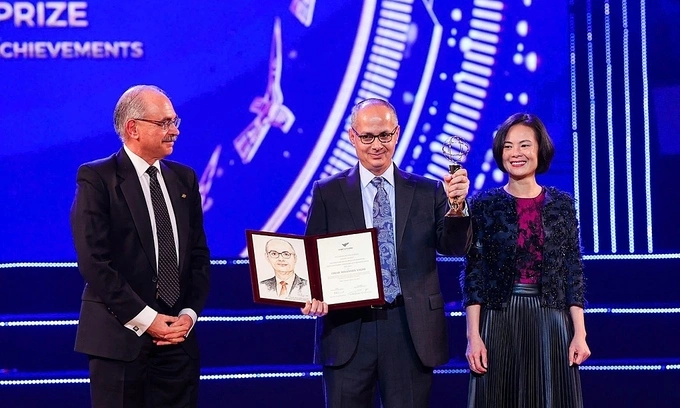
Professor Omar Yaghi receives the Special Prize for “Innovators with Outstanding Achievements in Emerging Fields” at the VinFuture Prize ceremony in Hanoi in 2021. Photo by Read/Giang Huy |
Born in Jordan to a Palestinian refugee family, Yaghi, 61, moved to the United States as a teenager and built a distinguished academic career. He held positions at Arizona State University, the University of Michigan, and the University of California, Los Angeles (2006-2011), before joining the University of California, Berkeley (2012-2026).
He is best known for pioneering metal-organic frameworks, highly porous materials capable of capturing and storing gases. According to Forbes, this breakthrough has driven significant advances in clean energy technologies and atmospheric water harvesting.
Before traveling to Stockholm to receive his Nobel Prize last year, Yaghi told The New York Times that he was concerned the Trump administration’s immigration policies could undermine the U.S. scientific ecosystem by weakening the universities, companies, and government institutions that drive research and innovation.
“We have to know that people coming from different backgrounds improve the level for everybody involved.
“That’s an amazing story. Great thinkers can improve not only the U.S. but the world,” he said.
He launched the Yaghi Science Institute last month as a planned network across roughly 30 countries. The network will support local researchers through university-based institutes combining basic research, commercialization, artificial intelligence, and robotics.
According to a report published on the website of Atoco, a California-based deep-tech climate technology startup founded by Yaghi to commercialize his Nobel Prize-winning breakthroughs in reticular chemistry, the institute is a non-profit, global research and education endeavor designed to transcend geographical and cultural borders.
The institute focuses on applying foundational molecular design to sustainability challenges through a collaborative network connecting academic research with Atoco’s commercial labs.
“The Yaghi Science Initiative is built on the conviction that science is an equalizing force in the lives of people everywhere and that discovery is a universal language. By establishing these global institutes, we are creating a global environment where young scholars can work together to solve problems that affect us all,” he said.
At Tsinghua University, Yaghi plans to advance artificial intelligence-driven research on ultra-porous materials capable of capturing pollution and extracting water from the atmosphere.
His move to one of China’s top universities is widely viewed as a major boost for Chinese science and a sign of a growing shift of research talent from the West to the East. The appointment underscores China’s long-term push to strengthen its research universities and attract leading scientists from around the world.
Once known mainly for sending top talent overseas, China is now increasingly drawing internationally renowned researchers to its own institutions. Universities such as Tsinghua have emerged as global research powerhouses, rivaling many leading U.S. institutions in research output, funding, and international influence.