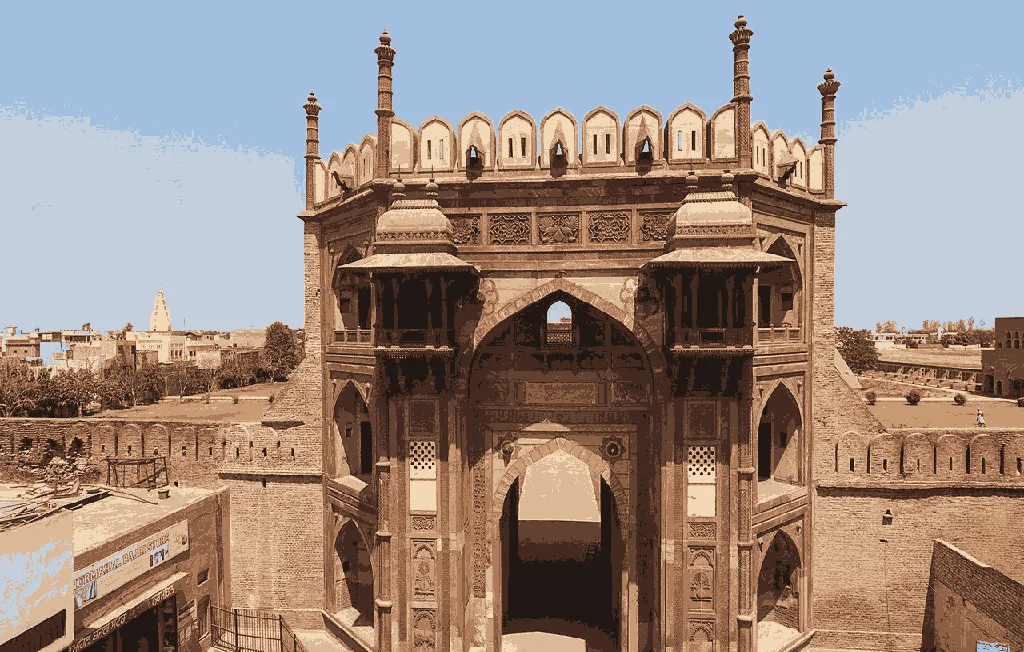
Nurmahal Sarai: You’ll read and hear many love stories from the Mughal era, which are still considered immortal love stories. The love stories of Jodha Akbar, Salim Anarkali, Shah Jahan and Mumtaz… But among these Mughal love stories, there’s one that began with a hunger for power and ended with the throne, a woman who chose war over renunciation. Where Mughal emperors reigned supreme, a woman’s love not only brought a ruler like Jahangir to his feet but also gave him the power of the throne. Yes, we’re talking about Noor Jahan, who always walked shoulder to shoulder with Jahangir. But did you know that Noor Jahan wasn’t just her name; it was a title bestowed by Jahangir? What was her history before becoming Noor Jahan? And how is she connected to the historical land of Punjab? What is the story of Noormahal Sarai, which still resides in the heart of Punjab? In this article, we’ll learn the story of Noor Jahan’s Noormahal Sarai…
The story before becoming Noor Jahan
Noor Jahan was born in 1577 in Kandahar, present-day Afghanistan, into a Persian aristocratic family. Her childhood name was Mehr-un-Nissa, meaning “Sun among women.” Noor Jahan’s family was wealthy. Her father, Mirza Ghiyas Beg, had close ties to the royal family. However, when his wife, Asmat Begum, was pregnant for the fourth time, the entire family was forced to leave Kandahar. With their remaining wealth, they decided to join the Mughal Empire. It was during Akbar’s reign, and India was becoming a major trading center. However, on the way, they were robbed again, and whatever remaining wealth they had was also looted. Meanwhile, Asmat Begum gave birth to a daughter. Both were worried about how they would raise the child, but suddenly, like an angel, the merchant Malik Masood came to their aid and included them in his caravan. He granted Ghiyas Beg a mansab of 300. The family realized that the baby girl they had born would change their family’s future.
Jahangir fell in love with Mehrunissa
and she was named Mehrunissa. Soon, Ghiyas Beg was given the title of Itimad-ud-Daula, or “Pillar of the State,” for her hard work and honesty. In 1594, at the age of 17, Mehrunissa was married to the Persian ruler Ali Quli Istajlu, also known as Sher Afghan Khan, who had left Persia and joined the Mughal army in India. This marriage was a purely administrative alliance, and she became the mother of a daughter, Ladli Begum. However, in 1607, Sher Afghan was assassinated, and Mehrunissa was brought to Agra for safety. Historians say that Jahangir loved Mehrunissa but could not make her his legal wife while her husband was alive. Therefore, he conspired to have Sher Afghan Khan murdered and brought Mehrunissa to the Agra Palace. However, he waited four years to marry her, and in 1611, he made Mehrunissa his 20th legal wife. She was the only woman during the Mughal period who actively participated in the administrative affairs of the Sultanate.
Jahangir, a drug addict, was often ill, which Nur Jahan took advantage of. She was so cunning and possessed such a keen eye that her influence grew even greater than Jahangir’s. A keen hunter, Nur Jahan often accompanied Jahangir on lion hunts. Nur Jahan’s courage and intellectual prowess earned her considerable fame. Despite this, she held a close bond with Jalandhar, the city in Punjab where she lived during her first marriage. She often visited there to spend time. And after becoming empress, when she visited Punjab in 1618, a special inn was built for her for the first time. Its beauty makes you realize the true influence Nur Jahan had.
In the 17th century, the Sarai Grand Trunk Road area in and around Jalandhar served as the historic Lahore-Agra trade route. Nur Jahan spent her childhood in this area, so she ordered Jalandhar’s governor, Zakaria Khan, to build an inn. This inn was a strategic stopover, crucial for facilitating trade between Lahore and Agra. Located 33 kilometers from Jalandhar district in Punjab, the square-shaped inn spans 551 square feet on the Grand Trunk Road. It is known as the Noor Mahal Sarai. Designed to accommodate traveling travelers, soldiers, and the general public, Noor Mahal was commissioned by Noor Jahan. Noor Jahan’s business acumen is evident in the fact that she built an inn that would ease the journey of merchants, so that more merchants could visit Agra.
This inn has 140 rooms. It is also special because it was built with red sandstone and lime mortar, reserved for royal projects, instead of ordinary bricks. This inn was loved by both Hindus and Muslims. It has two gates: the eastern and western gates. The eastern gate bears a Persian inscription, while the western gate features carvings of elephants, camels, birds, and flowers, captivating the imagination. Octagonal towers flank each corner of the inn, which served as military surveillance points. A domed mosque and a hammam were also built here. This reflects a Hindu-Muslim tradition. The small, yet harmoniously designed windows in the rooms kept the rooms airy and cool. The inn was also considered economically important, with visiting merchants seeking good accommodation.