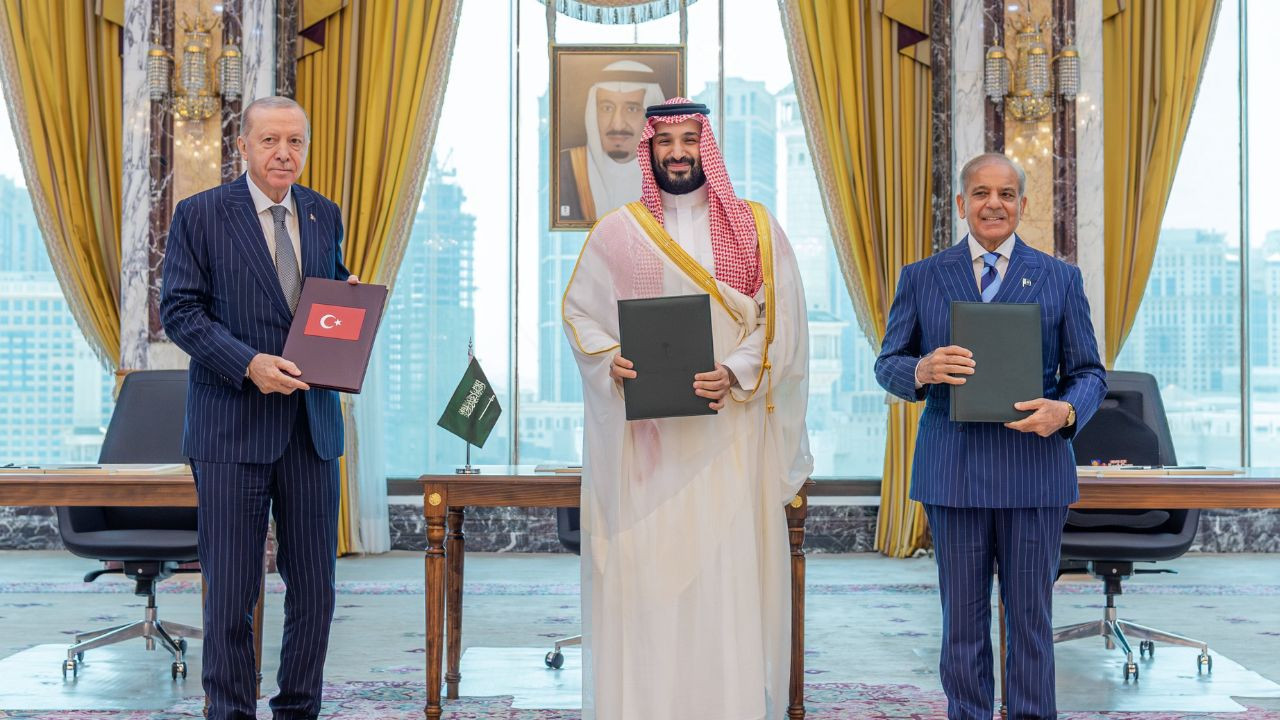
Pakistan, Turkey, and Saudi Arabia signed a mutual defense agreement on Friday, August 7, dubbed the “Mecca Joint Defense Agreement.” This agreement comes at a time when the security situation in the Middle East is rapidly changing and new strategic alignments are emerging among regional countries.
A Key Step Toward Strengthening Defense Cooperation
This agreement is being considered a significant step toward strengthening defense cooperation among the three countries. However, it is not yet clear to what extent military assistance from the other two countries would be necessary in the event of an attack on one country. The three countries have also refrained from portraying this as an alliance against any foreign country.
Different Strengths of the Three Countries
It is being said that each of the three countries could play a unique role in this new security structure. Pakistan has a large military with combat experience, missile, and nuclear capabilities, while Turkey is known for drone technology and the manufacture of defense equipment, while Saudi Arabia has strong economic resources. In such a scenario, this combination of military, technological, and economic capabilities could prove influential in the region.
Tension with which countries?
Pakistan has recently faced border tensions with Afghanistan and military confrontations with India. Saudi Arabia, on the other hand, has faced security threats from Iran and its allies. Turkey has long been operating against Kurdish armed groups and its relations with Israel have also experienced strains.
Questions about the US role
Experts believe that growing uncertainty about the US’s security role may also be a factor behind this agreement. Saudi Arabia and Turkey have long been important security partners of the US, but changing US foreign policy has prompted regional countries to consider alternative security arrangements.
The real test will be amid a security crisis
The importance of such a new alliance has increased amid the Israel-Hamas conflict and Iran-Israel tensions in the Middle East. Some analysts believe that future cooperation with countries like Egypt, Qatar, Syria, or the UAE could increase, but longstanding differences pose a significant challenge. The true strength of this agreement will be tested only if any of the three countries faces a serious security crisis and requires the full extent to which its allies will stand behind it.