


Parliamentary Panel Reignites Crypto Debate
For years, India’s approach to cryptos revolved merely around taxation. A parliamentary panel has now suggested creating a self-regulatory organisation (SRO) to fill this regulatory gap. So, is the country finally inching towards a real crypto rulebook?
A New Crypto Regime? The Parliamentary Standing Committee on Finance has proposed creating an interim mechanism to regulate virtual digital assets (VDAs) through an SRO, operating under a designated regulator. It has also sought more clarity on tokenised securities and crypto investment products under the proposed Securities Markets Code, 2025.
The Vacuum: The panel acknowledged that excluding VDAs from securities law has created a regulatory grey area. While the current policy imposes a 30% tax on gains from cryptos and mandates transaction reporting, the crypto ecosystem still lacks a dedicated framework. This gap has left startups and investors in an uncertain environment, where compliance exists but market structure does not.
Industry Cheers On: Crypto executives are calling the recommendations significant as they move the conversation beyond punitive taxation. Many see the recommendations as the first step toward clearer rules, better investor protection and a framework that distinguishes different digital asset classes within the crypto ecosystem.
Questions Remain: Nevertheless, uncertainty remains. Industry leaders claim that VDAs are too varied to fit into one bucket and under one regulator. As per them, tokenised securities should fall under SEBI, payment-linked assets under the RBI and a dedicated framework should oversee crypto-native assets. They also want the SRO’s powers to be limited to audits, setting standards and grievance redressal, while the regulator retains licensing and enforcement power.
As crypto platforms ponder if the Parliamentary recommendations actually translate into a law, is this the beginning of a real regulatory framework for cryptocurrencies? Let’s find out…
From The Editor’s Desk
💰 Weekly Startup Funding Tanks
- Indian startups cumulatively raised $209 Mn across 14 deals last week, down 26% from $281 Mn across 24 deals in the preceding week. Zetwerk and Veriqus took home the biggest cheques last week at $52 Mn and $40 Mn, respectively.
- Manufacturing emerged as the most funded sector last week and bagged $52 Mn. Following suit was the SaaS sector, which raised $50 Mn across two deals. AI startups managed to raise $259K, down 60% week-on-week.
- Early-stage activity remained thin as seed-stage startups raised about $1.8 Mn across three deals. However, Series A startups managed to bag $31.7 Mn across three rounds. Norwest emerged as the most active investor last week, backing two startups.
📉 Bearish Week For Startup Stocks
- Of the 59 new-age tech stocks under Inc42’s coverage, only 16 ended last week in the black, gaining between 0.15% to 29%. The remaining 43 stocks declined between 0.03% to over 9%.
- BlueStone and E2E Networks gained the most last week, while Swiggy and Ather emerged as the biggest losers. The combined m-cap of the 59 new-age tech companies stood at $138.25 Bn last week, down from $142.41 Bn commanded a week earlier.
- Going forward, investors will closely track the US Federal Reserve’s policy decision, movements in crude oil prices, domestic macroeconomic data and the ongoing Q1 FY27 earnings season for market cues.
📱 Inside ShareChat’s Turnaround
- The social media giant is gearing up to list on the bourses. But ShareChat’s path to a $400 Mn IPO next year looks very different from a startup that spent years fighting slowing growth, layoffs and monetisation issues.
- The unicorn crossed ₹1,000 Cr in top line in FY26 and reported profitability in Q1 FY27. This came on the back of stronger unit economics, a disciplined operating model and a management focused on sharper but fewer priorities.
- But the biggest ace up its sleeve has been microdramas, which contributed 25% to ShareChat’s revenue in FY26. The unicorn is also leaning heavily into AI to lift engagement and improve both content distribution and decision-making.
📊 Indian Startup FY26 Tracker
- Of the 65 startups that have released their numbers, 49 generated a net profit of ₹12,016 Cr. However, the remaining 16 reported a cumulative loss of ₹14,932.4 Cr, underscoring that sustainable profitability remains a work in progress for a section of the ecosystem.
- Even so, the scale of the Indian startup ecosystem continued to expand. The 65 companies generated ₹2.58 Lakh Cr in operating revenue in FY26, up 50% from ₹1.7 Lakh Cr in FY25.
- Meanwhile, a growing number of startups are inching closer to profitability after years of cost rationalisation due to funding winter, geopolitical tensions and investors tightening their purses.
🍵 VAHDAM Sets Eyes On India
- Most Indian consumer brands win at home before they dare to dream global. VAHDAM went the other way. It first spent a decade proving that Indian teas can compete on global shelves at Walmart and Costco, and is now turning its sights back to home turf.
- In the past ten years, the startup has stitched together a farm-to-cup supply chain, sourcing teas and botanicals from thousands of farmers and shipping products directly to users across 180+ countries.
- The tea brand is now eyeing ₹500 Cr in top line in FY27 and ₹1,000 Cr by FY29. As part of this, VAHDAM is focusing its energies on India: building local price points, everyday wellness products for sleep and immunity, and a digital-first playbook.
Inc42 Markets
Inc42 Startup Spotlight
Making India’s CCTV Networks Smarter
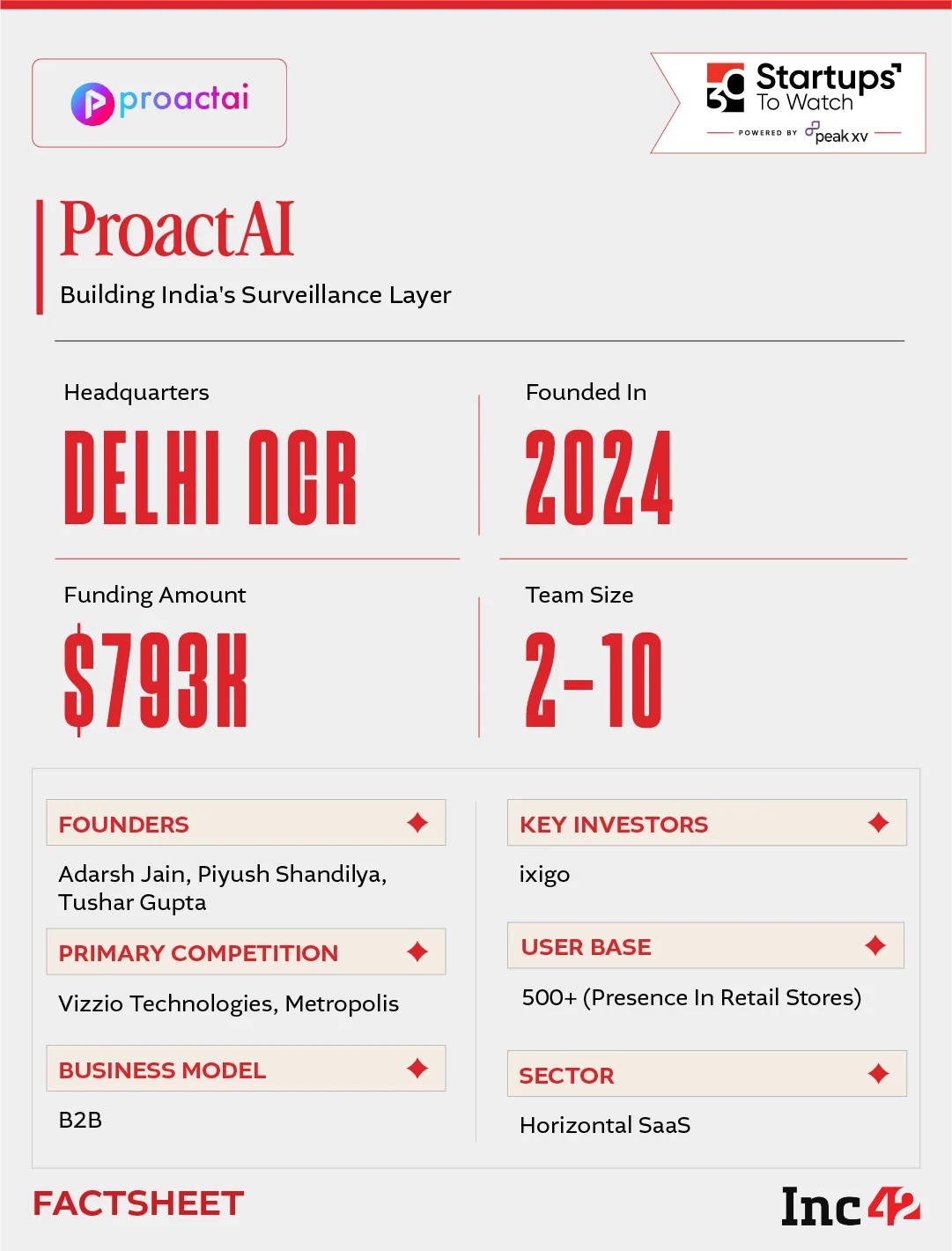
Much of India’s surveillance layer still depends on foreign computer vision systems, raising questions about sovereignty, customisation and control. ProactAI is trying to close this gap with an indigenous AI stack built for critical infrastructure.
A Sovereign Stack: Founded in 2024, ProactAI is developing what it calls India’s first vertical vision foundational model focused on object tracking and real-time intelligence. Its flagship product, Bhaskara, is designed to work on top of existing CCTV networks without new hardware, reducing dependence on imported tools.
The Vision Intelligence: Bhaskara converts conventional surveillance feeds into AI-powered monitoring systems that can identify persons of interest, track movement across multiple cameras and surface operational insights in real time. With 98% accuracy in person re-identification, ProactAI is positioning itself for deployments at airports, industrial plants and other large-scale facilities.
Eye On The Prize: Backed by ixigo, ProactAI claims to have already deployed its solutions across 500+ retail locations. The startup is now betting that it can build an affordable surveillance software with domestic control over data. With the global computer vision market projected to become a $53 Bn opportunity by 2030, can ProactAI help India secure its most sensitive spaces with AI?
Infographic Of The Day
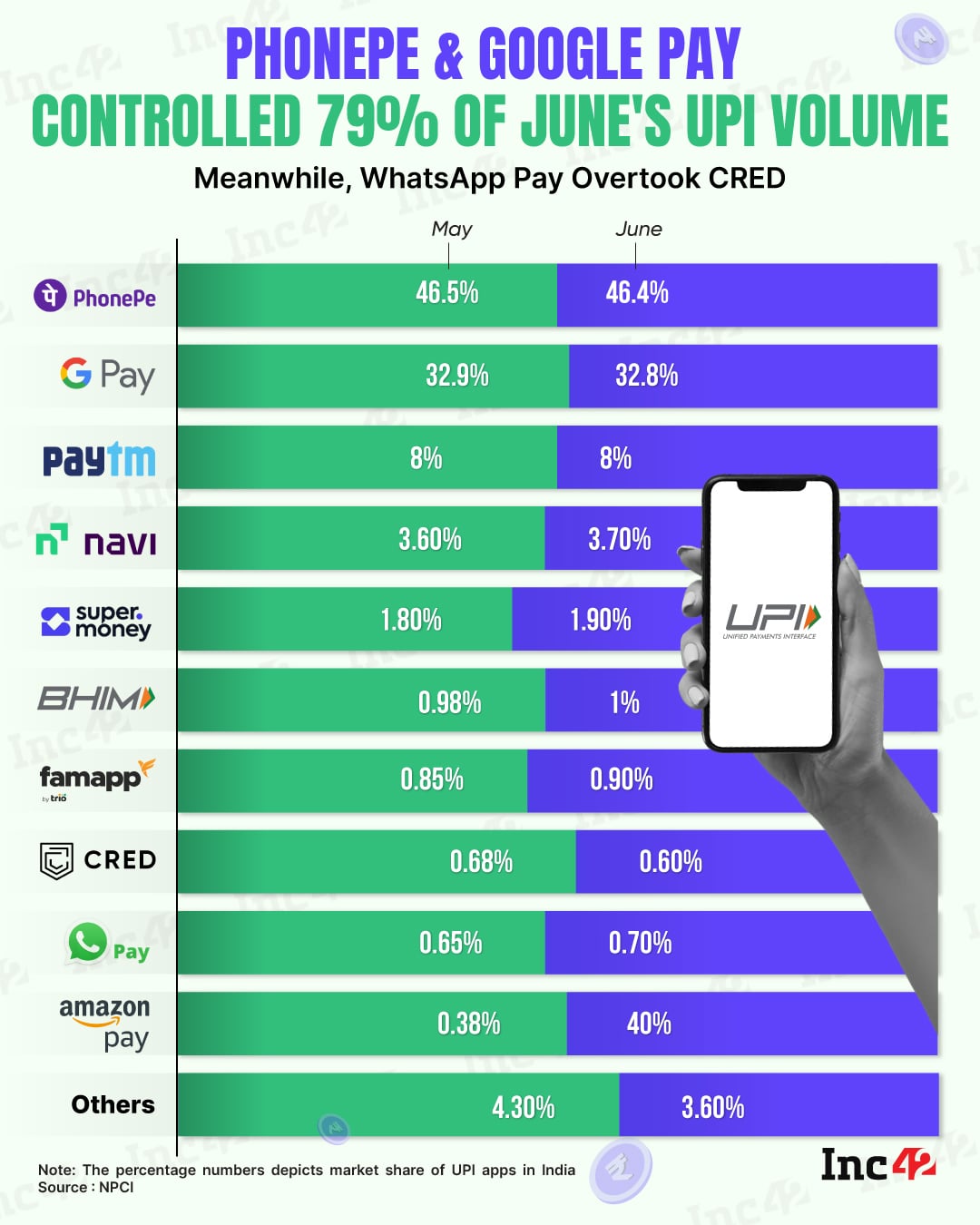
The UPI race turned interesting in June as smaller players continued to expand their presence in the digital payments ecosystem. Here is how the numbers stack up…

Comments are closed.