
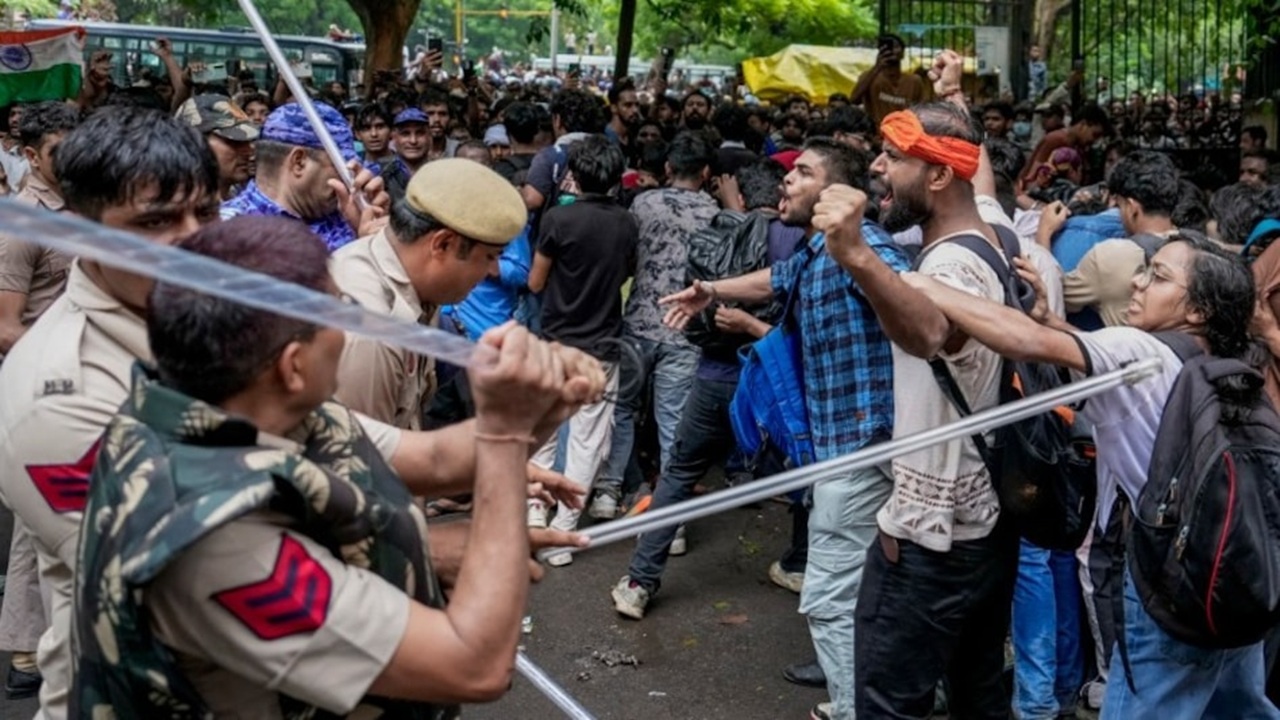
‘Can’t baton charge just because there’s a movement’; Court reprimands Delhi Police ‘supreme’! What exactly happened in court?

- Supreme Court comments on police action on student agitation
- ‘Use of force should be a last resort’
- Supreme Court’s harsh comment on the role of Delhi Police
The Supreme Court has taken a stern stance on the alleged use of excessive force by the Delhi Police during student protests in various parts of the country. During the hearing, the court clearly stated that just because the agitation is going on, the police does not get the right to direct lathi charge. While taking any action it is necessary to consider the situation thoroughly and follow the procedure prescribed by law. A bench headed by Chief Justice of India (CJI) Suryakant made the remarks. One of these petitions was filed by a group of students, who alleged that the police beat them up during the protest.
Parliament Monsoon Session: Anti-incumbent aggressive on the issue of paper futi! Both Houses of Parliament adjourned
Use of AK-47 rifles on protesters in Siwan
Another petition also accused protesters of using AK-47 rifles in Siwan, Bihar. Allegations of indiscriminate or excessive use of force by the police should be investigated separately, the court said. The same lawyer who wrote a letter to the Chief Justice of the Supreme Court demanding a high-level inquiry, saying the police action against protesters at Jantar Mantar was unjust, has now filed a Public Interest Litigation (PIL) on the same issue. Earlier, the Chief Justice did not take cognizance of the letter sent three days ago.
Public Interest Litigation in Supreme Court
In this PIL filed by advocate Narendra Mishra on behalf of petitioner Priya Mishra, Supreme Court It has sought a writ of mandamus directing the defendants to immediately preserve and preserve all electronic and digital evidence related to these incidents. This includes CCTV footage, body-worn camera footage, drone footage, mobile phone recordings, videos and posts available on social media, police wireless and communication records, call logs, control room records, deployment orders, GPS records and all other relevant electronic and documentary evidence.
The petition said that these evidences should be protected from destruction, alteration, tampering, suppression or loss. It should also ensure that all evidence is presented to the appropriate judicial and investigative authorities. The petition also demands that when available evidence—such as government records, electronic evidence, media reports and other reliable material—indicates that any person, public servant, police officer, security personnel or any other authority has committed a cognizable offence, an FIR should be registered immediately and a fair, independent and timely criminal investigation initiated in accordance with the Constitution and applicable laws.
A big revelation in the CJP movement! A pellet gun operated by an RAF soldier? Five protesters injured after seven rounds of firing

Comments are closed.