
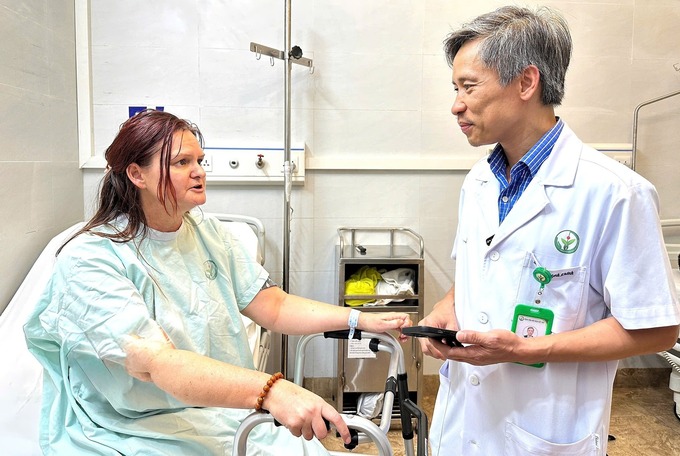

Nguyen Manh Khanh, deputy director of the hospital, said on July 26 the 51-year-old patient first developed pain in her left hip about 10 years ago. It came on during movement at first, then worsened until walking and daily activity became difficult.
Doctors in New Zealand told her years ago that she needed a replacement and put her on the public system’s schedule.
She has been on the wait list for four years. Switching to private services would have cost her nearly NZ$40,000 (US$23,100).
She researched Vietnamese surgeons and compared treatment across several countries in the region before choosing Viet Duc, Vietnam’s largest surgical center, and booking a more than 9,000-km flight to Hanoi.
Her left hip joint had been completely destroyed by the time she was admitted. She was in severe pain and largely dependent on a wheelchair. Her weight, close to 100 kg, complicated both anesthesia and surgery.
Doctors diagnosed avascular necrosis of the femoral head with end-stage hip osteoarthritis, a condition in which blood supply to the ball of the joint is cut off and the bone collapses.
Khanh attributed it to factors including disrupted blood flow to the bone, trauma, autoimmune disease, long-term corticosteroid use and excess weight. Medical literature identifies trauma, prolonged or high-dose corticosteroid use and heavy alcohol consumption as the leading causes, with obesity a weaker association.
The team performed a total hip replacement through an incision of 5 to 6 cm, roughly two inches. Thick soft tissue around the hip put the joint considerably deeper than in a typical case.
Khanh said the smaller opening limited soft-tissue damage, post-operative pain and recovery time.
She stood and began walking on the second day. After nearly a week the wound had healed, her legs were level, the pain was gone and she could walk unaided.
Khanh said she should be able to drive and take up sport suited to the new joint once she is home.
Before the operation she took every step on a cane or crutches and worked through the pain on painkillers, holding down a job as a property manager and personal assistant.
She said the surgery gave her a new lease on life and that she expects to run again within about three months, something she had not thought possible.
Dr. Nguyen Manh Khanh (R) at Viet Duc University Hospital examines a patient from New Zealand after her hip replacement surgery. Photo by Thuy Dung |
Health New Zealand’s target is for 95% of patients to receive elective treatment within four months. In the quarter to March 2026, 64.5% did, according to the Department of the Prime Minister and Cabinet.
Waits for hip replacement specifically averaged between 128 and 444 days depending on the hospital as of late January 2025, with about 4,600 people on the lists, RNZ reported.
Patients must clear a clinical scoring threshold before they join a list at all, and RNZ found the bar ranged from 20 points in Tairawhiti to 80 in Wairarapa.
Those who score below it are returned to their family doctor and can be referred again later, so a wait can accumulate over years without registering in official waiting-time figures.
Health New Zealand is buying capacity from private hospitals to clear the backlog, adding 21,000 hip, knee, cataract and other procedures through June 2026.
Khanh said the woman’s case reflects a growing number of foreign patients coming to Vietnam for technically demanding procedures, and that domestic hospitals have mastered modern joint replacement techniques at what he called reasonable cost, with faster access than in some countries.
Viet Duc has treated other foreign patients recently, including an Australian competitive arm wrestler and a Russian patient who underwent endoscopic spine surgery.
Comments are closed.