Tan Khi Wie, 58, presented an Indonesian passport in the name “Ken Srona” on March 7 and could not complete clearance at the automated lanes, Channel NewsAsia reported.
Immigration and Checkpoints Authority officers ran further checks, established his real identity, found he was wanted by police and handed him over.
He was convicted of six charges under the Immigration Act and the Penal Code, the Singapore Police Force and ICA said in a joint statement, covering two counts of failing to present a valid passport and one count each of making a false statement on an arrival card, knowingly producing a false passport, departing Singapore illegally and failing to attend court.
Another 16 Immigration Act charges were taken into consideration at sentencing.
Tan pleaded guilty, and the new term will begin only after he serves the 18-month sentence he fled, The Straits Times reported, citing court records. That puts his total time behind bars at close to two years and nine months.
|
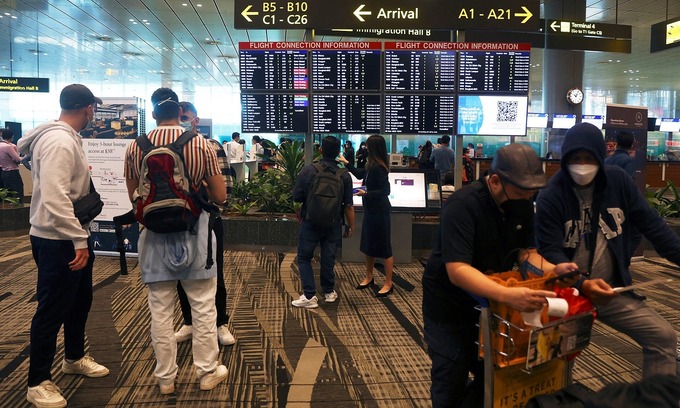
Travellers stand at the Changi Airport in Singapore, March 30, 2022. Photo by Reuters |
The original sentence was handed down on Aug. 6, 2002, for cheating the then-Singapore Productivity and Standards Board into disbursing a grant of SGD195,800 (US$153,000) under the Local Enterprise Technical Assistance Scheme, which covered up to half the cost of a consultancy project for small and medium-sized firms.
Tan filed a notice of appeal that same month, then did not show up for a court mention on Jan. 21, 2003. A warrant followed on Feb. 20.
Investigations by ICA found he had left Singapore illegally by boat sometime between August 2002 and January 2003. He traveled first to Johor, Malaysia, then on to Thailand and finally to Jakarta, Indonesia, where he settled.
Between 2011 and 2016 he used Indonesian passports in the Ken Srona identity to enter and leave Singapore on multiple occasions, the two agencies said, and falsely declared on his disembarkation forms that he had never used a passport under a different name.
ICA said it has strengthened clearance using biometrics and data analytics, with multi-modal biometric systems in place at checkpoints since July 2020 to detect people traveling under multiple or assumed identities.
Every automated lane at Singapore’s land, sea and air checkpoints is fitted with iris and facial scanners, and the agency said the concurrent use of both identifiers provides a highly accurate means of authenticating travelers. It warned it would take firm action against travelers using an impersonated identity to get around its checks.
ICA cleared close to 245 million travelers in 2025 and picked up 223 people arriving under multiple identities, down from 233 in 2024, according to annual statistics published on Feb. 23.