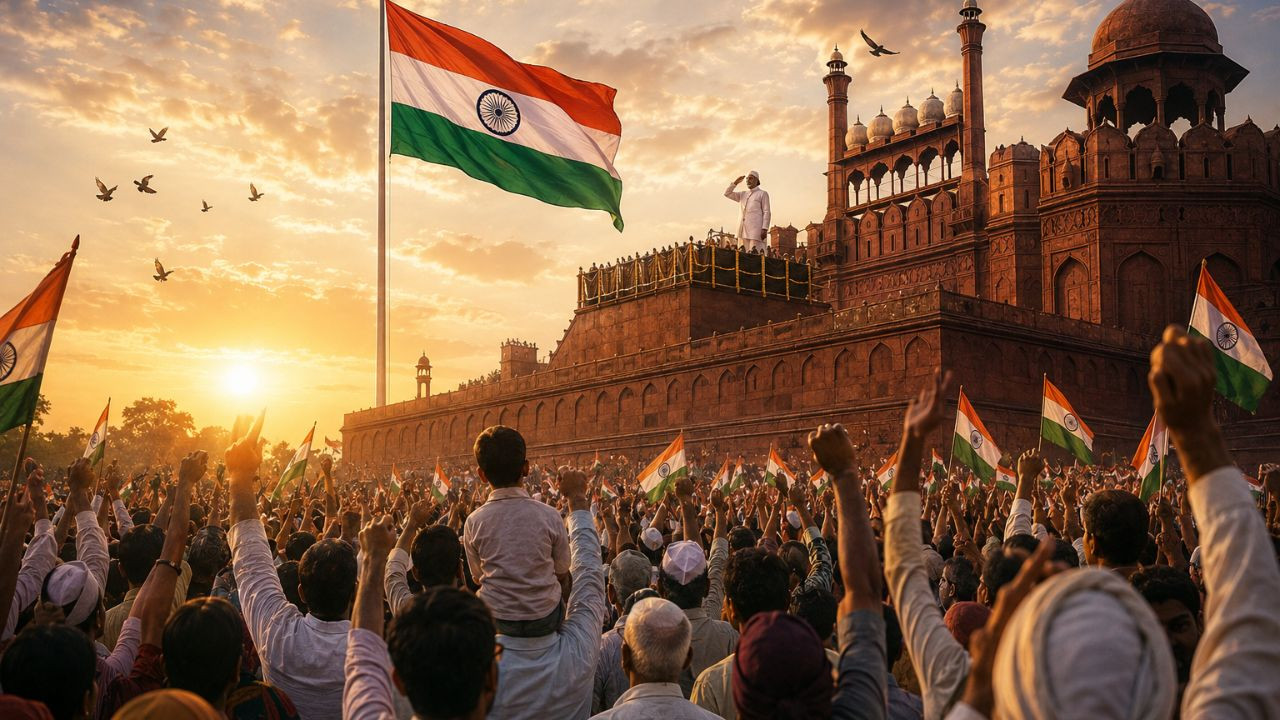
The morning of 15 August 1947 was the most special morning in the history of India. Lakhs of people had gathered in Delhi to see the tricolor at the Red Fort. Amidst the joy of independence, the pain of partition was also in the hearts of the people.
Today we consider our rights as a part of normal life. Any person can do a job, start a business and become a representative of the people by contesting elections in a democratic manner on the basis of his hard work and ability. It is also a normal thing for us to go out on the road with the Tricolor in our hands. But for the generation that saw the first dawn of independence, all this was like a dream come true.
The first morning of independence had a different color
On the morning of 15 August 1947, lakhs of people gathered in Delhi to celebrate independence. Many people did not even have their own tricolor. For him, the national flag flying on the Red Fort was the identity of independent India. People were waiting for hours to get a glimpse of him. At that time the tricolor was not just a piece of cloth. He was a symbol of the freedom that the countrymen had dreamed of for years. For the first time after liberation from British rule, people realized that the country would no longer be run on the orders of any foreign power. They will be able to take their own decisions and shape their future as per their wish.
Celebration started at midnight
Writer Rajendra Lal Handa has described in detail the social and political changes that took place in Delhi between 1940 and 1950 in his book ‘Delhi Mein Das Varsh’. He has also recorded the scenes he saw with his own eyes on the night of 14 and 15 August 1947. According to him, at around 2 o’clock in the night, Pandit Jawaharlal Nehru left the Constituent Assembly and went towards Viceroy Bhawan. Crowds of people followed him in the enthusiasm of freedom. There was such a huge crowd all around that it became difficult to understand even the coming and going of people.
After some time, Nehru reached the Constituent Assembly building along with the Viceroy. At that time the enthusiasm of the people present there was at its peak. Slogans were raised continuously to welcome the leaders. There was a crowd of people everywhere from the meeting hall to the surrounding grounds and roads. Handa wrote that Delhi had seen many big celebrations before, but a scene like the one on the night of 14-15 August had rarely been seen. At midnight it seemed as if freedom itself had descended on earth.
Waiting for the tricolor at the Red Fort
Even after the night’s celebrations were over, people’s enthusiasm did not diminish. Some people returned home, while many slept on the roads, footpaths and open fields. As soon as the morning came, people’s attention was towards the Red Fort. At around eight o’clock in the morning of 15 August, Pandit Jawaharlal Nehru hoisted the tricolor at the Red Fort. This moment was historic, because till now the flag of British rule was visible on the same Red Fort. The crowd gathered there on the first day of independence can be gauged from the fact that according to local newspapers and government estimates, around 10 lakh people were present there. The roads from Delhi Gate to Kashmiri Gate and from Jama Masjid to Red Fort were filled with people. The crowd was so huge that it took several hours to disperse. Till afternoon there was heavy presence of people on the main roads of the capital.
‘Jana Gana Mana’ and ‘Vande Mataram’ boosted enthusiasm
On that night of independence, the national anthem and the tune of ‘Vande Mataram’ had made the atmosphere more emotional. People had heard these songs before, but that night their meaning was felt to be different. After getting independence, the words of these songs were reminding people of their struggle and sacrifice.
When ‘Jana Gana Mana’ was played, thousands of people became emotional. But as soon as Punjab and Sindh were mentioned, many people remembered the pain of partition of the country. On one hand there was the joy of independence, while on the other hand the pain and violence caused by partition was also present in the minds of the people. That means the first morning of independence was not just a celebration. It included happiness, pride, hope and sadness of partition – all together.
Independence celebration from cities to villages
Authors Dominique Lapierre and Larry Collins have also described in detail the atmosphere of 14-15 August 1947 in their book ‘Freedom at Midnight’. According to him, celebrations had started in many cities and villages of the country from the morning of 14th August. People of Delhi started coming out of their homes and going towards important places of the city. Some were reaching by bicycle and some by bus, car, rickshaw or horse-drawn carriage. Many people came riding on bullock carts. Songs, slogans and congratulations were heard everywhere in the city. People wore new clothes and children came with their parents to witness this historic moment.
Many people who came from the villages initially did not understand what such a huge crowd and celebration was about. They were being told that the British were now leaving the country and India had become independent. For the people, this news in itself was no less than a celebration.
Independence meant something different to everyone
At that time, every person was understanding the meaning of independence according to his own situation. People coming from the villages were telling their children that now the British rule was over. Many people hoped that now farming would be better, there would be more animals and there would be less difficulties in life. For some, independence meant control over one’s own land, for others, it meant living with dignity and for others, being able to express one’s views without fear. People were confident that their lives would change after the end of foreign rule.
There was a similar atmosphere in other parts of the country also. The Union Jack was being removed from government offices, military cantonments and other important places and the tricolor was being installed. Where once the pictures and insignia of British officers were visible, the national flag of independent India was now taking its place.
The first morning of independence was like a dream
Today for us, hoisting the tricolor and celebrating Independence Day is a part of life. We belong to that generation which has seen an independent country since birth. We did not have to struggle with foreign rule for our rights. But for the generation of 80 years ago, independence had a much deeper meaning. He had seen a time when common people had to struggle for their rights. Honor and self-respect could be crushed by the power of power and even in our own country the decisions were in someone else’s hands.
Therefore the morning of 15 August 1947 was not just a date on the calendar. That was the beginning of a new life for crores of Indians after a long struggle. The tricolor fluttering on the Red Fort was for him a symbol of the dream in which India would take its own decisions. Today, when we are celebrating 80 years of independence, it is important to remember that first morning because the true value of the tricolor was known to the same generation that saw it waving under the open sky for the first time on the land of independent India.