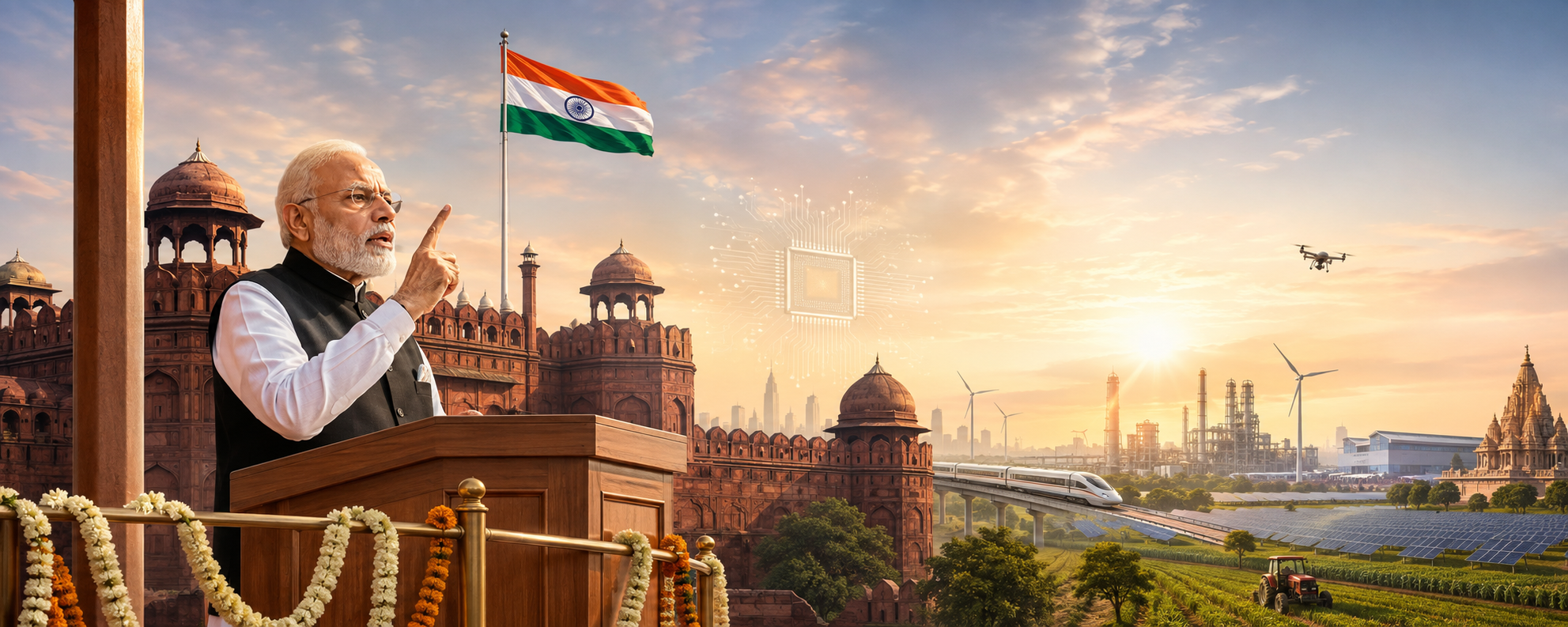
From artificial intelligence and free coaching to semiconductors, nuclear energy, civil defence, sports and rural women’s incomes, the Prime Minister used the Red Fort to argue that India’s next phase of independence must be built on strategic self reliance. The ambition is sweeping. The real test will be delivery.
By The Obnews Editorial Team
NEW DELHI: The Red Fort has always served two purposes on Independence Day. It is a memorial to the struggle that ended colonial rule, and it is a platform from which India’s leaders declare what freedom must mean next.
On August 15, 2026, Prime Minister Narendra Modi used that platform to make a larger argument about the country’s future. India, he said, could no longer be satisfied with limited ambitions or remain dependent on other countries for the technologies, energy, defence equipment and industrial capacity on which national power increasingly rests. Political independence was secured in 1947. The next objective, in his telling, is economic, technological and strategic independence by 2047.

India was officially celebrating its 80th Independence Day, marking the beginning of the 80th year since freedom. The ceremony also carried unusual historical symbolism. Modi said that, for the first time since independence, Vande Mataram was formally echoing from the Red Fort on August 15 as the country commemorated 150 years of the national song. Before turning to policy, he saluted Mahatma Gandhi, freedom fighters and revolutionaries, and expressed solidarity with families affected by recent floods and landslides.
The emotional centre of the address was simple: India should stop thinking small. “We can no longer move forward with small dreams,” Modi said. The policy centre was more complex. He placed the goal of a Viksit Bharat, or developed India, by 2047 on three foundations: Aatmanirbhar Bharat, a faster “Reform Express,” and a new framework called the Shakti Ki Saptadhara, or seven streams of national strength.
That distinction matters because the plan has already been described in some coverage as a six point programme. It is not. Modi’s formally named Saptadhara framework contains seven streams. The official government summary also lists seven headline announcements. For analytical clarity, the two closely connected youth measures, artificial intelligence training and free examination coaching, can be considered one mission. That produces six major delivery tracks, but “six point plan” was not the formal title used by the Prime Minister.
Independence as strategic capacity
Modi’s speech reflected a change in how governments around the world now talk about sovereignty. For much of the post Cold War period, globalisation encouraged countries to buy essential goods wherever they were cheapest. The pandemic, wars, energy disruptions, export controls and competition over critical minerals have exposed the risks of that model.
The Prime Minister argued that petrol, fertilisers, medicines, technology chips and even territory are increasingly being used as instruments of power. In that environment, self reliance is not simply a patriotic consumer campaign. It is a form of insurance against supply disruption and political pressure.
This was the logic connecting parts of the speech that might otherwise appear unrelated. Semiconductor plants reduce exposure to chip shortages. Nuclear and renewable energy reduce vulnerability to imported fuel. Domestic defence production protects military readiness. Critical mineral partnerships support batteries, electronics and advanced manufacturing. Food processing, ports and free trade agreements give Indian producers access to foreign demand. Civil defence prepares citizens and infrastructure for emergencies that may not resemble conventional war.
The ambition is being set during a period of substantial economic momentum. The International Monetary Fund’s India profile projects real growth of 6.4 per cent in 2026. That gives New Delhi more room to invest than many countries possess. Yet fast growth by itself does not guarantee developed country status. Productivity, employment quality, education, public health, institutional trust, energy reliability and per person income will determine whether the 2047 pledge becomes measurable progress or remains a national slogan.
The seven streams of Saptadhara
1. Manufacturing power
The first stream is manufacturing. Modi called for India to control a greater share of the full value chain, from design and components to finished products. He urged factories and smaller enterprises to compete internationally on “cost, quality and scale,” with precision, attractive packaging and credibility becoming marks of Indian production.
This is more demanding than increasing assembly output. A resilient manufacturing power must develop domestic suppliers, industrial research, tooling, machinery, standards, logistics and skilled workers. India can be a trusted alternative in global supply chains only if quality remains consistent at high volume and if firms can deliver on time at internationally competitive prices.
2. Agriculture and food processing
The second stream links farming to value added food production and exports. Modi said Indian farmers should move from the farm to the global market, turning millets, spices, traditional foods, fruit, vegetables and flowers into recognised international brands. He also encouraged chemical free farming, arguing that global demand for such products is likely to rise.
The opportunity is real, but the route is demanding. Export agriculture requires traceability, cold storage, processing, testing, reliable transport and compliance with foreign health standards. It must also increase farm incomes without making farmers excessively dependent on volatile international prices. Modi’s reference to heavily subsidised urea and DAP showed that food security and farm affordability remain closely connected to global energy and fertiliser markets.
3. Technology and innovation
The third stream covers artificial intelligence, quantum technology, space, robotics, data centres and next generation communications. Modi held up UPI and India’s digital public infrastructure as evidence that the country can create systems with global relevance. He set a larger aspiration for Indian digital platforms to travel abroad and for Made in India 6G technology to reach international markets.
The important shift is from technology adoption to technology ownership. India already has scale as a digital market and depth in software talent. The harder objective is to create intellectual property, advanced hardware, research institutions and companies that lead global standards instead of merely implementing technologies designed elsewhere.
4. Gati Shakti
The fourth stream is physical connectivity. Modi called for high speed rail between cities, modern highways, inland waterways, airports, multimodal logistics and port led development. The economic case is straightforward. A factory cannot compete globally if congested transport, slow customs or fragmented logistics erase its cost advantage.
Gati Shakti is therefore the connective tissue of the wider plan. Manufacturing, agriculture, tourism, defence and exports all depend on it. The challenge will be coordinated execution across the Union government, states, cities, ports, railways and private operators, while ensuring that land acquisition, environmental safeguards and local interests are handled transparently.
5. Raksha Shakti
The fifth stream is defence power. Modi argued that India cannot remain only a buyer in the international arms market and should become a global supplier of next generation defence systems. He identified drones, counter drone technology, hypersonic systems and cybersecurity as priority areas.
The goal goes beyond weapons exports. Modern security depends on secure electronics, communications, satellites, software, energy systems and domestic maintenance capacity. Defence self reliance also requires realistic testing, competitive procurement and space for private firms and start ups, rather than judging success only by the value of contracts announced.
6. The green and blue economies
The sixth stream combines clean growth on land with economic opportunity at sea. Modi called for leadership in green hydrogen, renewable power, energy storage, green mobility and cleaner manufacturing. He also pointed to fisheries, coastal tourism and ocean technology as routes through which India’s long coastline can generate exports and jobs.
This stream may determine whether industrial expansion can coexist with India’s environmental obligations. Renewable capacity is only one part of the problem. Grid expansion, storage, financing, resilient coastal planning, marine conservation and a fair transition for workers will decide whether green and blue growth is durable.
7. India’s soft power
The seventh stream is cultural and creative influence. Modi cited yoga, Ayurveda, holistic health, faith destinations, handicrafts, film, visual effects, animation, gaming, digital content, tourism, sports and the concert economy. His argument was that Indian culture should not be treated only as heritage. It can also build trust, attract visitors, support creative employment and expand India’s international influence.
The speech connected this ambition to the Heal in India campaign and the WAVES entertainment summit. The opportunity is large, but soft power cannot be ordered into existence. It grows when artists, universities, media, athletes, entrepreneurs and cultural institutions have the freedom and capacity to produce work that international audiences choose to embrace.
The six missions that now face a delivery test
The Saptadhara is a broad national framework. The more immediate news came from a set of specific promises and targets. Grouping the two youth education measures together produces six practical missions whose progress can be measured over the next several years.
Mission 1: Build youth capability through AI training and free coaching
Modi announced that one crore young people, or 10 million, would receive artificial intelligence training within one year. He also promised a national network of free online coaching for students preparing for competitive examinations, saying the private coaching burden places serious financial pressure on poor and middle class families.
The political and economic urgency is clear. The government’s 2025 Periodic Labour Force Survey summary reported a youth unemployment rate of 9.9 per cent among people aged 15 to 29. It also found that 25 per cent of that age group was neither employed nor in education or training, while only 5 per cent had received or were receiving formal vocational or technical training.
The scale of the AI promise is enormous. A separate government update issued three days before the speech reported 60,253 enrolments in the first phase of a national AI skilling initiative. Of those participants, 4,620 had completed two modules and 552 had completed all four. The new one crore commitment may use a much wider set of platforms and partners, but those figures show why enrolment alone cannot be the measure of success.
India will need clear course levels, instruction in multiple languages, reliable assessment, recognised credentials and direct links to jobs, apprenticeships and entrepreneurship. A brief introductory course can improve AI literacy, but it is not the same as producing engineers, researchers or workers capable of applying AI safely in agriculture, manufacturing, health care and public administration.
Free coaching could widen access to opportunity, especially outside major cities. It will succeed only if the teaching is high quality, accessible on low bandwidth connections and available in regional languages. It must also be paired with trusted examination systems and a larger supply of productive jobs. Otherwise, the government risks making an overcrowded examination race cheaper without addressing why so many young people are competing for so few secure positions.
Mission 2: Find India’s next generation of athletes
The Prime Minister announced a nationwide sports talent search in villages, cities and schools for children between the ages of 5 and 15. Selected children would receive specialised training, with particular attention to Olympic disciplines in which India currently has limited participation.
Modi said India is positioning itself as a contender to host the 2036 Olympic Games and is set to host the Commonwealth Games in 2030. A talent search beginning now recognises a basic sporting reality: athletes who may compete in 2036 are already children, and elite performance requires years of coaching, nutrition, competition and medical support.
The test will be what happens after identification. Transparent selection, long term funding, protection of children, support for girls, sports science, qualified coaches and pathways from school to national competition will matter more than the number of trials conducted. A database of promising children is not a medal system unless institutions stay with them for a decade.
Mission 3: Create a modern civil defence network
Modi announced a large voluntary civil defence force prepared for modern emergencies. He said conflict can now threaten refineries, banking systems, data centres, factories and other essential infrastructure, even when fighting is not confined to a border.
This may be one of the least noticed but most consequential announcements in the address. Civil defence is designed to protect the public and restore vital services during war or disaster. A modern version could train citizens in emergency communication, first aid, evacuation, shelter management, cyber incident response and support for local authorities.
The details will be decisive. The government will need to define recruitment standards, training requirements, command structures, funding, liability protection and the relationship between volunteers, state disaster agencies, police, the armed forces and private infrastructure operators. Because public safety is primarily delivered locally, the Union government cannot build this network without sustained state and municipal participation. Strong safeguards will also be needed so that an emergency volunteer system remains professional, nonpartisan and focused on public protection.
Mission 4: Move from chip packaging to a complete semiconductor ecosystem
Modi said three semiconductor plants had begun operations and that another five to eight facilities could come online over the next seven to eight years. The larger objective is to prevent India’s digital economy, vehicles, medical equipment and defence systems from remaining dependent on imported chips.
There has been real progress. A July government update said India had approved 12 semiconductor projects and that three facilities had entered commercial production. It identified the operating facilities as Micron ATMP, Kaynes Semicon and CG Power OSAT.
That description also reveals an important nuance. These plants are concentrated in assembly, testing, marking and packaging, important parts of the chip value chain, but not the same as having a mature domestic network of front end wafer fabrication at advanced scale. India is moving from policy intent to production, but it has not yet achieved full semiconductor independence.
The next phase must develop reliable power and water, specialised chemicals and gases, equipment servicing, advanced engineering talent, research and domestic buyers. Plant counts make headlines. Commercial yields, product quality, local value added and integration with global customers will reveal whether the ecosystem is truly competitive.
Mission 5: Expand nuclear power from 8.78 GW to 100 GW
The Prime Minister reaffirmed India’s target of reaching 100 gigawatts of nuclear power capacity by 2047 and said five new reactors should begin within the current decade. Nuclear power was presented as a source of reliable electricity for an economy increasingly shaped by data centres, AI, advanced manufacturing and electrified transport.
This is the largest industrial scaling challenge in the speech. According to a July 2026 Department of Atomic Energy reply in Parliament, India had 8,780 megawatts of installed nuclear capacity across 24 plants, providing about 3.1 per cent of electricity generation in 2025 and 2026. Reaching 100 GW would require an increase of more than eleven times from that base.
The government’s roadmap anticipates about 22 GW by 2031 and 2032, followed by additional capacity from the Nuclear Power Corporation of India, other public enterprises, states, private companies and joint ventures. The SHANTI Act of 2025 was designed to broaden participation. Modi also highlighted India’s progress in fast breeder technology.
The target is possible only through consistent construction, financing, regulatory capacity, domestic manufacturing and public confidence. Nuclear power offers low carbon electricity around the clock, but safety, waste management, liability, land, water and local consent cannot be treated as secondary matters. The credibility of the mission will depend on transparent milestones and an independent safety culture, not only a distant 2047 number.
Mission 6: Raise six crore rural women to sustainable higher incomes
Modi said India had surpassed the target of three crore Lakhpati Didis and was moving toward six crore. The programme works through women’s self help groups and aims to create sustainable rural livelihoods and entrepreneurship.
A Lakhpati Didi is officially defined as a self help group member whose household earns at least ₹1 lakh annually, with an average monthly income above ₹10,000 sustained across at least four agricultural seasons or business cycles. The six crore target had already been announced in February 2026, with March 2029 identified as the deadline. The Independence Day address therefore elevated and reaffirmed an existing commitment rather than unveiling it for the first time.
The programme could transform rural household power if it gives women control over income, credit, assets and market access. But the measure must remain meaningful. Income should be verified over time, adjusted against rising costs and distinguished from household turnover or one time loans. The goal is not to award a title. It is to create durable businesses and greater economic agency for women.
What else Modi put on the national agenda
The speech extended well beyond the Saptadhara and the six delivery missions. Modi urged smaller businesses to take advantage of India’s free trade agreements and called for Indian textiles, machinery, medicines, farm products and seafood to meet global standards. He linked energy security to nuclear power, solar expansion, piped gas, hydrogen rail and offshore exploration. He asked citizens to participate carefully in the census, including through digital self enumeration, because accurate data will shape future policy.
He also appealed to political parties to advance 33 per cent representation for women in the Lok Sabha and state assemblies. The legal and political background is complicated. The women’s reservation law passed in 2023 ties implementation to a census and subsequent delimitation. A further attempt in April 2026 to combine expanded representation with a new delimitation arrangement failed to secure the required parliamentary majority. Opposition parties broadly supported women’s representation but challenged the proposed electoral map and its effect on the balance among states. Modi’s Red Fort appeal kept that unresolved conflict in the national spotlight.
On internal security, the Prime Minister claimed armed Maoist violence was close to elimination and credited security operations and development in affected regions. He then used the politically charged phrase “dimaagi Naxals” for ideological actors he said promote violence and disorder, calling for them to be identified and isolated. Congress leader Jairam Ramesh responded that the label risked vilifying dissent. The exchange showed the two sides of the address: a forward looking development blueprint and a sharper political message about who belongs within the national project.
A speech of ambition, and a ledger that must now be opened
Independence Day addresses are designed to inspire, but a developed India will be built through institutions, budgets, laws, engineering schedules and measurable public outcomes. Every large promise in this speech can be converted into a public ledger.
For AI training, the country can publish enrolment, completion, assessment and employment results. For free coaching, it can report languages, examinations, teachers, learner performance and access in rural areas. For sports, it can track how many children remain in funded development programmes after one, five and ten years. For civil defence, it can disclose training standards, readiness exercises and response times. For semiconductors, it can report operational capacity, yields, exports and domestic value added. For nuclear power, it can publish reactor milestones, costs and safety reviews. For Lakhpati Didis, it can measure income sustainability and women’s actual control over earnings.
That is the central question left by Modi’s address. The vision is not lacking in scale. It connects factories, farms, technology, infrastructure, defence, clean growth and culture into a recognisable theory of national power. It also places young people and women at the centre of the next phase of development.
President Droupadi Murmu, in her address on the eve of Independence Day, offered a complementary reminder. Freedom has meaning when every citizen can use opportunity to fulfil an aspiration, and nation building belongs not only to government but to workers, farmers, students, scientists, health professionals, artists, entrepreneurs, public servants, soldiers and the Indian diaspora.
Modi closed by invoking figures from across India’s national tradition, including Mahatma Gandhi, Netaji Subhas Chandra Bose, B.R. Ambedkar, Jawaharlal Nehru, Sardar Vallabhbhai Patel, Bhagat Singh, Sukhdev, Rajguru, Syama Prasad Mookerjee, Birsa Munda and Jyotiba Phule. That breadth carried an important message. India’s independence is a shared inheritance. Its development must also be a shared project.
The speech succeeded in defining the scale of the ambition: developed country status, strategic autonomy and global influence by 2047. Whether August 15, 2026, is remembered as the day a new national roadmap was announced will depend on what comes next. The distance between a declaration and a transformation is execution.
Sources and editorial credits
This article was developed from the official English rendering of Prime Minister Narendra Modi’s address, the Prime Minister’s Office summary of major announcements, the Government of India’s 2025 labour force findings, official updates on AI skilling, semiconductors, nuclear capacity, and the Lakhpati Didi programme. Constitutional context on women’s representation was checked against PRS Legislative Research and Reuters.