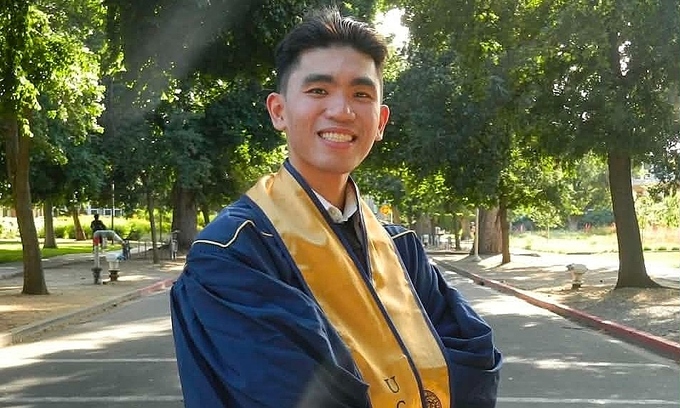
Hoang Hieu, a student from Ho Chi Minh City who earned a bachelor’s degree in Data Science and Statistics from the University of California, Davis (UC Davis), is set to begin a PhD in Applied Statistics at UCR.
In the 2026 U.S. News & World Report Best Colleges rankings, the University of California, Riverside (UCR) is ranked 75th among national universities and 36th among top public schools.
“I decided to pursue a PhD directly to follow a path of in-depth research and become an expert in AI,” he said.
|
Hoang Hieu graduating from the University of California, Davis in a photo he provided. |
After completing middle school in HCMC, Hieu attended high school in the U.S. on a full scholarship. He was later admitted to UC Davis, where he chose Statistics because of his passion for mathematics, particularly linear algebra and multivariable calculus.
“The world constantly operates on and revolves around data, while statistics combines mathematical thinking, machine-learning algorithms and the ability to apply them to countless fields such as healthcare, technology and economics,” he said.
At UC Davis, Hieu joined the Google Developer Student Club (GDSC) and a machine-learning student network to deepen his knowledge, strengthen his teamwork skills and expand his professional network. During his final year, he worked as a research advisor on job-search tools.
He also took part in an academic training program sponsored by NASA, contributing to a project proposal aimed at reducing costs for the agency’s platforms.
The turning point that convinced Hieu to pursue a PhD came from a research project led by one of his professors on changes in DNA and cell structures. Hieu was tasked with collecting data and creating 3D models to help the professor visualize changes in cellular structures, but he struggled because he lacked practical skills.
“The professor shared his research journey, which inspired me tremendously,” Hieu said. He realized that when facing difficulties, he needed to overcome them through self-learning and by proactively connecting with lab colleagues to exchange knowledge.
After graduating, he worked for a nonprofit organization. The experience further convinced him that he was better suited to an academic environment. Confident in the knowledge he had accumulated over four years at university, he decided to apply for PhD programs. His application included his academic transcripts, recommendation letters and a research proposal.
He was particularly interested in research on large language models, focusing on aspects such as scalability and real-world interpretability. He therefore took the initiative to email professors at UCR who were working on related projects.
In his emails, Hieu demonstrated his understanding of the professors’ research and attached a CV detailing his contributions to previous studies.
“I may not have outstanding achievements yet, but I need to demonstrate that my practical skills can contribute to completing their projects,” he said.
This approach helped him gain acceptance from a UCR professor before proceeding to interviews with the department’s faculty panel.
“I already knew what the professor wanted to do with the project and how the research could be expanded into other fields,” Hieu said, describing this as an advantage in convincing the interviewers.
He also prepared carefully for his research direction over the next four to five years, clearly explaining why he chose the university and his prospective supervisor. He believes applicants should avoid overusing complicated technical terminology and instead explain concepts concisely and clearly to demonstrate a strong grasp of the fundamentals. This makes it easier for interviewers to understand their research methodology.
Another lesson he learned was to proactively ask questions. Hieu asked professors about their management style, the number of students involved in their projects and how often the research group met each week.
He said this helped him gather information, assess the professor’s working style and determine how he could adapt.