
Kumar Siddharth, senior journalist
Looking back over the last century, industrial development was characterized by huge factories, tall chimneys, steel plants and the hum of machines. They were considered symbols of a country's economic power and industrial progress, but the face of development has changed in the twenty-first century. Today, spacious, quiet and state-of-the-art buildings are becoming the pivot of the new economy. Neither the noise of machines is heard nor clouds of smoke rise in them, yet the foundation of almost every digital activity in the world rests on them. We know these new modern buildings as 'data centres'.
Today, a mobile payment, a student's online class, a hospital's digital health record, a farmer's mobile weather forecast, a picture shared on social media or any communication, none of these activities are possible without data centres. Every digital action ultimately reaches some data center, where information is stored, analyzed and returned to us within moments.
This is the reason that as virtual and invisible as the digital world appears, its foundation is equally solid and real. This is not just a world of the Internet or software, but a vast physical infrastructure based on huge data centers, millions of servers, continuous power supply, high capacity communication networks and large amounts of natural resources such as energy and water.
In the last few years, artificial intelligence has given a new impetus to this entire system. Tasks like chatbots, language translation, image generation, video analysis, medical research and scientific calculations are requiring more computing power than ever before. Because of this, a race to build new data centers has started around the world. According to international research studies, there are currently about 11,800 data centers operating in the world, while their number in India is increasing rapidly and the country has become one of the major data center markets in Asia.
Digital India, UPI, cloud services, e-commerce, online education and government digital platforms have further accelerated this expansion. There is no doubt that data centers are as essential to the modern economy as roads, railways and power plants ever were. They attract investments, create jobs and ensure the reliability of digital services.
Every 'development' also brings with it some unseen questions. For a long time, the discussion of data centers was limited only to their power consumption. Now the attention of scientists, environmentalists and policy makers is turning towards a natural resource which is often left out of discussion, that is water. We believe that our data is safe in the 'Cloud'. Cloud is not an imaginary place, but a network of huge data centers filled with thousands of servers.
Every e-mail, every digital payment, every video, every online search and every AI request is processed on these servers. These servers work continuously day and night. The more calculations that take place, the more heat is generated. If this temperature is not controlled, server performance can be affected, equipment can be damaged and digital services can be disrupted, so cooling is a critical requirement for data centers.
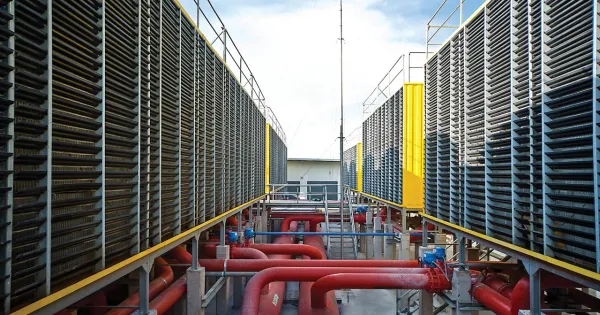
Water-based cooling towers, chillers, and evaporation-based cooling systems are used to maintain servers at a safe temperature in large data centers. Water absorbs heat quickly, hence it is considered an effective medium for large data centers, but the flip side of this is that with the increasing demand for digital facilities, the demand for water also starts increasing. This is the question which has started a new debate all over the world. Is the expansion of artificial intelligence and the digital economy at a time when the world is already grappling with challenges like water scarcity and climate change? And if so, can future digital development be balanced with water security?
The answers to these questions are not only technical, but also environmental, economic and social. This will decide in the coming years whether digital progress truly becomes the basis of sustainable development or a new pressure on natural resources. According to the International Energy Agency (IEA), a hyperscale data center with a capacity of about 100 MW can use up to two million liters of water per day for cooling alone. This quantity can be equal to the daily water requirement of many small towns. Water is used not only in cooling towers, but also in humidity control and other supporting systems.
CEEW, an organization working on energy, environment and climate in India, estimates that in the year 2024, the country's data centers will use about 150 billion liters of water. If the current pace of expansion continues, this consumption could more than double by 2030. This estimate is indicative not only of the size of the industry but also of the policy challenges in the coming years. In fact, AI has created a new irony. On one hand, it can help in solving problems like climate change, weather forecasting, agriculture, health and disaster management, on the other hand, the same technology can also increase environmental pressure if its infrastructure uses resources excessively.
Also read:-Pakistani migrants got citizenship