18
Infrastructure critical to national security can become a vulnerability when its operation is ultimately dependent on a foreign-controlled system.
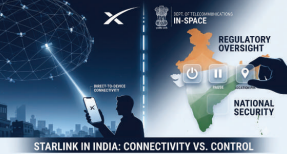
United States-based Starlink, owned by Elon Musk, has reapplied to India’s space regulator for approval of its second-generation satellite constellation, seeking authorisation for nearly 30,000 low-earth-orbit satellites and proposing direct-to-device (D2D) technology that would allow compatible mobile phones to connect directly to satellites without a separate terminal. The details of the filing have not been independently verified. The application follows an earlier Gen-2 proposal that encountered regulatory hurdles in India and comes as the Department of Telecommunications and IN-SPACe work on a broader framework for satellite communications and D2D services.
Beyond its commercial implications for India’s emerging satellite broadband market, the filing has brought back a larger policy question: how much operational control India would retain over a foreign-operated satellite network during a war, border crisis or major disaster. D2D technology differs from conventional satellite broadband because it is designed to work with ordinary mobile handsets rather than requiring a separate dish or terminal.
Comparable regulatory frameworks are already in place in other countries. In the US, the Federal Communications Commission’s Supplemental Coverage from Space rules allow satellites to carry traffic on spectrum licensed to terrestrial wireless carriers, enabling satellite services to supplement existing mobile networks. The FCC has also continued to expand Starlink’s Gen-2 authorisations, including a grant in January 2026 covering previously authorised satellites, with subsequent action relating to additional capacity and D2D operations. In the UK, communications regulator Ofcom licenses Starlink’s gateway earth stations, the ground infrastructure that links the satellite network with terrestrial systems, and has approved additional gateways through public regulatory processes. Ofcom has also established a framework allowing mobile operators to partner with satellite companies to provide D2D services to standard smartphones. In both countries, however, access to the domestic market does not exempt satellite operators from national oversight of spectrum, gateways, carriers and technical conditions.
The central questions for Indian policymakers are therefore not limited to licensing. They include whether Indian authorities would be able to order an operator to suspend service over a particular area during an emergency and whether such an order could be technically enforced. Another issue is where traffic generated by Indian users would enter the terrestrial telecom network and where associated records would be stored. Lawful interception is another critical concern. Satellite networks operate across national boundaries, raising questions about whether Indian agencies would be able to obtain data and conduct interception as required under Indian law. There is also the question of who ultimately controls the technical configuration of satellites serving Indian territory, particularly if an Indian emergency directive were to conflict with an operator’s obligations in its home jurisdiction.
The question becomes more significant in a crisis because communications infrastructure can acquire strategic importance well beyond its original commercial purpose. India’s own experience with satellite navigation offers a precedent. During the 1999 Kargil conflict, India relied in part on the US-controlled Global Positioning System. Accounts from the period say Washington denied India access to GPS data it had sought. The precise nature and extent of that denial remain disputed in the public record. What is undisputed is that GPS was controlled by the US, and India subsequently developed its own satellite navigation capability. The Indian Space Research Organisation describes NavIC as an independent navigation system created partly to reduce dependence on foreign systems for strategic requirements.
Satellite navigation and satellite communications are not identical capabilities. The underlying strategic principle, however, is similar. Infrastructure critical to national security can become a vulnerability when its operation is ultimately dependent on a foreign-controlled system. The experience of the war in Ukraine has added another dimension to that debate. Starlink has become significant to Ukraine’s civilian connectivity, emergency response and military communications. The Ukrainian experience does not provide a direct template for India, which faces a different security environment, and there is no evidence that Starlink intends to act against Indian interests. The broader lesson is that ownership and control of commercial satellite infrastructure can acquire strategic significance rapidly during a conflict, regardless of the original commercial intent of the network.
For India, however, the potential benefits of D2D technology are substantial. Satellite-to-phone connectivity could extend mobile coverage to remote and difficult terrain where terrestrial infrastructure is expensive or impractical to build. It could also provide a communications backup following earthquakes, floods or cyclones that damage mobile towers and fibre networks. Ships and aircraft could similarly benefit from wider connectivity. For a country with a long land border and significant maritime interests, such capabilities have clear strategic value. That is also why the question of access and control is becoming a regulatory priority rather than simply a commercial licensing issue.
India is not choosing between Starlink and having no satellite communications capability. Domestic satellite communications operators are already present, while other companies are also pursuing D2D services. The policy choice is increasingly between allowing a dominant foreign network to become a critical component of India’s communications infrastructure and developing a mixed ecosystem of Indian and foreign providers. Industry observers argue that redundancy, rather than excluding foreign operators, may offer the more practical route to resilience.
The logic is similar to the development of NavIC. India did not seek to eliminate GPS from civilian use. Instead, it sought an independent capability that could provide a fallback when strategic requirements demanded it. The final regulatory framework for satellite communications and D2D services will therefore determine more than the conditions under which Starlink can operate in India. It will establish how foreign satellite networks are integrated into the country’s telecommunications infrastructure, how gateways and data are governed, what powers the government has during emergencies and how much operational independence India retains during a national-security crisis.
The immediate decision on Starlink’s renewed Gen-2 application remains pending. But the larger issue extends beyond one company. As satellite networks become increasingly capable of providing communications directly to users on the ground, India will have to determine how much of its future communications resilience can safely depend on infrastructure that it does not own.