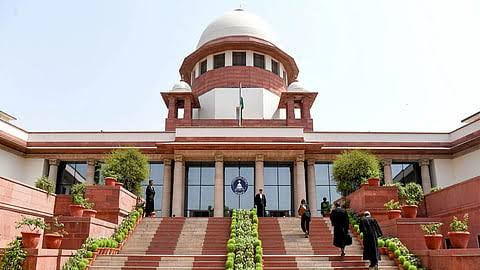
The Supreme Court has questioned the validity of the five-year tenure claimed by Bar Council of India (BCI) chairman Manan Kumar Mishra and directed that the Attorney General (AG) and Solicitor General (SG) be “actively associated” with major policy decisions of the apex lawyers’ body until its fresh reconstitution.
A bench comprising Chief Justice of India Surya Kant and Justices Joymalya Bagchi and V Mohana made it clear that Mishra’s continuance as BCI chairman cannot be treated as an arrangement extending until 2030.
The court observed that, prima facie, his position was only a “pro tem” continuation until a newly constituted BCI elects its office-bearers.
Why did the Supreme Court question Mishra’s tenure?
The issue arose during a hearing on petitions concerning elections to state bar councils. The proceedings also involved a fresh challenge to Mishra’s continuance as BCI chairman and the validity of notifications that purportedly extended the tenure of the chairman and vice-chairman until 2030.
Senior advocate Madhavi Divan, appearing for the petitioners, told the court that Mishra had been unanimously elected chairman on March 2, 2025, with his term beginning on April 17, 2025.
She argued that a January 9, 2025, resolution had sought to extend the tenure of the chairman and vice-chairman from three years to five years, despite the BCI Rules prescribing a two-year tenure.
The bench questioned how an extension could operate when the governing rules provided for a two-year term.
SC says BCI cannot continue indefinitely
The petitioners also challenged reliance on the proviso to Section 4(3) of the Advocates Act, which allows BCI members to continue until their successors are elected.
Divan argued that the provision, intended to prevent an administrative vacuum, had effectively been used to avoid elections and allow existing office-bearers to continue.
The Supreme Court said the provision was meant to operate as a transitional or ad hoc mechanism.
With elections to state bar councils now completed pursuant to the court’s directions, the bench indicated that the process for reconstituting the BCI should move forward.
The court asked whether there was any basis for the present office-bearers to continue until 2030 and emphasised that newly elected state bar councils must exercise their statutory power to elect their representatives to the BCI.
Those representatives would subsequently elect the BCI chairman and vice-chairman.
AG and SG to oversee major policy decisions
The Supreme Court also addressed concerns over the BCI’s institutional functioning and the concentration of decision-making powers.
Senior advocate CU Singh argued that resolutions were being issued from the chairman’s office without wider consultation and suggested that the involvement of the Attorney General and Solicitor General could provide an institutional check during the interim period.
The bench agreed that the two law officers should be involved in significant policy decisions.
However, it clarified that the AG and SG would not be required to participate in the BCI’s day-to-day functioning.
The court recorded the undertaking that the Attorney General and Solicitor General would be “actively associated” before any policy decision was taken by the BCI.
The BCI, represented by senior advocates Maninder Singh and Guru Krishnakumar, agreed to the arrangement.
Court raises questions over BCI trust
The bench also examined concerns surrounding trusts created by the BCI and allegations of concentration of control among current and former office-bearers.
Senior advocate Gopal Sankaranarayanan referred to the Bar Council of India Trust for Promotion of Education, Legal and Professional Reforms and Improvement in Research (PEARL Trust), established in 2020.
He alleged that the trust deed designated 11 managing trustees as “original and permanent trustees”, irrespective of whether they continued to serve as BCI members.
The court questioned whether an elected corporate body such as the BCI could use its assets to establish a trust in which individuals could remain permanent trustees even after leaving the body that created it.
Four-week roadmap for state bar councils
The Supreme Court has set out a four-week roadmap for completing the reconstitution process of the state bar councils.
Chief justices of the respective high courts have been given two weeks to complete the co-option of women members. The state bar councils must then notify their final composition within one week.
The newly constituted councils will subsequently have two weeks to elect their chairpersons, vice-chairpersons and other office-bearers, as well as their representatives to the BCI under the Advocates Act.
Once compliance reports are received, the Supreme Court will consider the reconstitution of the BCI.
The matters have been listed for further hearing on September 23.
NALSAR controversy had earlier put BCI under scrutiny
The latest directions come days after the Supreme Court criticised the BCI’s intervention in a controversy involving the 2026 graduating batch of NALSAR University of Law.
BCI chairman Mishra had initially directed state bar councils not to enrol students following their protest over the invitation extended to the CJI for their convocation.
The BCI later withdrew the freeze and closed proceedings against the students. Mishra subsequently apologised for any hurt caused by his remarks or the Council’s actions.
The Supreme Court has now stressed that its immediate concern is not the conduct of any individual but the institutional functioning of the BCI and the restoration of the statutory electoral framework.