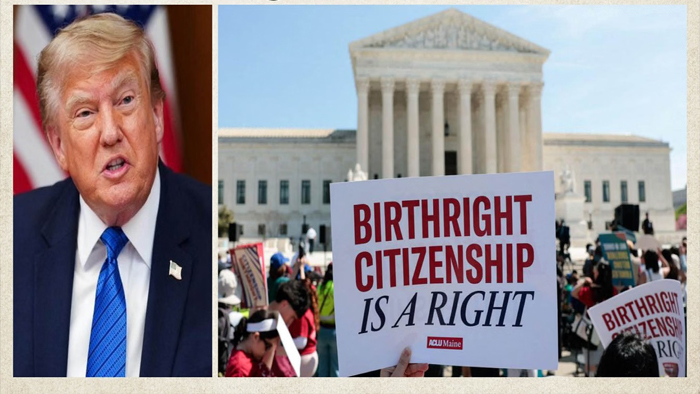
Washington. President Donald Trump's new attempt to limit birthright citizenship in America has suffered a major setback. Maryland federal judge Deborah L. Boardman has issued a preliminary injunction blocking the Trump administration's new executive order. The judge imposed the stay while a class-action lawsuit filed by immigrant families and rights groups is pending. Boardman, in his order, cited the previous decision of the Supreme Court and said that children falling in the concerned category are American citizens at the time of birth. However, there was no immediate reaction from the White House on this matter.
Under current US law, most children born on US soil receive US citizenship by birth. There are some exceptions to this. The legal foundation of this system was laid after the implementation of the 14th Constitutional Amendment in 1868. Trump has long been demanding the abolition of birthright citizenship. Earlier, he had issued an executive order in which an attempt was made to ban the granting of American citizenship to the children of people living in America illegally or in temporary status. That effort was rejected by the Supreme Court in June.
In August, the Trump administration issued a new, more limited-scope executive order. In this, an attempt was made to ban automatic citizenship of children born under certain circumstances. It mentioned children whose parents had ties to foreign embassies or organizations or who were considered 'foreign enemies' of America.
'Birth tourism' was also talked about in the order. This refers to a person who enters the country on a non-immigrant visa for the purpose of giving birth to a child in the US. U.S. regulations already allow such status to be considered grounds for visa action if a person obtains the visa specifically for the purpose of granting U.S. citizenship to a child.
Families and organizations challenging the new order said in the court that it had caused confusion and fear among many families. Some families feared that their children could be denied citizenship simply because they purchased air tickets to come to the United States and conceived after arriving. The petitioners also alleged that the executive branch is taking a broad approach to deeming an individual a 'foreign enemy' and in some cases may rely on conjecture or misinformation. Some families expressed concern that their children's citizenship could be affected because a member of their extended family was associated with a gang in their home country, even though the parents themselves were not gang members.
Lawyers for the Trump administration told the court that the demand to stop the order is premature. His argument was that the federal agencies implementing it will take appropriate action based on official guidelines that have not yet been released. Judge Boardman did not accept this argument. He said that regardless of what the guidelines say, the 2026 executive order directs agencies to stop providing citizenship documents to several broad categories of children.