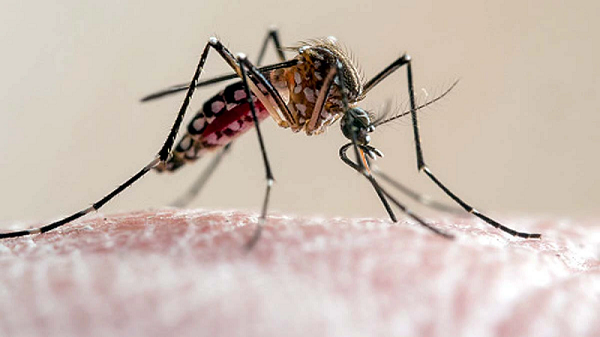
New Delhi. The problem of mosquitoes increases during rainy and humid seasons. Often you must have also felt that if many people are sitting in the same room, then mosquitoes hover around one person more and almost leave the other person. After all, on what basis does a mosquito choose its prey? Can he distinguish between humans? Does body odor attract him towards a particular person? To find answers to these questions, scientists at IIT Kanpur are studying the mosquito's brain and its ability to detect smells.
This research is being done in the lab of Professor Nitin Gupta at the Mehta Family Center for Engineering in Medicine, IIT Kanpur. Scientists want to understand how mosquitoes recognize the smell emanating from the human body. After this, how does the information related to that smell reach its brain and how does the mosquito decide to move towards a person on the basis of this information. The aim of this study is to understand the entire biological process behind mosquito behaviour.
In the research, special attention is being given to Aedes aegypti mosquito. This mosquito plays an important role in spreading diseases like dengue and chikungunya. Scientists want to find out why some people are more attracted to mosquitoes while others are less attracted to them. Different chemical signals emanating from the human body may play a role behind this.
Human body odor is not created only by sweat. Microorganisms living on the skin also produce different chemicals and affect the overall body odor. Not every person's body odor is the same. This difference can affect the behavior of mosquitoes. Scientists are now trying to understand what smell attracts a mosquito to a person and what signals can drive it away from a person.
Special sensors present on the mosquito's body detect chemical signals from the surroundings. The information from these signals reaches his brain where the information related to smell is processed. Scientists are studying this connection. To understand in simple language, researchers want to know what a mosquito smells. How his brain understands that smell and after that he decides in which direction to fly or approach the human.
Genetic technology like CRISPR Cas9 is also being used in this research. With its help, by making changes in certain genes of the mosquito, scientists can see how they affect the smell recognition and behavior of the mosquito. This can help in understanding the biological system of mosquito through which it searches for humans.
An important part of the study is to understand the behavioral changes that occur after a female mosquito drinks blood. Female mosquitoes need blood to develop eggs. After drinking blood its priority changes. After this, she focuses more on finding a suitable place to lay eggs rather than searching for humans. Scientists are trying to find out what changes in the mosquito's brain during this transition.
The importance of this research also increases because diseases spread by mosquitoes are a big health challenge. If scientists are successful in understanding what smells and signals mosquitoes use to reach humans, then in the future methods can be developed that alter these signals or disrupt the mosquito's recognition process. With this, instead of killing or driving away the mosquito, only its process of reaching the human being can be targeted.
This research of IIT Kanpur is currently focused on understanding the mosquito's ability to recognize smell and the activities taking place in its brain. Scientists hope that this study will lead to a better understanding of mosquito behavior and may help in finding new scientific solutions to control diseases like dengue and chikungunya in the future.