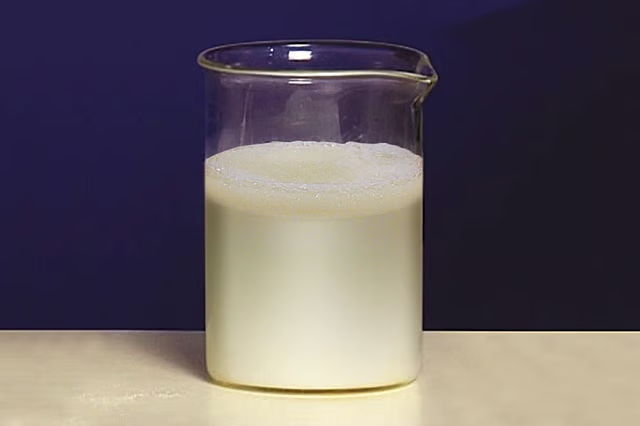
Is Your Milk Adulterated With Detergent? Check It at Home With This Simple Test
Milk is a daily staple in millions of Indian households, but concerns about adulteration often make consumers wonder whether the milk they are drinking is actually pure. One of the adulterants that can be tested for is detergent.
The Food Safety and Standards Authority of India (FSSAI) includes a simple shake test in its home-based food adulteration guidance.
How to Check Milk for Detergent at Home
You need only milk, water and a clean transparent container.
Step 1: Take the milk sample
Pour around 5–10 ml of milk into a clean glass or transparent container.
Step 2: Add an equal amount of water
Add approximately the same quantity of water to the milk.
Step 3: Shake it well
Close the container and shake the mixture thoroughly for a few seconds.
Step 4: Observe the foam
Now look carefully at the foam that forms on the surface.
- Pure milk: It may produce a very thin layer of foam because of agitation.
- Milk suspected of detergent adulteration: FSSAI’s home test says it can produce dense, persistent-looking lather.
But Don’t Treat the Foam Test as Final Proof
This is important: foam alone cannot conclusively prove that detergent is present. Milk naturally contains proteins and other components that can produce some foam when shaken.
For laboratory confirmation, FSSAI has a specific analytical method for detecting anionic detergents using methylene blue, methanol and chloroform. The official method requires laboratory safety precautions because some of these chemicals are hazardous.
So, if your milk produces unusually dense foam in the home test, don’t consume the suspected sample until you have investigated further, particularly if the result is consistent across samples.
You Can Also Check for Other Common Adulterants
FSSAI’s home-testing guidance includes tests for several milk adulterants. For example, an iodine test can be used to screen for starch, while the shake-with-water test is used for suspected detergent.
If you repeatedly suspect adulteration, a proper food laboratory test is the more reliable option. FSSAI also provides channels for reporting suspected food adulteration, including its Food Safety Connect system and toll-free number 1800-11-2100.
Bottom Line
Shake milk with an equal amount of water and observe the foam. A thin foam is expected from agitation, while unusually dense lather can be a warning sign of possible detergent adulteration. But remember: the home test is only a screening method—laboratory testing is needed for confirmation.