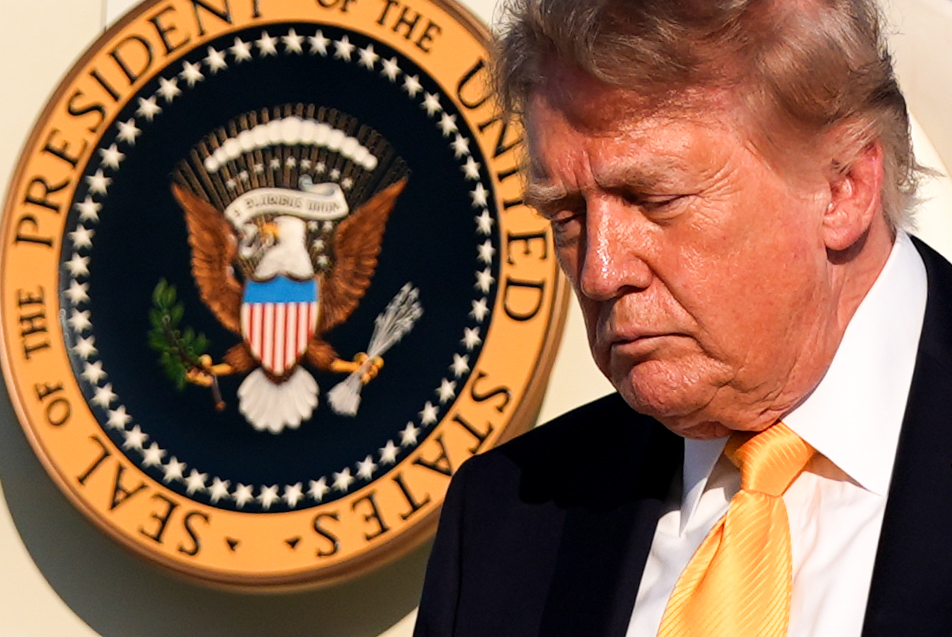
Trump Looms Over Volatile Final Stretch of 2026 Midterm Elections/ TezzBuzz/ WASHINGTON/ J. Mansour/ The 2026 midterm campaign is entering its final stretch amid shifting congressional maps, economic anxiety, overseas conflict and disputes over voting rules. Both parties agree that President Donald Trump will be the election’s central figure as Republicans defend narrow congressional majorities. Democrats see opportunities in House, Senate and gubernatorial races, but a shrinking number of competitive districts and their party’s ideological divisions create uncertainty.

Quick Look
- Trump remains the central figure in the final midterm campaign of his presidency.
- His overall approval stood near one-third in July polling cited by AP.
- Voters also expressed dissatisfaction with his handling of the economy and immigration.
- Congressional maps changed in Texas, California, Florida and other states.
- Missouri’s blocked Republican-backed map remains under appeal.
- Democrats need only a small number of seats to regain the House.
- The Senate fight centers on Democratic defenses and possible pickups in Republican-held states.
- Democrats are investing in gubernatorial races in Georgia, Ohio, Iowa and Nevada.
- Republicans are trying to connect Democratic candidates to the party’s socialist faction.
- Trump controls more than $400 million that could influence late campaign spending.
- Mail-ballot restrictions and federal election monitoring are causing concern in both parties.
- State and local officials oversee voting, ballot counting and certification under laws that vary by state.

Deep Look
A volatile election enters its final phase
WASHINGTON — The 2026 midterm elections are approaching their final weeks after a campaign transformed by war, trade disputes, economic pressure, artificial intelligence, redistricting and battles over voting procedures.
Many of the year’s defining issues were not prominent when the election cycle began. The United States had not entered its conflict with Iran, congressional boundaries had not undergone their latest revisions and concerns about energy-intensive AI data centers had not become a bipartisan political issue.
President Donald Trump has helped drive many of those changes, leaving Republicans to defend narrow congressional majorities in an unusually unsettled political environment.
“Some of these things are out of our control,” House Speaker Mike Johnson said when asked whether the upheaval could damage Republican prospects.
Congressional maps continue changing
The political map itself has remained in flux.
Texas, California and Florida are among the states that have redrawn congressional districts. The changes could affect the balance of power in a House where control may depend on a small number of races.
Missouri’s Republican attorney general is appealing a court ruling that blocked a Trump-backed congressional map from being used in November.
The mid-decade redistricting efforts have intensified the national fight for House control. At the same time, years of partisan mapmaking have reduced the number of districts where either party has a realistic chance of winning.
That means national changes in voter sentiment may produce fewer seat changes than in earlier midterm cycles.
Tariffs and economic anxiety create uncertainty
Economic concerns remain central to the campaign.
Trump’s tariffs on Canadian imports could produce additional price increases or business disruptions before Election Day. The continuing Iran conflict has also contributed to higher energy costs and broader inflationary pressure.
Trump has more than $400 million available through aligned political organizationsgiving him the ability to influence advertising, turnout programs and individual contests during the campaign’s closing weeks.
His administration’s expensive Washington construction and renovation plans may also offer Democrats a political contrast with Americans concerned about household costs.
The president reported receiving approximately $1.2 billion from cryptocurrency businesses during the previous year, according to a federal financial filing cited by AP.
Cryptocurrency ethics complicate Senate legislation
Trump’s financial involvement in cryptocurrency has affected a bipartisan Senate effort to strengthen regulation of the industry.
Democrats are demanding more extensive ethics provisions before supporting the legislation.
“We’ve watched this president enrich himself,” said Maryland Sen. Angela Alsobrooks, whose vote could be important to advancing the measure.
Alsobrooks said she would not support the legislation without stronger language addressing conflicts of interest.
The disagreement illustrates how Trump’s personal business activities could influence legislative debates and campaign messages during the final election stretch.
Both parties say the election centers on Trump
Republican and Democratic strategists agree that Trump will dominate voters’ decisions.
“No. 1, President Trump,” said Ari Fleischer, who served as White House press secretary under President George W. Bush, when asked to rank the election’s leading issues.
Rep. Suzan DelBene, chair of the Democratic Congressional Campaign Committeeoffered a similar assessment from the opposing party.
“People are feeling the pain from Trump,” she said.
DelBene predicted that voters would favor candidates who challenge the administration and Republicans in Congress.
A July AP-NORC survey found that roughly one-third of U.S. adults approved of Trump’s overall job performance. His approval on immigration stood at 39%, while his economic approval was approximately 32%.
Historical pattern favors the opposition party
Midterm elections traditionally create problems for the president’s party.
Democrats gained 40 House seats during Trump’s first midterm election in 2018. They added 31 seats during the final midterm of George W. Bush’s presidency in 2006.
Republicans captured 63 House seats under President Barack Obama in 2010 but gained fewer than 10 during President Joe Biden’s 2022 midterms.
The historical pattern gives Democrats reason for optimism, although the reduced number of competitive districts could limit the size of any national swing.
Democrats see path to House and Senate control
Democrats believe they can capture the relatively small number of seats required to regain control of the House.
Their Senate strategy is more complicated. The party must protect seats in states including Georgia, Michigan and New Hampshire while looking for possible gains in Maine, Texas, Iowa or Ohio.
The outcome will depend on candidate quality, turnout and the political conditions within each state rather than national sentiment alone.
Republicans, meanwhile, hope Trump’s core supporters will turn out in sufficient numbers to preserve the party’s majorities despite his low national approval.
Governors’ races offer opportunities beyond Washington
Democrats are also investing heavily in state elections.
The party is targeting Republican-held governorships in Georgia, Ohio, Iowa and Nevada.
“I’m excited about the map and I am bullish that we are going to pick up several seats,” said Kentucky Gov. Andy Beshear, chair of the Democratic Governors Association and a possible 2028 presidential contender.
Democrats are particularly optimistic about Iowa, which has not elected a Democratic governor in 20 years.
The association has spent $5 million supporting Rob Sand, whose campaign is focused on rebuilding Democratic support among rural voters.
Beshear acknowledged that other contests will be difficult. He described Arizona Gov. Katie Hobbs’ race against Republican Andy Biggs as a “tough race.”
Republicans target Democrats over socialism
Republicans are trying to connect mainstream Democratic candidates to democratic socialists who won several congressional primaries during the summer.
Most socialist-aligned nominees are competing in safely Democratic districts, limiting their direct impact on control of Congress.
Republicans nevertheless hope those victories will help define the broader Democratic Party as ideologically extreme.
Fleischer said Democrats had snatched “defeat out of the jaws of victory” by nominating socialist candidates in several races.
Beshear rejected the Republican argument and sought to redirect the label toward Trump’s economic interventions.
“The only person that I see engaged in socialism is Donald J. Trump, who is taking equity in private companies for the United States government,” he said.
Anti-incumbent mood affects both parties
Republicans are also trying to use voter dissatisfaction against longtime Democratic officials.
In Minnesota, Republican gubernatorial candidate Lisa Demuth is challenging Amy Klobuchar, who served nearly two decades in the Senate following her earlier work in local government.
“She is a 30-year politician,” Demuth said.
The argument reflects an anti-incumbent sentiment that could affect candidates from both parties, even in an election largely framed as a referendum on Trump.
Mail voting dispute adds another variable
Trump’s effort to restrict mail voting could create uncertainty as states begin distributing absentee ballots.
The issue is especially significant in North Carolina, which has a closely watched Senate race.
State and local officials traditionally administer American elections under rules that vary by jurisdiction. The National Association of Secretaries of State directs voters to their state election officials for authoritative information about registration, voting methods, security and certification.
Trump administration involvement in election oversight has concerned some Republican officials as well as Democrats.
Republican governors resist federal election control
Wyoming Gov. Mark Gordon criticized Justice Department officials who monitored poll workers and observed voters during his state’s primary election.
Gordon described their behavior as “a bit aggressive” and “irregular.”
“I feel very strongly about the federal government coming in and taking our guns,” he said. “I don’t like that. I don’t like the federal government coming in and taking our votes, either.”
Oklahoma Gov. Kevin Stitt has also opposed federal control of elections despite supporting stricter proof-of-citizenship requirements.
“I don’t think that we should federalize the elections at all,” Stitt said. “I believe that is a state issue. The states should control their own elections.”
State races could shape the 2028 environment
Some Democrats are connecting the 2026 state elections to the next presidential contest.
Nevada Attorney General Aaron Ford, who is running for governor, argues that electing officials who will protect state voting procedures is important beyond the midterms.
“2028 starts right now,” Ford said. “People across the nation need to understand that Nevada is a swing state, it needs a governor who is going to stand up for the electoral process.”
The November results will determine control of Congress and numerous state governments. They will also shape each party’s organization, leadership and strategy heading into the 2028 presidential election.
More on US News