Trump Says a Unified Ireland Would Be ‘Fantastic’ During Dublin Visit/ TezzBuzz/ WASHINGTON/ J. Mansour/ President Donald Trump said he would like to see the Republic of Ireland and Northern Ireland unified. His remarks touched on a politically sensitive question governed by the consent provisions of the 1998 peace agreement. Trump also discussed the Falkland Islands while combining official meetings with a visit to the Irish Open at his Doonbeg golf property.

Quick Look
- Trump expressed support for a unified Ireland during talks in Dublin.
- He acknowledged that the United Kingdom would have a role in any decision.
- The 1998 peace agreement allows a referendum if majority support appears likely.
- The U.K. government says it sees no current basis for another referendum.
- Trump also commented on the Falkland Islands dispute.
- He met Irish Prime Minister Micheál Martin and President Catherine Connolly.
- Protesters planned demonstrations against Trump in Dublin.
- Trump traveled to his Doonbeg resort to attend the Irish Open.
- Eric Trump defended the family’s investment and employment record in Ireland.


Deep Look
Trump expresses support for Irish unification
DUBLIN (AP) — President Donald Trump said Saturday that a unified Ireland would be “fantastic,” entering a sensitive constitutional debate during a visit combining official meetings with attendance at a golf tournament held at his family’s Irish property.
Trump made the comments while meeting Irish Prime Minister Micheál Martin in Dublin. A reporter asked whether he supported unifying the Republic of Ireland with Northern Ireland, which remains part of the United Kingdom.
“I don’t want to cause any problems but I’d love to see it unified,” Trump said. “It’s going to happen eventually. It may as well happen now.
“I think it would be a fantastic thing,” he continued, adding that “the U.K. will have something to say about it, obviously.”
Previous American presidents generally avoided stating a direct preference on Northern Ireland’s constitutional status, including those such as Joe Biden who emphasized their Irish heritage.
Northern Ireland’s status remains politically sensitive
Disagreement over whether Northern Ireland should remain British or become part of a unified Ireland contributed to decades of violence known as the Troubles, which killed approximately 3,600 people.
After most of Ireland became self-governing a century ago, six northern counties with a predominantly Protestant population remained within the United Kingdom.
Northern Ireland subsequently became divided primarily between nationalists, most of them Catholic and supportive of Irish unification, and mostly Protestant unionists who wanted the region to remain British.
Those tensions developed into approximately three decades of conflict involving republican and loyalist paramilitary organizations, British troops and security forces.
Peace agreement requires democratic consent
The 1998 peace accord, which the United States helped broker, largely ended the violence but did not resolve Northern Ireland’s permanent constitutional status.
Under the agreement’s principle of consent, Northern Ireland can join the Republic of Ireland only if a majority of its voters supports that outcome in a referendum.
British Prime Minister Andy Burnham said Wednesday that the conditions for such a vote had not been met.
“I am not aware that there is majority public support for another referendum, and until that changes, there will not be one.”
The British government has reaffirmed its commitment to the agreement’s consent principle, under which Northern Ireland’s status is determined by the freely expressed choice of its population.
Trump comments on Falkland Islands dispute
Trump also discussed the sovereignty dispute between the United Kingdom and Argentina over the Falkland Islands.
Argentina calls the South Atlantic territory Las Malvinas and continues to claim sovereignty over it. The islands remain a British overseas territory.
Argentine President Javier Milei, an ally of Trump, recently renewed his country’s claim. Trump has previously suggested that Washington could reconsider its neutral position on the sovereignty dispute.
Britain regained control of the islands after Argentina invaded them in 1982. Trump expressed doubt that the United Kingdom could repeat that operation if another conflict occurred.
“I’m sure I’ll be called into that potential disaster, but if they do, I’ll probably be able to settle, settle it out,” he said.
Trump meets Ireland’s political leaders
Trump held separate meetings with Martin and Irish President Catherine Connolly during his visit to Dublin.
Connolly, a left-wing politician and supporter of the Palestinian causehad previously criticized Trump and U.S. policy in the Middle East. She participated in protests during Trump’s 2019 visit to Ireland and has called him a “bully.”
The Irish presidency is an elected but largely ceremonial position.
Connolly welcomed Trump at the end of a red carpet at Áras an Uachtaráin, the president’s official residence. They shook hands and spoke briefly before entering the building.
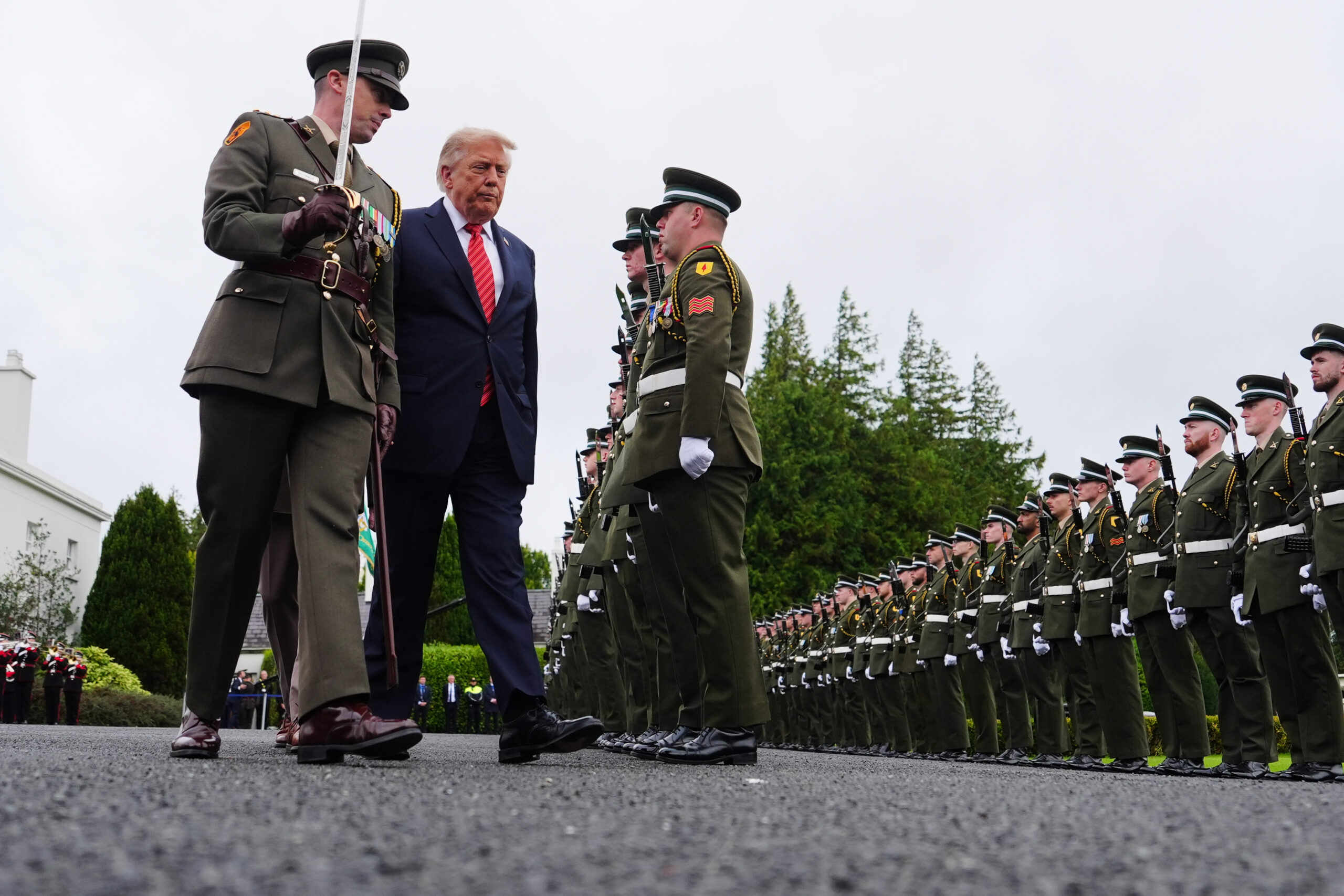
Trump emerged alone several minutes later. He saluted while an Irish Defence Forces band played the U.S. national anthem and then inspected an Irish Army honor guard.
He also met Martin, known in Ireland as the taoiseach, at the Farmleigh state guesthouse and visited Deerfield, the official residence of the U.S. ambassador.
Security restrictions disrupt Dublin
Police established a security perimeter around the 1,750-acre, or 700-hectare, Phoenix Parkwhich contains the presidential residence, the U.S. ambassador’s residence and Farmleigh.
Some Dublin residents criticized the disruption caused by Trump’s visit.
“He’s causing mayhem in this city because he wants to go down to Doonbeg and play golf,” taxi driver Christopher Fox said. “The world’s in turmoil and this fella’s down playing golf.”
University student Mina Petrovski said Trump’s “attitudes toward women, toward immigrants, toward minority communities in general are abhorrent.”
She described it as “shameful that the Irish government is welcoming him with open arms.”
Left-leaning opposition parties, antiwar groups, pro-Palestinian organizations and environmental campaigners planned demonstrations in Dublin during the visit.
Eric Trump defends family’s Irish presence
Eric Trump defended his family’s ties to Ireland and said the Trump International golf resort is the largest employer in the Doonbeg area.
“Go down to Morrissey’s tavern in Doonbeg and hear from a real Irish person as to whether or not they like President Trump and the Trump family, go have them attest to what we’ve done for the country and what we’ve invested in the country and the love and respect that our family has always shown them,” he told Irish broadcaster RTE.
The president planned to travel from Dublin to his oceanfront resort in Doonbeg, on Ireland’s western coast, to attend the Irish Open.
Official visit overlaps with Trump business interests
Trump’s trip combined presidential activities with an appearance at a sporting event hosted at a property owned by his family business.
He frequently plays golf at clubs bearing his name in Florida, New Jersey and Virginia. He has also attended prominent sporting events and participated in organizing tournaments held at Trump properties.
The family’s clubs in Doral, Florida, and Bedminster, New Jersey, hosted professional tournaments earlier in 2026.
The Irish Open is the second European Tour event held at a Trump property during the year. The Nexo Championship took place in August at his course in Aberdeen, Scotland.
Trump also spent five days in Scotland in 2025, playing at his Turnberry resort and inaugurating another Trump golf course in Balmedie, Aberdeenshire. He met the British prime minister and European Commission president during that trip.
More on US News