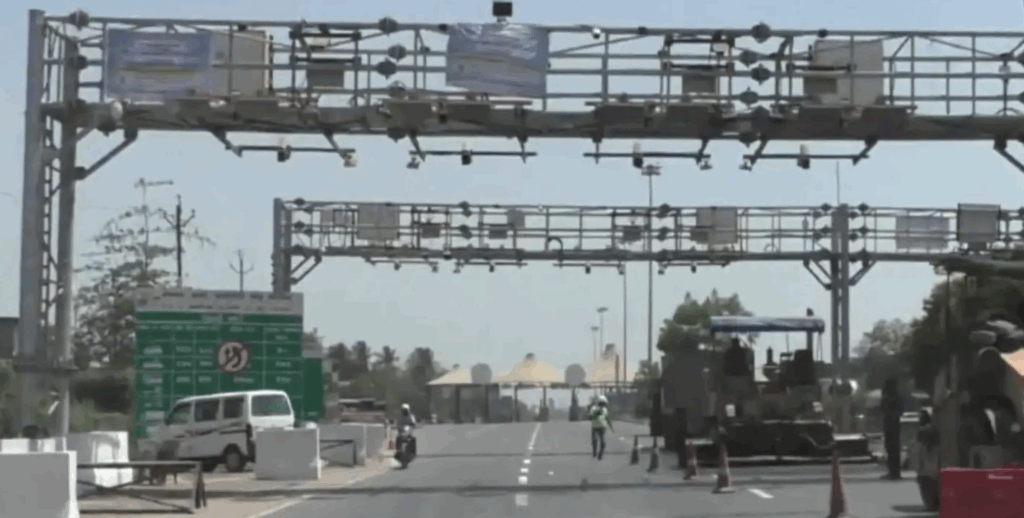
India is set to move towards a fully barrier-free toll collection system across its national highways by March 2027, Union Road Transport and Highways Minister Nitin Gadkari has said. The move is aimed at eliminating stoppages at toll plazas and making highway travel faster and more efficient.
Multi-Lane Free Flow System to Replace Toll Barriers
The government plans to implement the Multi-Lane Free Flow (MLFF) system, which allows vehicles to pass through tolling points without stopping at physical booths or barriers.
The system uses overhead gantries equipped with Automatic Number Plate Recognition (ANPR) cameras and FASTag readers to identify vehicles and automatically collect the applicable toll.
Unlike conventional toll plazas, motorists will not need to slow down or queue behind barriers. The technology is designed to allow vehicles to continue travelling at normal highway speeds.
India launched its first MLFF barrier-less tolling system at the Chorayasi Toll Plaza on the Surat-Bharuch section of NH-48 in Gujarat in May 2026.
70% of Toll Plazas Targeted by December
Gadkari said the government has directed officials to accelerate the rollout, with around 60% to 70% of the work expected to be completed by December 2026.
The entire national highway tolling network is then expected to transition to the barrier-free model by February-March 2027.
There are around 1,200 toll plazas operated by the National Highways Authority of India and private concessionaires.
The government is targeting virtually zero stoppage at toll points, with waiting time expected to fall to less than 10 seconds under the new system.
Lower Costs and Fuel Consumption
The shift away from conventional toll booths is also expected to reduce the cost of operating and maintaining toll plazas.
Gadkari said toll-plaza operating costs currently account for around 12% to 15%but could fall to approximately 2% to 4% once MLFF is implemented nationwide. This could generate annual savings of around ₹6,000 crore to ₹7,000 crore.
FASTag has already substantially reduced waiting times at toll plazas. The government estimates that reduced delays have saved around 56 crore litres of fuel annuallywith fuel savings valued at approximately ₹5,250 crore.
FASTag Moves to Its Next Stage
FASTag transformed India’s toll collection by replacing cash payments with electronic deductions. MLFF represents the next step by removing the need for vehicles to stop altogether.
The system is expected to reduce congestion, fuel consumption and emissions while improving the movement of passengers and freight across national highways.
Summary: India plans to make all national highway toll plazas barrier-free by March 2027 using the Multi-Lane Free Flow system. Around 60–70% of the rollout is expected by December 2026, with ANPR cameras and FASTag enabling automatic toll collection without stopping. The government expects the system to reduce operating costs and significantly cut waiting time, fuel consumption and congestion.