From forgotten mountain to tourism destination
More than a century ago, in November 1901, an expedition led by French Captain Debay under orders from Governor-General Paul Doumer reached Mount Chua.
At 1,487 meters, the mountain had a cool climate comparable to Da Lat and was later developed by the French as a hill station. A road connecting Ba Na with the national highway was completed in 1919, followed by nearly 240 villas and guesthouses. The area became a retreat for French officials and wealthy residents in Indochina.
Much of the infrastructure was destroyed during wartime, leaving Ba Na largely undeveloped for decades.
In early 1997, the Da Nang government began efforts to revive Ba Na as an ecotourism destination, but visitor numbers remained limited.
Access was a major challenge. Reaching the summit required traveling along a winding 15-kilometer mountain road with numerous sharp bends, while facilities at the top remained basic.
|
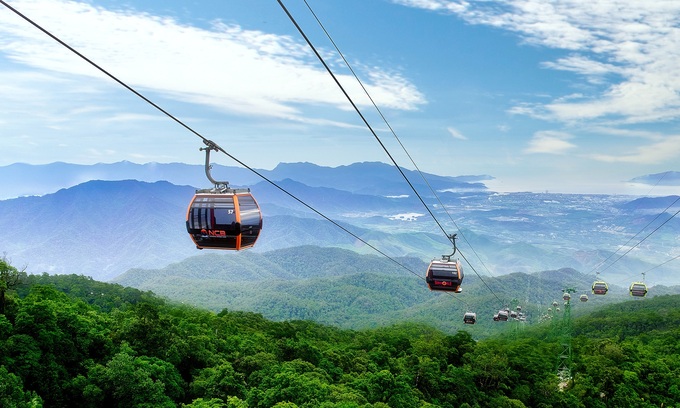
Mount Chua has undergone significant tourism development over nearly two decades. Photo courtesy of Sun Group |
As late as 2009, Ba Na attracted only around 30,000-40,000 visitors a year.
Several investors had considered developing Ba Na before Sun Group became involved. The group’s chairman Dang Minh Truong recalled that companies had surveyed Ba Na and Fansipan but decided against investing because of the required capital and engineering challenges.
In October 2007, its executives traveled to the mountain with Da Nang officials to assess the possibility of building a cable car system.
The terrain presented major challenges, while the project also sought to minimize its impact on the surrounding forest. On Sept. 14, 2007, Ba Na Cable Car Service Joint Stock Company was established, marking the start of the development that would become Sun World Ba Na Hills.
 |
|
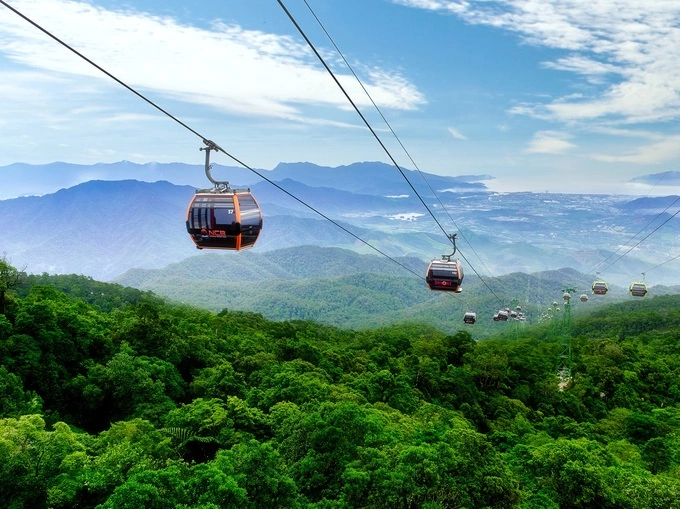
The cable car system in Ba Na. Photo courtesy of Sun Group |
On March 25, 2009, the Ba Na-Suoi Mo cable car began operations and was recognized with four Guinness World Records at the time.
The cable car improved access to the summit and marked a turning point in Ba Na’s development as a tourism destination.
New attractions reshape Ba Na
Following the cable car’s opening, new tourism products and attractions were introduced at Ba Na Hills, giving visitors more reasons to return.
The phrase “Ba Na Hills – The path to fairy land” became associated with the destination, replacing the old saying that had reflected local perceptions of Ba Na before its redevelopment.
A major milestone came in 2018 with the opening of the Golden Bridge.
Nearly 150 meters long and visually supported by two giant stone hands, the bridge attracted international attention and was featured by CNN, BBC, The New York Times, TIME, Fox News and The Guardian.
 |
|
The Golden Bridge, opened in 2018, has become one of Ba Na Hills’ most recognizable attractions. Photo courtesy of Sun Group |
Other attractions followed, including Helios Waterfall, featuring bronze sculptures from Italy’s Frilli Gallery; Time Gate; Lunar Castle, which opened in 2022; and Eclipse Square.
More recent additions include Ba Na Brew House and a Pop Mart store, expanding the destination’s mix of entertainment, cultural and commercial experiences.
Ba Na Hills has also received World Travel Awards titles including “Asia’s Leading Theme Park” and “World’s Leading Iconic Tourist Attraction.”
The Golden Bridge was named “World’s Leading Iconic Tourist Bridge” for four consecutive years by the World Travel Awards and was included by Britain’s Daily Mail in its “New Wonders of the World” selection in 2021.
From mountain attraction to tourism growth
The development of Ba Na Hills has coincided with rapid growth in Da Nang’s tourism industry.
Between 2009 and 2018, visitor numbers to Ba Na increased more than 160-fold, while total visitors to Da Nang rose 463%, according to figures provided in the article.
Over the same period, passenger traffic through Da Nang International Airport increased from around two million in 2009 to more than 13.3 million in 2018.
Ba Na also recorded a strong recovery after the Covid-19 pandemic. From 2021 to 2024, visitor numbers increased nearly 22-fold, while the number of accommodated visitors to Da Nang rose more than ninefold over the three-year period.
Ba Na recorded annual visitor growth of more than 20% for three consecutive years from 2022 to 2024.
The growth has also supported an operational and tourism supply chain employing thousands of direct and indirect workers.
Agoda booking data for the first half of 2026 ranked Da Nang sixth among Asian destinations with the highest levels of repeat travel. Attractions including Ba Na Hills and the Golden Bridge are among the tourism products contributing to the city’s appeal to returning visitors.
The figures show how major attractions have accompanied Da Nang’s broader tourism expansion, alongside improvements in aviation connectivity, accommodation, infrastructure and other tourism products.
 |
|
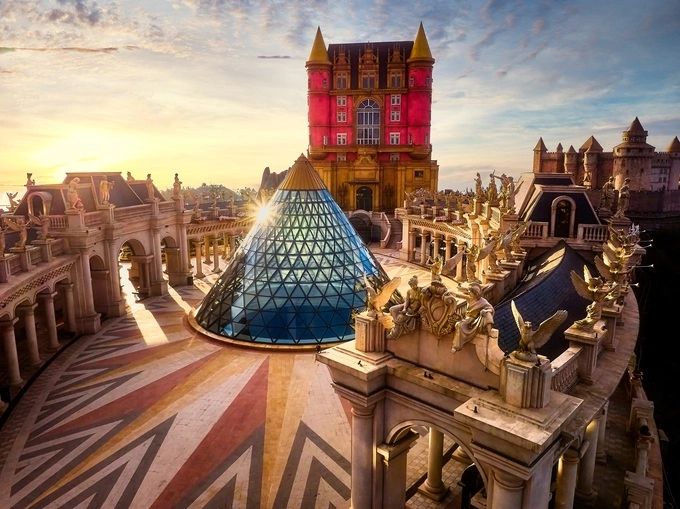
Ba Na Hills has developed from a relatively little-visited mountain destination into one of Da Nang’s major tourist attractions. Photo courtesy of Sun Group |
Resolution No. 26-NQ/TW of the Politburo identifies Da Nang as one of Vietnam’s three major tourism growth poles, alongside Hanoi and Ho Chi Minh City.
Major attractions such as Sun World Ba Na Hills and the Golden Bridge form part of the city’s efforts to strengthen its position as a tourism hub in central Vietnam.
Nineteen years after Ba Na Cable Car Service Joint Stock Company was established, Mount Chua has changed substantially from the destination once described in the old local rhyme.
The fading of that saying reflects a broader shift in how Ba Na is perceived: from a difficult-to-reach mountain with limited tourism infrastructure to a landmark associated with Da Nang’s tourism development.