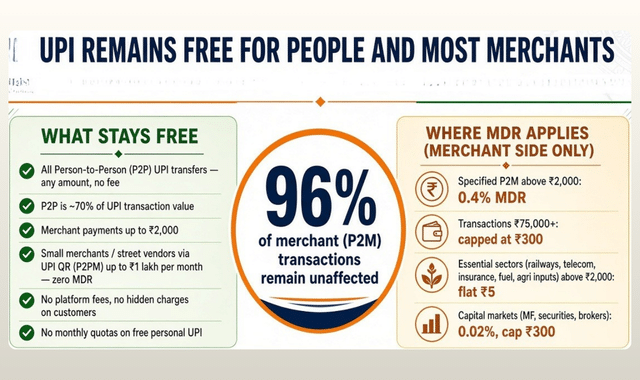
India’s Unified Payments Interface will remain completely free for every person-to-person transfer, the Ministry of Finance said on 15 September 2026. There is no transaction fee, platform fee or hidden charge on sending or receiving money between individuals, regardless of amount.
That matters because P2P already accounts for about 70% of UPI’s total transaction value. Those flows sit entirely outside the new merchant discount rate (MDR) framework.
For payments to merchants, the picture is almost as protective. All person-to-merchant (P2M) transactions up to Rs 2,000 stay free of MDR. Street vendors and other small merchants who receive up to Rs 1 lakh a month through UPI QR codes under the person-to-person-merchant (P2PM) category also keep zero MDR on every transaction. Officials say that combination leaves roughly 96% of merchant transactions untouched.
MDR will apply only to a narrow slice of larger merchant payments. For specified P2M transactions above Rs 2,000, the rate is a nominal 0.4%, shared among banks, payment service providers and UPI apps. On transactions of Rs 75,000 and above, the charge is capped at Rs 300. Essential and thin-margin sectors — railways, telecom, insurance, fuel and agricultural inputs — face a flat Rs 5 on payments above Rs 2,000. Capital-market payments (mutual funds, securities, brokers) attract 0.02%, also capped at Rs 300.
The government was explicit on two points that often get lost in payment debates. First, MDR is not a tax and is not collected by the Centre or NPCI. It is a fee inside the merchant ecosystem, meant to pay for rails, fraud controls and expansion, including in rural and semi-urban areas. Second, customers must not pay it. Banks have been told to stop merchants from passing the charge on to buyers. UPI apps are barred from adding platform fees. There are still no monthly quotas or volume caps on free personal use. Existing daily limits of Rs 1 lakh to Rs 5 lakh remain risk controls, not pricing thresholds.
A dedicated fund, seeded with 5% of MDR collections, will push UPI further among small merchants. The framework sits under the Payment and Settlement Systems Act, 2007, after work by the UPI Steering Committee, and tracks a Standing Committee on Finance recommendation that the system needs a viable revenue model if it is to stay reliable at national scale.
In short: if you are sending money to family, splitting a bill, or paying a kirana or street vendor for an everyday purchase, nothing changes. The limited charge is aimed at larger merchant tickets so the rails that made UPI ubiquitous can keep running without shifting the cost onto individuals or the smallest shops.