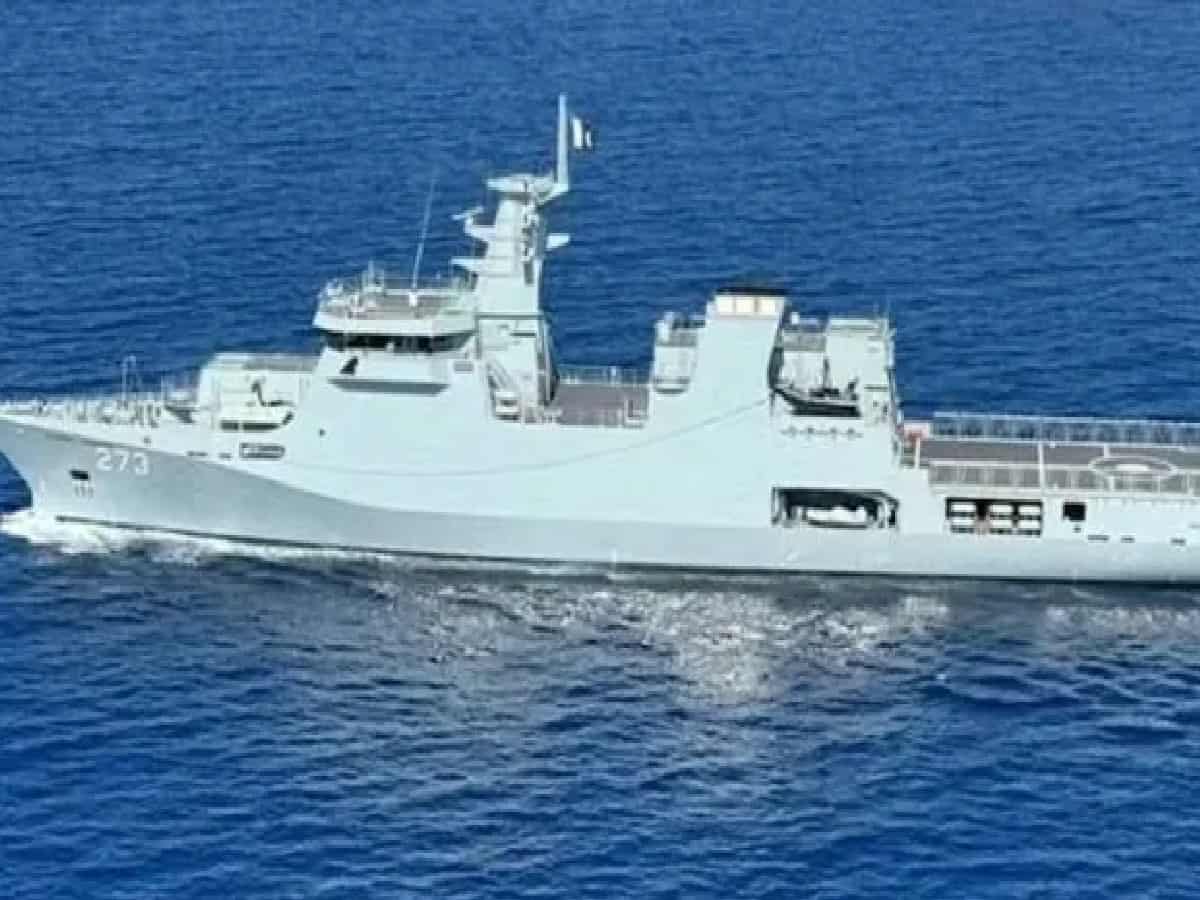
An extremely dangerous and provocative military incident has come to light on the evening of 15 September 2026 in the strategically sensitive international maritime corridor of the Arabian Sea. A frontline warship of the Indian Navy deployed on a routine surveillance mission was directly hit by the Pakistan Navy's brand new guided-missile corvette PNS Hunain (PNS Hunain F-273). This unexpected maritime encounter took place when the Indian Navy warship was on peaceful patrol and vigil in its assigned maritime area. According to eyewitness military sources and initial operational reports, the Pakistan Navy warship suddenly came very close to the Indian warship at extremely high speed, carried out unprofessional, aggressive and unsafe maneuvers and lost control and collided with it. This incident, which flouts international rules and basic maritime etiquette related to the movement of ships at sea, has once again created huge military and diplomatic tension between the two neighboring countries. In this tremendous collision, while the Indian warship did not suffer any major structural damage, on the other hand, after colliding with the Indian warship, the front part and outer structure of the Pakistani warship PNS Hunain was seriously damaged. Immediately after the incident, PNS Hunain was forced to abandon her patrol and return to Karachi port for repairs to save her life. At this critical moment of crisis, the Commanding Officer and crew of the Indian warship displayed extraordinary tactical maturity, unparalleled patience and a high degree of restraint, due to which any major military retaliation such as missile or artillery fire at sea could be avoided. Taking this audacious and reckless incident extremely seriously, the Government of India summoned the Charge d'Affaires of the Pakistan High Commission in New Delhi to the South Block of the Ministry of External Affairs and submitted a very strong protest letter against this provocative action of Islamabad. What is Pakistan Navy's PNS Hunain and why it was considered their new maritime trump card? PNS Hunain, which was damaged after colliding with the technical strength of the Indian Navy in the Arabian Sea, is not an ordinary patrol vessel, but it is the newest and much-publicized warship of the Pakistan Navy. PNS Hunain (pennant number F-273) is the lead frigate of the Yarmouk class Batch-2 Offshore Patrol Corvette of the Pakistan Navy. It was built by the famous Dutch defense company 'Damen Shipyards' located in Galați, Romania, in the European country. This modern warship was formally inducted into the Pakistan Navy very recently, i.e. during a grand military ceremony in July 2024. These ships of the Yarmouk class, based on a Dutch design, were designed to provide surface-to-surface warfare, coastal security, anti-submarine surveillance and missile defense systems. Islamabad had made this warship a part of its fleet at a huge cost despite the international financial crisis to challenge the traditional dominance of the Indian Navy in the Arabian Sea. Talking about the technical specifications of PNS Hunan, its overall length is approximately between 95.8 meters to 98 meters, while its width ranges from 14.4 to 14.6 meters. This corvette, with a displacement capacity of approximately 2600 tons, is powered by four powerful Caterpillar diesel engines, giving it a maximum speed of 41 to 44 kilometers per hour (approximately 22 to 24 knots) at sea. The ship has the capability to travel non-stop for approximately 11,000 kilometers (6,000 nautical miles) at an economical speed of 22 kilometers per hour. Apart from this, this warship is fully capable of being deployed in deep waters for 40 continuous days without stopping at any port. It has a large flight deck and hangar at its rear, on which maritime surveillance helicopters and unmanned aerial vehicles (UAVs) can be deployed. It is also equipped to carry two Rigid Hull Inflatable Boats (RHIB) for quick maritime strikes and boarding operations. PNS Hunain was equipped with Turkish and indigenous weapons: Details of radar and lethal missile systems Pakistan Navy had claimed to develop PNS Hunain not just as a patrol vessel but as an offensive missile platform. State-of-the-art weapon stations manufactured by Turkey's leading defense company Aselman have been installed on this warship. A 30-millimeter Asselman SMASH remote-controlled weapon station is installed on its main deck, which is capable of tracking targets even in the dark of night. Along with this, two 12.7 mm Aselman Stamp (STAMP) remote weapon stations have been installed for close security. There is a provision to install two twin-cell or quad-cell (total four to eight missiles) launchers of indigenously developed 'Harbah' sub-sonic cruise missile by Pakistan on this ship to target enemy surface warships and ground targets with heavy destruction. Every missile is considered capable of delivering accurate strikes from sea to surface and from sea to land. To protect the ship from air attacks and incoming anti-ship missiles, it is fitted with a 20 mm Phalanx Block 1B Close-in Weapon System (CIWS) or a Turkish-made equivalent rapid-fire air defense system. As the ship's electronic eyes and ears, it is fitted with MR-36A surface and air search radar, advanced electronic warfare (EW) suite and state-of-the-art decoy dispensing launchers to divert incoming guided missiles. The Pakistani Navy intended to field this corvette in multi-role maritime security operations, offensive patrolling in the high seas and limited air defense operations. However, this recent irresponsible action in the Arabian Sea has proved that despite being equipped with modern electronic equipment and weapons, the severe lack of professional maritime training and navigation discipline in the crew can prove to be suicidal for the warship itself. Open violation of the historic India-Pakistan military agreement of 1991: Strong stance of the Ministry of External Affairs This incident of deliberate endangering of an Indian Navy ship by a Pakistani warship in the Arabian Sea has raised serious questions on the three decade old bilateral agreements between the two countries. The Indian Ministry of External Affairs has clarified that this provocative action of Pakistan is a direct and gross violation of the 'India-Pakistan Agreement on Advance Notice on Military Exercises, Maneuvers and Troop Movements' signed on 6 April 1991. Article 10 of this historic treaty clearly directs that the Navies, Armies and Air Forces of both the countries shall completely refrain from aggressive maneuvers, unexpected close movements or any military activity near each other which could lead to misunderstanding, miscalculation or unexpected military conflict at sea or in the airspace. The Pakistani warship coming very close to the Indian surveillance ship at very high speed and colliding with it is a direct violation of the basic principles of this agreement. Senior officials of the Ministry of External Affairs have bluntly warned the Pakistani diplomat summoned in New Delhi that such childish and aggressive actions in international waters can turn into a major strategic crisis at any time. India has demanded Pakistan to conduct a high-level court of inquiry into this entire incident, take strict disciplinary action against the guilty naval officers and strictly follow international navigation safety standards in future. Experts believe that the alertness and professional restraint of the Indian Navy averted a catastrophic conflict, but the serious damage caused to the modern ship of the Pakistani Navy has shocked the military strategists of Islamabad.