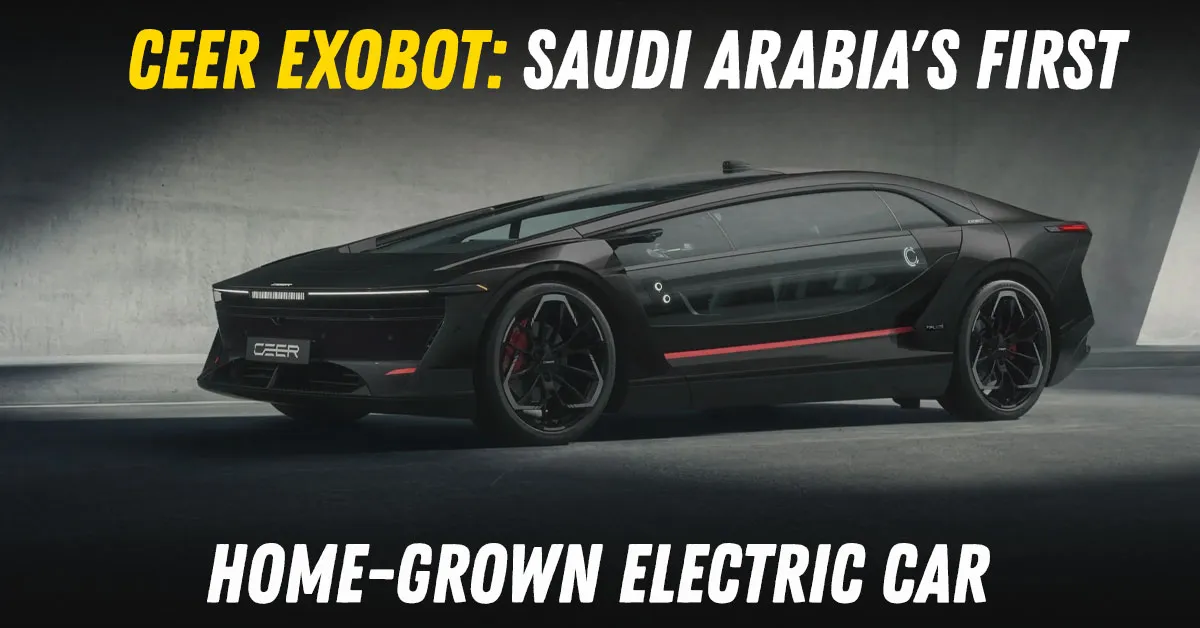
Saudi Arabia now has its first home-grown carmaker. Ceer has unveiled the Exobot sedan and SUV, two high-performance electric flagships that will begin sales in Saudi Arabia in early 2027. Prices have not yet been announced.
The headline numbers are deliberately ambitious. The highest-spec Exobot uses three motors and all-wheel drive to produce up to 1,111hp and 1,500Nm. Ceer claims 0-100kph in 2.1 seconds for the sedan and 2.4 seconds for the SUV. Lower Exobot Plus versions are rated at 850hp.
Both use a 112kWh battery and 800V electrical architecture. Ceer quotes up to 670km of NEDC range for the sedan and 560km for the SUV, with a 10-80 percent DC fast charge taking under 30 minutes. Those are NEDC figures, so real-world range will be lower.
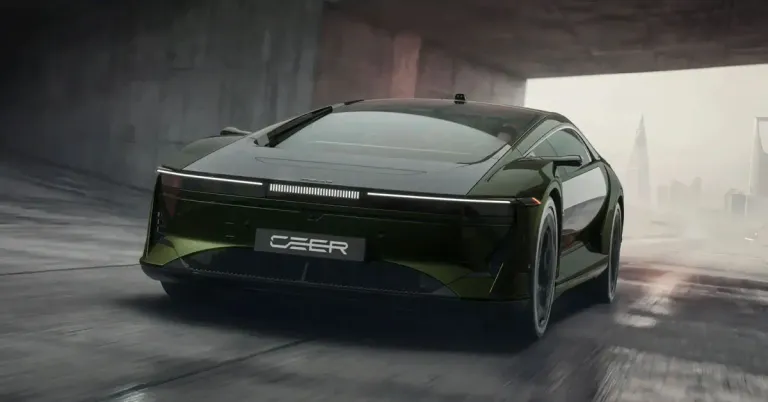
Ceer was created in 2022 as a joint venture between Saudi Arabia’s Public Investment Fund and Foxconn. BMW licenses component technology for the programme, while Foxconn has been involved in the electrical architecture. The vehicles are being designed, engineered and manufactured in Saudi Arabia rather than simply imported and rebadged.
Production will take place at Ceer’s manufacturing complex in King Abdullah Economic City near Jeddah. The company is building a local supplier ecosystem around the factory, with global component makers and Saudi companies being brought into the programme.
That makes Ceer different from Saudi Arabia’s investment in Lucid. The PIF is a major shareholder in Lucid, but Ceer is intended to create a domestic automotive industry, engineering base and supplier network inside the kingdom.
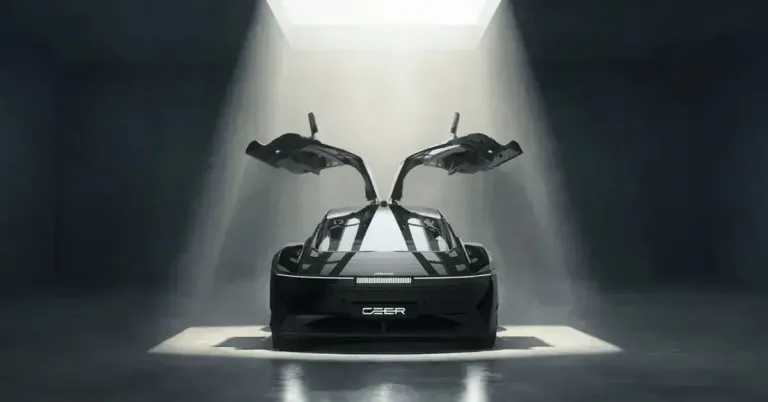
The Exobot sedan and SUV are not mass-market cars. Both use large upward-opening Shahin Wing doors, no conventional B-pillar between the front and rear doors, steer-by-wire, rear-wheel steering and adaptive air suspension. The sedan can be configured as a four-seater, while the interiors use a dashboard-wide digital display and additional touchscreens.
Ceer is also using the flagships to show technology that can later move into less expensive models. The company plans a seven-model range by 2030, including smaller vehicles and different propulsion systems. Reuters reports that plug-in hybrids and combustion-engine vehicles are also planned as Ceer adjusts to changing global demand.

That is important because Saudi Arabia is not yet a large EV market. Chinese brands already sell a wide range of competitively priced petrol, hybrid and electric cars in the Gulf, so the cars that determine Ceer’s success are likely to be the more mainstream models that follow the Exobot.

Ceer originally targeted an earlier launch, but the first customer cars are now due in early 2027. The company says the initial focus is Saudi Arabia and the wider Gulf region, with possible Middle East and North Africa expansion by 2028. The cars have also been engineered with global homologation in mind, although sales in Europe or North America have not been confirmed.
For now, there is no price to judge the Exobot against established luxury EVs. That missing number will decide whether its 1,111hp specification is commercially meaningful or simply a flagship statement.
What has already changed is the industrial side. Saudi Arabia has spent years trying to attract vehicle manufacturing with mixed results. Ceer is the first attempt to build a national car brand around local engineering, production and suppliers from the start. The Exobot’s extreme performance will get the attention, but the real test is whether Ceer can turn two attention-grabbing EVs into a sustainable seven-model car company.