Republicans Pour Millions Into Red States as Democrats Gain Midterm Momentum/ TezzBuzz/ WASHINGTON/ J. Mansour/ Republicans are directing unprecedented campaign spending into traditionally conservative states as voter frustration over fuel prices, inflation and the Iran war threatens their congressional majorities. Trump-aligned groups have spent more than $163 million since Sept. 1, with nearly 40% going to places Trump won by at least 10 points in 2024. Several Republican candidates are distancing themselves from the president’s war and immigration policies while acknowledging strong Democratic enthusiasm.

Quick Look
- Republicans are defending races in Texas, Ohio, Iowa, Alaska and Kansas.
- Three Trump-aligned groups have spent more than $163 million since Sept. 1.
- More than $63 million went to areas Trump carried by at least 10 points.
- Republicans have reserved nearly $107 million in Texas to support Ken Paxton.
- GOP spending in Ohio’s Senate race has exceeded $152 million.
- Republican candidates are facing voter anger over fuel prices and the Iran war.
- Some GOP nominees are publicly calling for the war to end.
- Democrats are competing in states that were previously considered reliably Republican.
- Republican leaders still hold a substantial financial advantage.
- Both parties view control of Congress as highly uncertain.


Deep Look
Republicans Enter Final Stretch on Defense
WASHINGTON — Republicans are spending heavily in traditionally conservative states as party strategists grow increasingly concerned about their prospects in November’s midterm elections.
Races in Texas, Ohio, Iowa and Alaska have become unexpectedly competitive while GOP candidates confront an electorate frustrated with President Donald Trump, high fuel prices and the continuing war with Iran.
Republicans still have significantly more campaign money than Democrats, giving them the ability to influence close contests through advertising and voter outreach. Their decision to spend heavily in states Trump carried comfortably in 2024, however, demonstrates the party’s defensive position.
“Everybody is tired. You see the poll numbers. Everybody is cranky about gas prices,” said Jeanette Hoffman, a Republican strategist from New Jersey. “The party in power is playing defense. This is a referendum on the incumbents.”
Trump Groups Release Campaign Cash
After weeks of pressure from endangered candidates, organizations aligned with Trump began spending their large cash reserves earlier in September.
The spending supplements the resources of Republican campaign committees that have raised substantially more money than their Democratic counterparts.
“Republicans have air superiority. House Democrats are scrambling to catch up with the very limited resources they have,” said Mike Marinella, a spokesperson for the National Republican Congressional Committee.
MAGA Inc., No Going Back PAC and Safety and Affordability PAC have spent more than $163 million on advertising and reserved airtime since Sept. 1.
An Associated Press analysis of AdImpact data found that nearly 40% of the spending—more than $63 million—went to states and congressional districts Trump won by at least 10 percentage points in 2024.
The spending covers 12 House districts and three states with significant Senate contests. Trump-aligned groups had already committed more than $130 million to midterm races the previous week.
Nearly $107 Million Directed to Texas
Republicans have spent or reserved nearly $107 million in Texas since the beginning of September to support Attorney General Ken Paxton in his Senate race against Democratic state Rep. James Talarico.
The Republican total is almost four times Democratic spending in a state Trump carried by nearly 14 percentage points.
Paxton entered the general election after defeating Sen. John Cornyn in the Republican primary with Trump’s support. His candidacy has been complicated by years of legal controversies and political scandals.
Cornyn remains skeptical that the party’s financial advantage will be enough to overcome its broader difficulties.
“I think it’s going to be very rough, lots of headwinds,” he said. “Even in places like Texas, which are pretty red, we’ve got flawed candidates who I think are going to have a hard time.”
Ohio Senate Race Draws More Than $240 Million
Republican spending to defend Ohio Sen. Jon Husted has exceeded $152 million.
Groups supporting Democratic nominee Sherrod Brown have spent approximately $90 million, according to AdImpact.
The spending reflects the competitiveness of a state that has moved toward Republicans in recent presidential elections.
Terry Casey, an Ohio Republican strategist, said members of both parties are “kind of sitting on pins and needles because of the national and economic circumstances.”
He said the outcome could depend on whether Democrats convert their enthusiasm into strong voter turnout.
Democrats Compete in Republican Strongholds
States Trump won decisively in 2024 have become central midterm battlegrounds.
Vice President JD Vance recently visited Kansas to campaign for Republican Sen. Roger Marshall, who is being challenged by Democrat Adam Hamilton.
Hamilton, the founder of the country’s largest United Methodist congregation, drew a large and enthusiastic crowd at a coffee shop in Topeka.
“In all my 50, 60 years in politics, I’ve never seen a candidate that quite has the momentum going,” said Jim Ploger, an 82-year-old Democratic activist.
Ploger said Hamilton offered Democrats “the best chance we’ve ever had” to capture a Kansas Senate seat.
Trump and Vance Campaign Across the Country
Vance has traveled to Iowa, Ohio, Maine, North Carolina and Kansas to support Republican candidates.
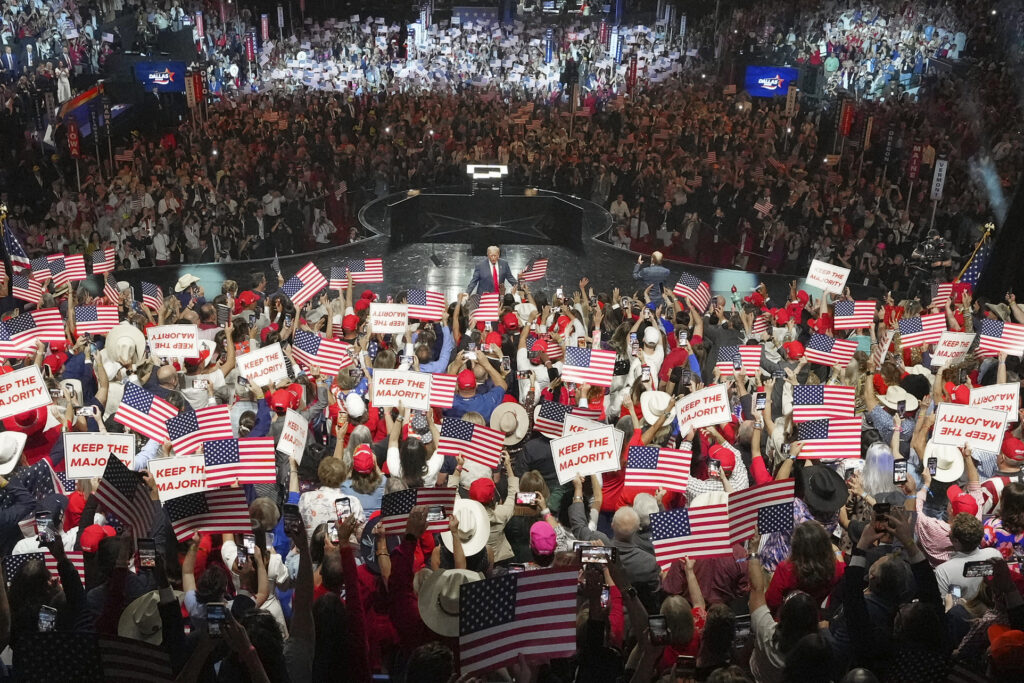
Trump has also resumed campaign travel. Following the Republican midterm convention in Dallas, he appeared in North Carolina with Senate nominee Michael Whatley.
Whatley, Trump’s former national party chairman, is running against Democratic former Gov. Roy Cooper. Republicans are increasingly concerned that Whatley could lose the race.
The party remains more optimistic about Senate contests in Maine and New Hampshire, states Democrat Kamala Harris carried in 2024.
Republicans also continue to see an opportunity in Michigan, where Trump won by fewer than two percentage points. Republican Mike Rogers is facing progressive Democrat Abdul El-Sayed.
Georgia Republicans Lower Expectations
Republican Rep. Mike Collins is attempting to defeat Democratic Sen. Jon Ossoff in Georgia.
Ossoff initially entered the election cycle as one of the Republican Party’s top targets, but Collins has faced negative coverage surrounding a House ethics investigation and his son-in-law’s white nationalist views.
“I don’t think anyone’s expecting Collins to win,” said Tim Waters, chairman of the Peach County Republican Party. “Do I like that? No, I don’t like that. But it’s just the facts.”
Democrats have increasingly viewed the Georgia contest as an opportunity to preserve a Senate seat that Republicans had expected to contest aggressively.
RNC Says It Is Focused on Turnout
Republican National Committee spokesperson Natalie Baldassarre said the party understands that the president’s party typically loses congressional seats during midterm elections.
“We have money to spend and we’re not taking anything for granted this cycle,” she said. “This is very high stakes, and it’s unfortunate that other people feel glum and down. But we’re doing everything we can to protect and expand our majorities so we’re full steam ahead.”
Republicans currently hold narrow majorities in both chambers, meaning even modest Democratic gains could transfer control of the House or Senate.
The GOP’s financial advantage may allow it to defend a broader political map, but the party must also overcome an unfavorable national environment.
Republican Candidates Call for Iran War to End
Several Republican candidates are distancing themselves from Trump’s management of the Iran war.
Wisconsin gubernatorial nominee Tom Tiffany and Michigan gubernatorial nominee John James have joined calls to end the conflict.
“War is terrible, and no one likes war,” James told reporters.
Michigan Senate nominee Mike Rogers released an advertisement filmed in a grocery store in which he criticized high prices and advocated suspending gasoline taxes and halting diesel exports.
“The war with Iran needs to end and end quickly,” Rogers said. ”Michigan families can’t afford to wait.”
The comments reflect growing concern that the conflict’s effects on fuel prices and household expenses could damage Republican candidates.
Iowa Republicans Face Voter Frustration
In Iowa, Republican Rep. Ashley Hinson is running against Democrat Josh Turek for the Senate seat being vacated by retiring Sen. Joni Ernst.
Hinson publicly urged a quick resolution to the war.
“Iowans are being squeezed and shouldn’t have to foot the bill at the pump or the checkout line for the war in Iran” she wrote on social media. “These actions to lower costs are needed ASAP, and the war needs to be brought to a successful and immediate end.”
Hinson did not, however, join fellow Iowa Republican Reps. Zach Nunn and Mariannette Miller-Meeks in supporting a Democratic-backed resolution seeking to halt continued military action without congressional authorization.
That vote highlighted divisions within the party over how far candidates should go in breaking with Trump.
Florida Republicans Remove Trump References
Rep. Maria Elvira Salazar, who represents a competitive majority-Hispanic South Florida district, issued one of the party’s most direct criticisms of Trump.
In an advertisement filmed outside the White House, she said the president had gone “too far” with his immigration policies.
Other Republican candidates have removed or reduced references to Trump on their campaign websites.
Florida gubernatorial candidate Byron Donalds recently redesigned his website, eliminating several prominent mentions of Trump and the president’s endorsement.
The changes reflect an effort by some candidates to establish political distance from a president whose approval ratings could become a liability in competitive races.
White House Defends Trump’s Role
White House spokesperson Davis Ingle rejected suggestions that Trump was weakening Republican candidates.
He said Trump “is the unequivocal leader, best messenger, and unmatched motivator for the Republican Party” and that “the choice has never been more clear: doubling down on President Trump’s winning, commonsense agenda or the Democrats’ extreme liberal policies and obstruction.”
Trump has urged supporters to participate in the midterms as if his own name appeared on the ballot.
But some candidates are concentrating on local issues and personal brands rather than making the president the centerpiece of their campaigns.
Republicans Acknowledge Voter Dissatisfaction
Some elected Republicans say the party must directly acknowledge voters’ economic frustrations.
“We shouldn’t say, ‘Hey everything’s perfect,’ because it’s not,” said Sen. Bernie Moreno of Ohio. “But look what we’ve done in 18 months, and we need two more years to finish the job.”
Louisiana Sen. John Kennedy, who has traveled nationally to campaign for Republican colleagues, said Democrats appeared to have an enthusiasm advantage.
“You can’t look the American people in the eye and say, ‘Don’t believe your lying checkbooks,’” he said. “The cost of living increase is real.”
Kennedy also said voters are “confused about the war” and “they don’t understand how we’re going to get out.”
Senate Leader Calls Environment Competitive
Senate Majority Leader John Thune offered a cautious assessment of the Republican Party’s position.
“Well, I’m hopeful, obviously, but also realistic,” he said. “It’s a very competitive environment out there.”
Republicans are counting on their financial advantage to offset the president’s low approval ratings, widespread economic dissatisfaction and Democratic enthusiasm.
Whether that money can protect GOP candidates in increasingly competitive red states may determine control of Congress for the final two years of Trump’s term.
More on US News