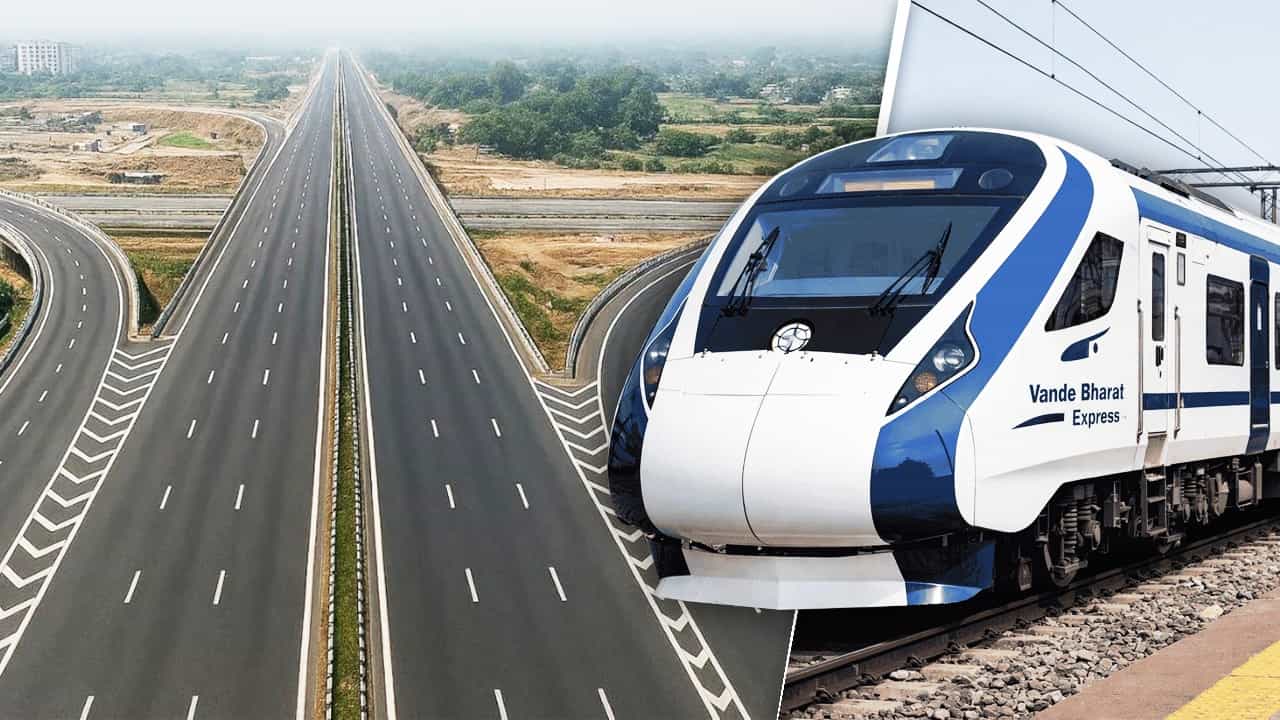
The landscape of transport and mobility in India has fundamentally changed in the last few years. Once upon a time, traffic jams, broken roads and slow-moving trains used to waste hours of travelers traveling from one city to another. Today, the same journey has become fast and extremely easy through world-class access-controlled expressways and indigenous semi-high speed trains. The Central Government's 'Bharatmala Project', 'Gati Shakti National Master Plan' and the modernization drive of the Indian Railways have together halved the distances between major industrial, business and religious centers of the country over a period of time. Expressway Revolution: 100 to 120 km/hr uninterrupted speed on roads. The growing network of modern expressways in the country has become not just concrete roads but the new lifeline of economic development. Projects like the Delhi-Mumbai Expressway, Purvanchal Expressway, Bundelkhand Expressway, Samruddhi Mahamarg (Mumbai-Nagpur), and Bengaluru-Mysuru Expressway have completely transformed the inter-city travel experience. Vehicles travel at speeds of 100 to 120 km per hour on these 6 to 8 lane controlled-access routes without any traffic signals or local obstructions. For example, with the construction of the more than 340 km long Purvanchal Expressway from Lucknow to Ghazipur, the distance between the districts of eastern Uttar Pradesh, which earlier took 10 to 12 hours, has now come down to just 4 to 5 hours. Similarly, the coordination of Agra-Lucknow Expressway and Yamuna Expressway has reduced the road journey from the capital Lucknow to Delhi within 6 to 7 hours. Vande Bharat and NaMo Bharat: Changing tracks and decreasing hours of railways Along with road transport, Indian Railways has also taken a quantum leap in terms of speed and comfort. Vande Bharat Express trains built with indigenous technology have reduced long distance journeys in every corner of the country by hours. These chair-car and sleeper trains, with an operating speed of 130 to 160 kmph, have given passengers an air travel-like experience on the tracks. A huge reduction of 25% to 40% in travel time has been recorded on busy rail routes like Delhi to Varanasi, Delhi to Katra, Mumbai to Ahmedabad, and Chennai to Mysuru. Parallel to this, 'NaMo Bharat' (RRTS – Regional Rapid Transit System) operating in the National Capital Region (NCR) has provided unprecedented speed to the movement between Delhi, Ghaziabad and Meerut, providing complete freedom from traffic jams to the daily commuters. Reduction in logistics costs and boost to business activities. The country's economy and logistics sector are getting the biggest benefits of expressways and fast rail connectivity. While earlier it used to take days for heavy trucks and goods vehicles to move from one state to another due to toll booths, bad roads and urban jams, now through Dedicated Freight Corridors (DFC) and expressways, the time to transport goods has been reduced by 50%. Time savings have resulted in huge reduction in fuel consumption, reduction in maintenance cost of vehicles and major success in bringing the country's Gross Domestic Product (GDP) closer to global standards by reducing logistics costs. The development of industrial corridors along the expressways has given new impetus to employment and manufacturing units at the local level. Direct connectivity of Tier-2 and Tier-3 cities with metro cities This infrastructure revolution has changed the fortunes of small cities in the country. Cities like Lucknow, Kanpur, Gorakhpur, Prayagraj, and Varanasi of Uttar Pradesh now feel so close to the national capital Delhi that people can leave in the morning and return after completing their work by evening. With the new expressway corridor between Bengaluru and Chennai in South India, the distance between the two IT hubs will be reduced to just two to three hours. In Western India, the distance between Mumbai and Nagpur has reduced from 16 hours to about 8 hours due to the Samriddhi Highway. This fast connectivity has not only facilitated the general public's access to tourism, healthcare services and higher education, but has also led to a huge boom in real estate and local industries.