True Fitness and True Yoga abruptly ended all operations in Singapore last week, shutting down all 10 outlets. Parent company Kontafarma China Holdings cited cost pressures and intense market competition as reasons for winding up the business.
While the large-format gym model was attractive two decades ago, the market has since fragmented, said Jack Tong, an assistant professor of business at Nanyang Technological University, as cited by the South China Morning Post.
Operators now have to compete across multiple fronts, including the experience and sense of community they offer, he added.
“This leaves traditional full-service gyms potentially squeezed in the middle. They may find it difficult to compete with low-cost gyms on price while also struggling to compete with specialized operators on experience,” Tong said.
|
Inside an outlet of True Fitness before its closure. Photo courtesy of True Fitness |
Industry experts said the closure did not necessarily signal that Singapore’s fitness market was saturated, but instead reflected changing consumer preferences.
Gym-goers are increasingly dividing into two groups: those seeking value and convenience, and those looking for specialized experiences beyond traditional big-box facilities.
The fitness market is not declining, but instead growing. SportSG data showed that 76% of residents exercised at least once a week last year, up from 66% in 2019, before the Covid-19 pandemic. The figure has risen almost every year since then.
As the market expands, fitness studio owners have pushed back against the idea that industry-wide headwinds were responsible for True Fitness and True Yoga’s difficulties.
“If a free gym downstairs is enough to make someone switch, it raises the question of what else that gym is offering beyond access to equipment,” said Samuel Gallo, co-founder of Surge Strength & Results, as quoted by Channel News Asia.
“The market itself has never been bigger,” he said. “Demand is not the problem. Being nothing in particular is the problem. Not the cheapest, not the best, so people drift out of the middle.”
Conventional big-box gyms such as True Fitness occupy the middle of the market, between boutique gyms offering specialized or premium experiences at one end and low-cost, 24-hour gyms in convenient heartland locations at the other.
Big-box gyms typically measure more than 1,390 square meters and provide various forms of training under one roof, from treadmills and elliptical machines for cardio to pin-loaded machines for strength training, said Sean Tan, co-founder and president of the nonprofit Singapore Fitness Alliance.
They generally offer personal training and studios for group classes, along with recovery facilities such as saunas and cold plunge baths, as well as showers, changing rooms and even swimming pools, he said.
But the premium facility comes with high costs. “Large gyms carry significant fixed costs in rent, equipment, staffing, utilities and maintenance, so profitability becomes a challenge when utilization falls,” said Damien Lee, a senior lecturer in sport and wellness management at Nanyang Polytechnic, as quoted by CNA.
“Operating costs remain high, while consumers have more alternatives these days and can switch providers with ease, making membership revenue less predictable.”
 |
|
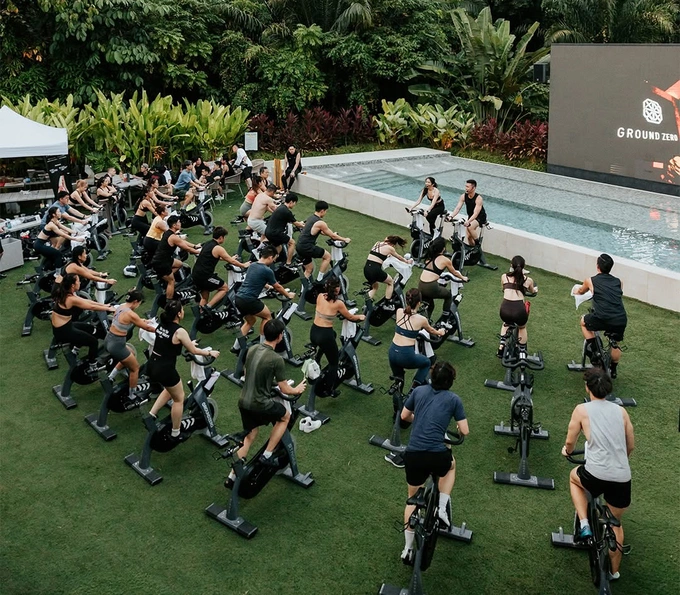
A session at gym chain Ground Zero. Photo courtesy of Ground Zero |
Sizes matter
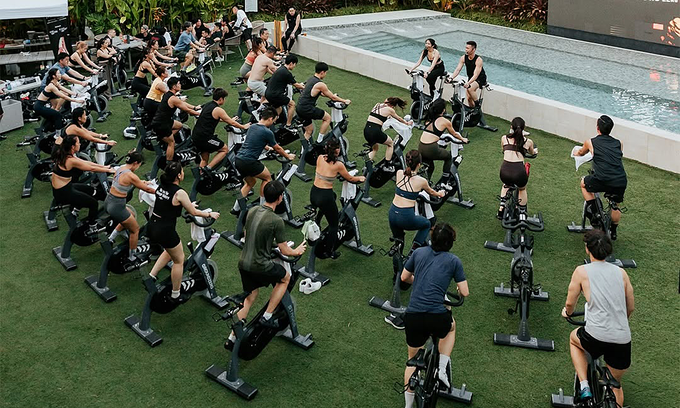
By contrast, boutique gyms typically occupy 1,000 to 233 square meters and are less expensive to establish. They generally focus on a single modality, such as Pilates or indoor cycling, and may not provide showers or toilets.
These gyms provide specialized expertise, personalization, a strong sense of community and measurable fitness outcomes, Lee said.
“Their lean operating model allows them to compete effectively on convenience and affordability without the overhead burden that weighs on larger operators,” Lee added.
Gym chain Ground Zero founder Jeong Fok said the community-driven nature of such studios was a key selling point for boutique gyms.
“People who train at such studios want somewhere they can call their own, meet like-minded people, and actually feel like they belong … It almost becomes a modern-day version of a club or community space,” Fok told the SCMP.
Natt Srinara, a consultant at the Singapore campus of EHL Hospitality Business School, said that there is still plenty of demand for fitness in Singapore. The opportunity may actually be growing as people become more conscious of health, longevity and well-being.
But demand for fitness does not necessarily translate into demand for large, traditional gyms. The businesses that survive may increasingly be those with a clear identity: low-cost and convenient, specialized and community-driven, or genuinely premium, he wrote in an opinion piece on The Edge Singapore.
“The dangerous place may be somewhere in between: too expensive to operate like a budget gym, but not distinctive enough to command a premium. That’s when working out stops working out.”