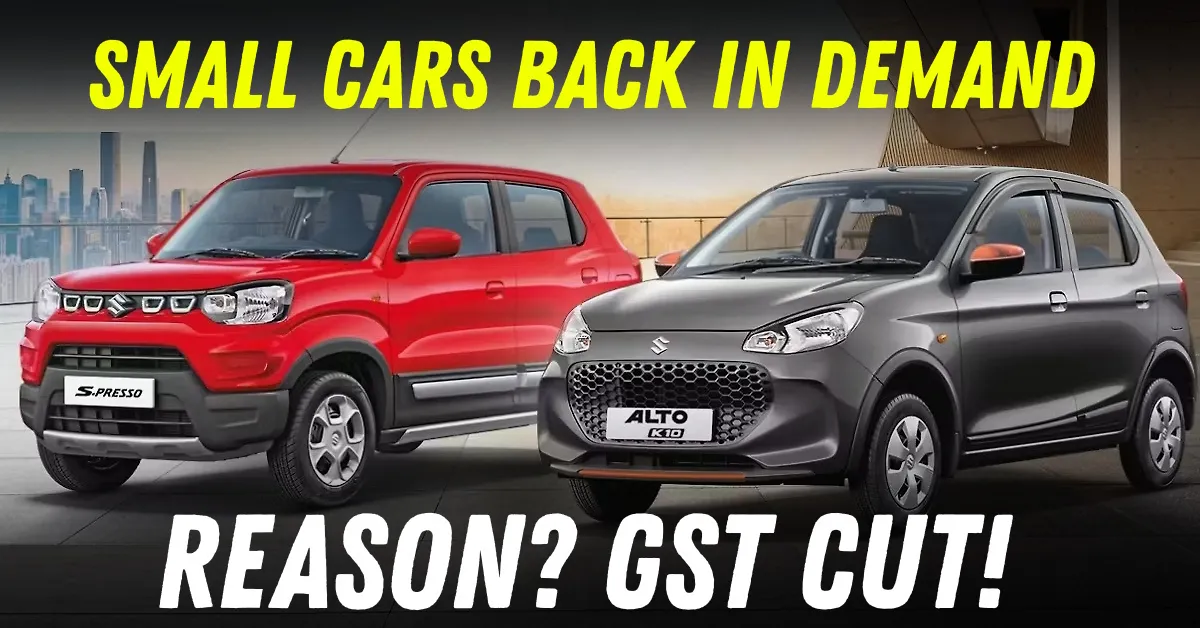
Small cars are growing again after two years of sharp decline, and first-time buyers are returning with them. Industry data for the first five months of FY27 shows small-car volumes rising 27 percent to 5.9 lakh units. Maruti Suzuki says the share of first-time buyers in its sales has climbed from 44 percent to 54 percent, returning to roughly the level seen in FY19.
The recovery follows the GST reduction that took effect in September 2025. Small cars now attract 18 percent GST instead of 28 percent. The lower tax burden has brought entry prices and monthly finance costs down at the part of the market where even a relatively small change in price can decide whether a household buys a car or keeps using a two-wheeler.
The turnaround comes after a difficult period. Small-car sales fell from 16.4 lakh units in FY23 to 14.5 lakh in FY24, then dropped again to 12.8 lakh in FY25. FY26 finally produced a modest recovery to 13.2 lakh units. The 27 percent growth recorded in the first five months of FY27 is therefore a much stronger change in direction than the previous year’s 3.2 percent rise.
Maruti says its own small-car sales are up 58 percent this year. The WagonR alone is selling at around 21,000 units a month, despite the continuing popularity of SUVs. This does not mean hatchbacks are about to replace SUVs as the dominant growth story, but it does show that the lower end of the market still has substantial demand when prices become easier to manage.

Under the revised tax structure, petrol, LPG and CNG cars with engines up to 1,200cc and length up to 4,000mm qualify for 18 percent GST. Diesel cars qualify if they are no longer than 4,000mm and use engines up to 1,500cc. Larger cars generally attract 40 percent GST.
Sales trends since the change show a clear difference. Vehicles in the 18 percent bracket are reportedly growing at around 30 percent, compared with about 22 percent for vehicles in the 40 percent bracket. That gap supports the view that affordability is bringing customers back into the lower-priced end of the market.
This is where cars such as the Alto K10, WagonR, Swift and Baleno remain important. For a first-time buyer moving up from a two-wheeler, the priority can still be basic four-wheeled mobility, predictable running costs and a manageable EMI rather than the equipment offered by a larger SUV.
The tax definition is important because ‘small car’ does not simply mean hatchback. A sub-four-metre sedan or compact crossover can also qualify if it meets the engine limits, while a physically larger model moves into the higher tax bracket. That makes dimensions and engine size directly relevant to showroom pricing.
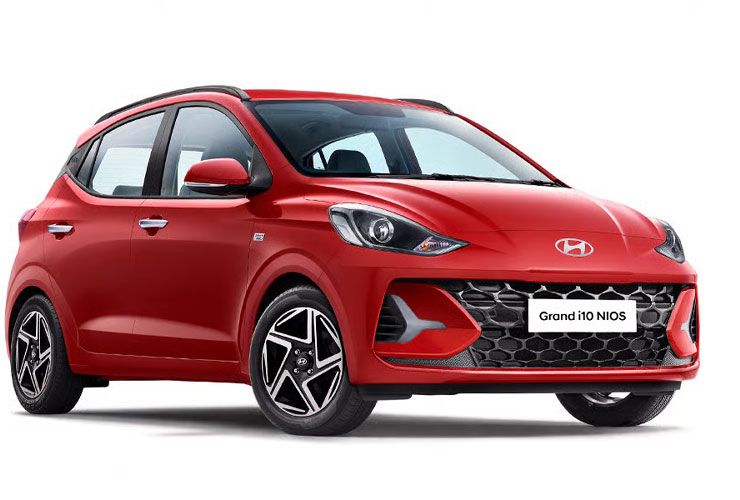
The segment’s recovery does not remove one long-running problem: there have been far fewer new small-car launches than SUV launches. Most entry hatchbacks have been on sale for years, even if they have received updates. Maruti has refreshed products such as the Baleno, while Hyundai has indicated that an upgraded Grand i10 is coming in the near future.
More fresh models could test whether this revival is mainly a tax-led rebound or the start of a longer recovery. For now, the numbers show that the SUV boom has not removed demand for affordable cars. When the purchase price comes down far enough, a sizeable group of first-time buyers is still ready to enter the car market.