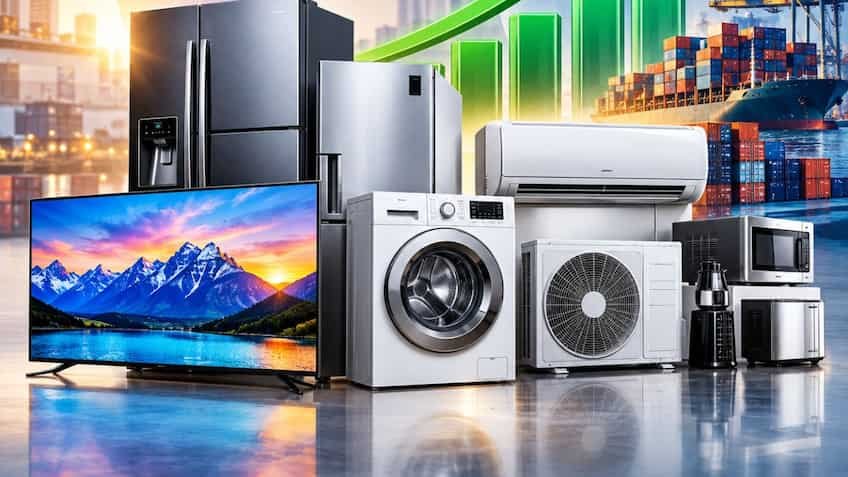
The Indian consumer durables and home electronics industry is set to enter a new phase of unprecedented growth in the coming years. According to industry analysts and recent market study reports, the country’s consumer durables market is expected to grow at a strong compound annual growth rate (CAGR) of around 10 to 11 percent by 2030. ₹3.25 lakh crore (about 38 to 40 billion dollars) It is estimated to reach a huge size.
Rising per capita income, rapid urbanization, access to electricity and increasing acceptance of home appliances in Tier-2 and Tier-3 cities have made this sector the fastest engine of Indian manufacturing and retail.
Due to structural changes in the priorities of Indian families, air conditioners (ACs), refrigerators, washing machines and smart TVs have no longer become luxuries but have become basic daily necessities. The following factors are driving this rapid expansion of the market:
-
Growing craze of premium and smart appliances: Indian consumers are no longer just looking for affordable models with basic features, but are willing to spend extra for energy-efficient (5-star inverter), IoT-enabled and AI-powered smart devices.
-
Easy Consumer Financing: No-Cost EMI, ‘Buy Now Pay Later’ (BNPL) and easy credit card options have made it very accessible for middle and lower-middle class families to buy large appliances in the Rs 30,000 to Rs 60,000 range.
-
Emergence of Tier-2, 3 and rural markets: The market in metro cities is moving towards saturation, while the penetration rate in non-metropolitan towns and rural India is still much lower than the global average. Initiatives like rural electrification and Jal Jeevan Mission have given an unprecedented boost to the demand for washing machines and refrigerators in these areas.
-
Climate change and heat records: Due to the lengthening summers and severe heat waves in India, the demand for air conditioners has become a regular need of about 8-9 months rather than being seasonal.
The policies of the Government of India to strengthen domestic production have proved to be the backbone of making this market self-reliant:
-
Production Linked Incentive Scheme (PLI Scheme): Billions of rupees of new capital investment has come under the PLI scheme for white goods (mainly air conditioners and LED lights). Whereas earlier the country was completely dependent on China or South-East Asia for critical components like compressor, copper tubing and PCBA, now their local manufacturing has increased by 50 to 60 percent.
-
Preparing to become a hub of global exports: Along with meeting the domestic demand, companies like Voltas, Dixon Technologies, Havells, LG India and Samsung are developing India as a global export hub for the Middle East, Africa and SAARC countries.
The share of different categories in this target of Rs 3.25 lakh crore by 2030 is changing rapidly:
-
Air Conditioner (RAC): This category is expected to record the highest annual growth rate of 14 to 16 percent. At present the domestic penetration of AC in India is only 8 to 9 percent, which is expected to increase to 18 to 20 percent by 2030.
-
Refrigerators: There is a rapid migration of consumers from single door to frost-free and side-by-side large capacity refrigerators.
-
Washing Machines: The demand for fully-automatic and front-load machines in place of semi-automatic machines is growing at the fastest pace in tier-2 and tier-3 cities.
-
Smart and Connected Home Entertainment: Large-screen 4K/8K smart TVs and connected home appliances are becoming mainstream in every home.
According to the report, the share of online platforms (Amazon, Flipkart) in the sales of consumer durables has increased, but in the case of electronics, ‘touch and feel’ is still the deciding factor for the Indian buyer. This is why big retailers like Reliance Digital, Croma, Vijay Sales and local multi-brand showrooms are now working on an omnichannel model, where the consumer is researching online and buying the product from the store with a personalized experience and immediate delivery.
This unprecedented expansion of the consumer durables sector will not only provide a new boost to the country’s economy, but will also create millions of new direct and indirect employment opportunities in semiconductor packaging, component manufacturing, supply chain logistics and after-sales service networks.