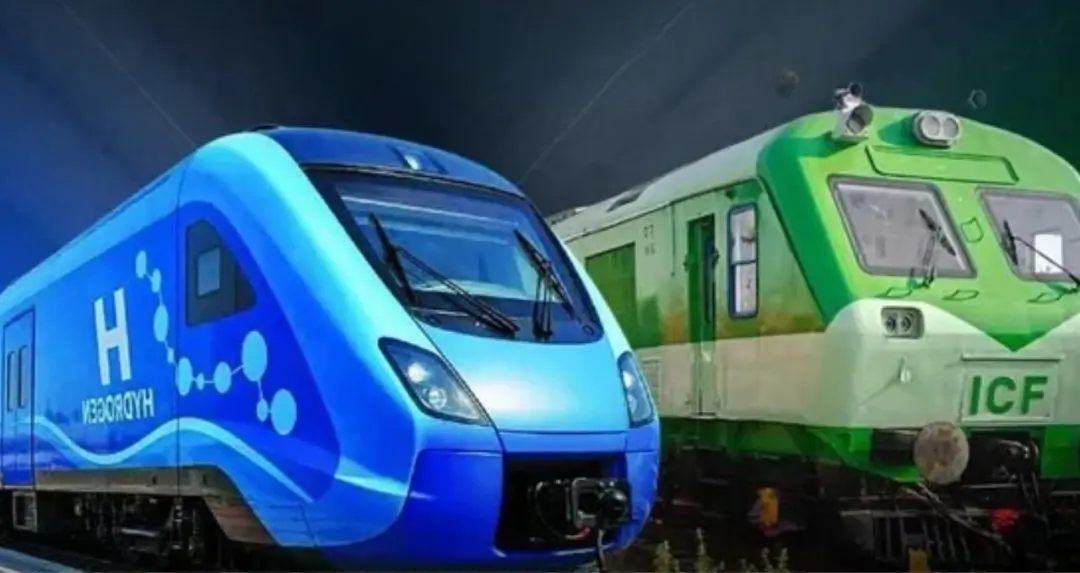
Indian Railways has now started its first Liquefied Natural Gas (LNG) train, about 10 months after the first hydrogen train. On Sunday, Home Minister Amit Shah flagged off the country’s first LNG train from Gujarat’s Sabarmati station.
New Delhi: Indian Railways is continuously moving towards alternative fuels and low emission technologies. About 10 months after starting the hydrogen-powered train, the Railways has now included the country’s first LNG train in service. Based on Liquefied Natural Gas (LNG), this train uses dual-fuel technology that runs in conjunction with diesel. In such a situation, this question is also important that what is the difference between LNG train and Hydrogen train and how the power of both works.
India’s first LNG train started from Sabarmati
India’s first LNG train was flagged off from Sabarmati station in Gujarat. This initiative is being considered as part of the alternative fuel program of the Railways. Its objective is to reduce fuel consumption and emissions while reducing dependence on diesel. Along with this project, several railway related development works worth more than Rs 1,500 crore were also dedicated. These include railway line doubling, Kavach Train Protection System, automatic signaling and maintenance facilities for electric locomotives.
How does Dual-Fuel Technology work in LNG train?
The LNG train is not completely dependent on LNG. Dual-Fuel System has been installed in it, under which the engine can use both LNG and diesel. Two Driving Power Cars i.e. DPCs in Sabarmati Integrated Coaching Depot have been modified according to this technology. Each DPC has a capacity of approximately 1,400 horsepower. Field trials of both these DPCs were carried out over 2,000 kilometers to test the technology in real operating conditions.
A major advantage of this system is that the train can use LNG or diesel depending on the availability of fuel. This provides a way for the Railways to incorporate alternative fuels into the existing diesel infrastructure instead of completely replacing it.
Diesel consumption can be reduced by 40 percent
According to the data obtained from the trial, dual-fuel technology can help in reducing diesel consumption by about 40 percent. With this, fuel costs and emissions like carbon dioxide, nitrogen oxides and particulate matter are also expected to reduce. Each modified DPC is fitted with an LNG tank of approximately 2,200 liter capacity. About 850 to 900 kg of usable LNG can be stored in it. The train can run for approximately 1,600 kilometers on a full tank.
At present this LNG-diesel dual-fuel DEMU train is running between Sabarmati and Mahesana Junction. It has eight non-AC chair car coaches. Its regular route will be decided after further operational decisions.
How does Hydrogen Train work?
Unlike the LNG train, the basic basis of the Hydrogen Train is fuel-cell technology. In this, electricity is generated inside the train through electrochemical reaction between hydrogen and oxygen. In this process, there is no need to burn diesel like traditional engines. India’s first hydrogen train was started between Jind and Sonipat in Haryana.
This train has a total of 10 coaches including two Hydrogen Driving Power Cars and its total power is said to be around 2,400 kW. Hydrogen storage system and lithium iron phosphate batteries have been used in it. The main product produced directly from a hydrogen fuel cell is water vapour. This is the reason why there is no smoke or direct carbon emission from the tailpipe of the train like a diesel engine.
The biggest difference between LNG and Hydrogen Train
Both technologies aim to take railways beyond traditional diesel, but their approach is different. The LNG train uses existing internal-combustion engines with a dual-fuel system. That means, LNG partially replaces diesel. In contrast, Hydrogen Train runs an electric motor by converting the chemical energy of hydrogen into electricity through a fuel cell.